USDBRL should reflect US Payroll, Copom minutes, US government shutdown, geopolitical fears, and ECB decision
- Bullish
- If US labor market indicators reinforce the reading of employment stability, the expectation that US interest rates will remain high for a prolonged period tends to consolidate, supporting Treasury yields and strengthening the dollar globally.
- A signal to start the easing cycle in March in the Copom minutes tends to reduce the outlook for the Brazilian interest rate differential and weigh on the real.
- The intensification of tensions involving the US and Iran increases global risk aversion, favoring "safe-haven" assets and potentially hurting emerging market currencies, such as the real.
- Bearish
- The possibility of a shutdown of public services in the US could intensify aversion to the dollar and stimulate portfolio diversification toward emerging markets, benefiting the real.
- Maintaining the benchmark rate in the Eurozone tends to support the appreciation of the euro against the dollar, a movement that could weaken the dollar globally and indirectly favor the real.
The week in review
- Copom and the FOMC voted to maintain their respective benchmark interest rates at 15.00% and the range of 3.50% to 3.75% per year. The Central Bank of Brazil kept the rate unchanged for the sixth consecutive meeting, while the Federal Reserve ended a cycle of three cuts.
- President Donald Trump nominated Kevin Warsh to succeed Jerome Powell as Chair of the Federal Reserve. Warsh became known for advocating a more restrictive monetary policy during the 2008 crisis, although he has recently advocated for interest rate cuts. After the nomination, the dollar strengthened globally.
- In the Brazilian labor market, data from CAGED and PNAD presented a mixed scenario. While the former indicated the creation of 1.28 million new formal jobs throughout 2025—the worst result since the pandemic in 2020—the latter pointed out that the average unemployment rate ended the year at 5.6%, the lowest annual average in the historical series. This contradictory data may reduce bets for interest rate cuts at the March Copom meeting.
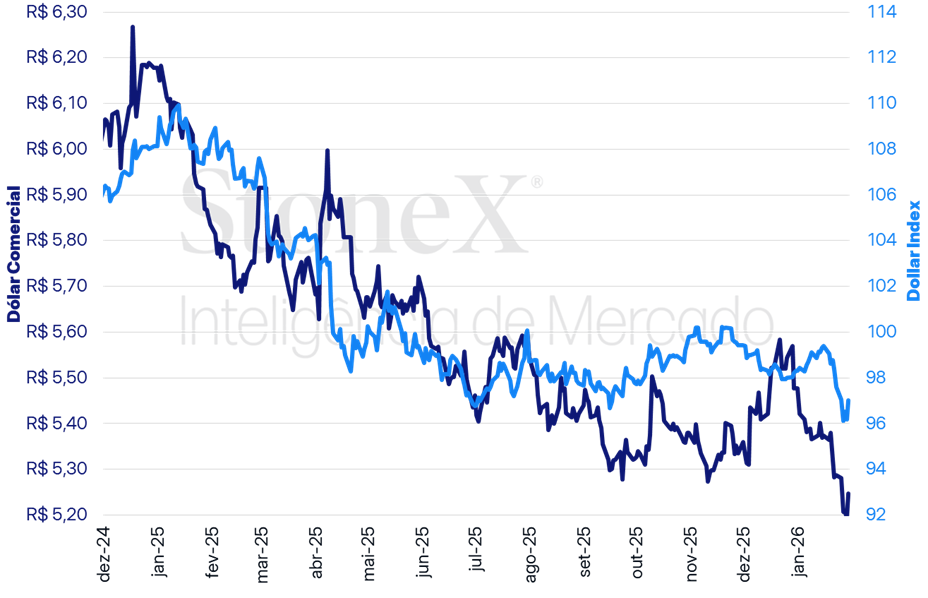
USDBRL and Dollar Index (points)
Source: StoneX cmdtyView. Preparation: StoneX.
USDBRL variations
Daily: +1.00% | Weekly: -0.77% | Monthly: -4.20% | Annual: -15.07% | In 12 months: -10.37%
Dollar Index variations
Daily: +0.89% | Weekly: -0.60% | Monthly: -1.31% | Annual: -10.27% | In 12 months: -10.00%
KEY EVENT: US Employment Data
Expected impact on USDBRL: bullish
This week concentrates the release of relevant economic indicators, which should help investors calibrate their expectations for the United States economy.
- The main focus falls on labor market data, which will be released throughout the week. On Tuesday (3), the JOLTS report will be published. On Wednesday (4), ADP private employment figures will be released. Finally, on Friday (6), the Non-farm Payroll report will be released, considered the most relevant indicator of the set.
- It is worth noting, however, the risk that some of this data may not be released, given the prospect of a US government shutdown, which could suspend the activities of the Department of Labor, responsible for collecting and publishing some of these indicators.
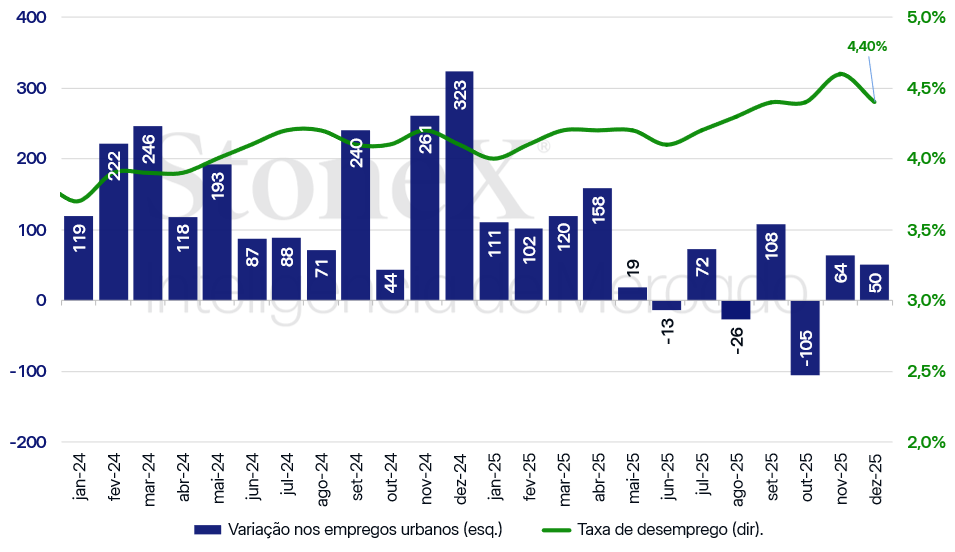
Variation in total urban jobs (thousand people) and the unemployment rate (%) in the United States
Source: U.S. Bureau of Labor Statistics (BLS), Federal Reserve Bank of St. Louis. Preparation: StoneX.
Why this matters: The evolution of economic activity, the labor market, and inflation continues to exert a decisive influence on the Federal Reserve's monetary policy decisions.
- If employment data reinforces the perception of stability in the US labor market, the expectation of maintaining interest rates for longer tends to consolidate, which could raise Treasury yields and favor a stronger dollar globally.
Overview: In the last employment report, referring to December, the net creation of 50,000 jobs was observed, a result slightly below expectations but still compatible with a scenario of gradual and controlled deceleration of the labor market.
- Given this, investors are looking to the January release for additional signs of labor market conditions at the start of the year, especially considering that economic indicators have presented divergent readings since then.
- The most recent statistics continue to point to a contradictory scenario, with some data suggesting a loss of momentum in activity while others indicate economic resilience.
- In this context, the release of new data is seen as essential to bring greater clarity to the trajectory of the US economy and, consequently, to the future evolution of monetary policy.
Risk of a new shutdown: In the most recent US government shutdown, which lasted 43 days, all labor market data releases by the Department of Labor were suspended immediately after the shutdown began.
- This included the payroll and JOLTS reports, while private indicators, such as the ADP, continued to be published as they do not depend on government agencies.
- Additional information about the risk of a new shutdown will be detailed in a specific topic below.
Copom Minutes
Expected impact on USDBRL: bullish
Investors should react to the release of the minutes from last Wednesday's (10) decision by the Central Bank's (BC) Monetary Policy Committee (Copom), which kept the benchmark interest rate (Selic) stable at 15.00% p.a. for the fourth consecutive decision.
- The post-decision statement, however, surprised by anticipating that, if the current scenario is maintained, the committee should start the interest rate easing cycle at the next meeting on March 18, albeit with "serenity."
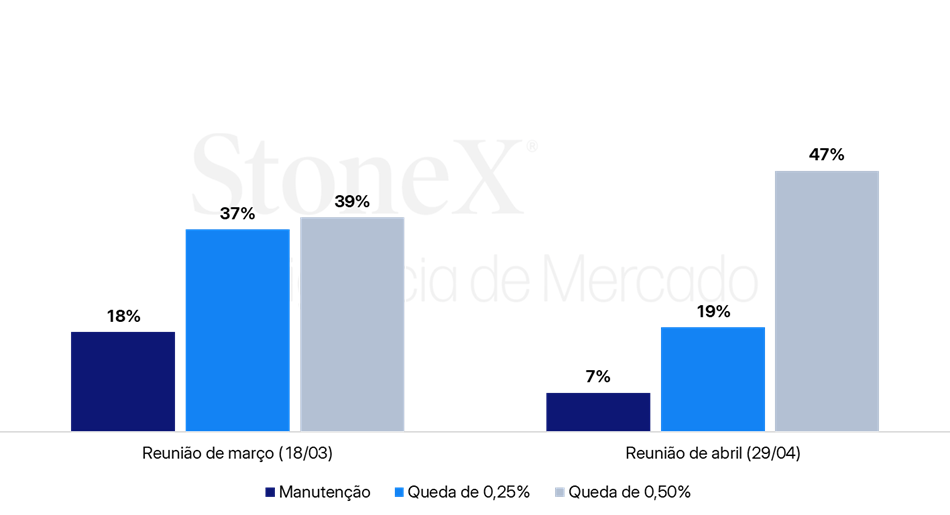
- Bets are now divided, with some investors indicating that the BC should start the cycle of cuts with a magnitude of 0.25%, and others with 0.50%.
Probabilities for the next Central Bank meetings – updated on 01/30/2026
Source: CME FedWatch. Preparation: StoneX.
Why this matters: If the statement confirms the possibility of cuts as early as March more clearly, the movement could reduce the relative attractiveness of domestic assets by compressing the interest rate differential between Brazil and other economies, which would tend to exert depreciating pressure on the real.
In detail: According to the statement released after the decision, the BC should "initiate the easing of monetary policy at its next meeting, but reinforces that it will maintain appropriate restriction to ensure the convergence of inflation to the target."
- The inclusion of another forward guidance in the statement reinforces a practice adopted by the current management of the Central Bank, which has sought to anticipate its intentions to the market whenever possible. This strategy has contributed to reducing communication noise and limiting episodes of excessive volatility in domestic assets, especially in foreign exchange.
- At the same time, the committee reiterated the presence of relevant risks to the disinflation process, sustaining a rhetoric of caution regarding the pace and extent of the cycle of cuts.
- The statement highlighted that economic activity indicators continue to show, as expected, a trajectory of growth moderation, while the labor market remains resilient. Recent readings of headline inflation and underlying measures indicate cooling, although still at levels above the established target.
Changes in Copom: This month's Copom meeting occurred with only seven of the nine members, following the end of the mandates of Diogo Guillen, former Director of Economic Policy, and Renato Gomes, former Director of Financial System Organization and Resolution.
- The absence of appointments, so far, for the open positions adds an element of uncertainty to the scenario, as new names could influence the perception of risk and the credibility of monetary policy conduct in the coming months.
Risk of new US government shutdown
Expected impact on USDBRL: bearish
The chances of a US government shutdown grew this Friday (30) after obstacles in the US Senate for an agreement to maintain funding for a wide range of government programs, including the DHS, the department responsible for funding the country's homeland security, which includes immigration agents (ICE).
- Voting was interrupted on Thursday night and the funding deadline expires at midnight this Friday. Even with Senate approval, House of Representatives approval will still be required, which reduces the likelihood of the vote occurring before midnight.
- Expectations, however, are that any shutdown will be brief, unlike what was observed last year, as the consensus among lawmakers from both parties is to prevent the issue of immigration from interrupting other government activities.
Why this matters: Interruptions in US government services could intensify the sentiment of aversion to the dollar and the search for asset diversification, which tends to promote the continuity of foreign capital inflow to Brazil and the sale of US assets.
Impact: If the shutdown is confirmed, it would start at 12:01 AM on Saturday (01/31) and would include departments that have not yet received funding.
- Unfunded departments: Defense, Education, Health and Human Services, Homeland Security, Labor, State, Transportation, Housing and Urban Development, and Treasury.
- For global investors, the main impact of the lack of budget would be the interruption of data collection and the publication of statistics prepared by the Department of Labor, including the important “payroll,” which details US labor market conditions.
Risk of US intervention in Iran
Expected impact on USDBRL: bullish
In recent days, the market observed an intensification of risks in the Middle East region, with a focus mainly on Iran. The country was already the target of a surgical US military action in June last year that sought to disrupt the Iranian nuclear program. Since then, the Persian nation has seen its internal politics fermenting, with popular protests being accompanied by violent repression by the Ayatollahs' regime, leaving thousands dead.
- Since last year's American military intervention, Iran has ceased to be transparent with data related to enriched uranium stockpiles, which has increased fears of a return to accelerated development of the country's nuclear program.
- In this scenario, US President Donald Trump has used military threats to pressure Tehran into signing a new nuclear deal.
- Last week, Trump confirmed the sending of military aircraft to US bases in the Middle East, which was understood as preparation for possible new interventions. This week, fears of an attack were further reinforced by rumors suggesting that the White House was considering attacks against Iranian army targets.
Why this matters: The increase in global geopolitical tensions can generate a flight of investments from assets considered risky, such as emerging market currencies, while assets considered "safe-havens" benefit. If this movement is confirmed, the real could be negatively affected.
ECB Interest Rate Decision
Expected impact on USDBRL: bearish
This Thursday (5), the European Central Bank (ECB) is expected to keep the benchmark interest rate unchanged at 2.00% per year.
- The decision occurs in a context in which the most recent data indicates that the Eurozone economy grew by 0.3% in the third quarter, a pace above that projected by the ECB in its September meeting, while inflation has proven to be more persistent than expected.
Why this matters: Maintaining the interest rate in the European Union tends to favor the appreciation of the euro against the dollar. This movement could, indirectly, benefit the real, as a stronger euro is usually associated with a globally weaker dollar.
Overview: Market consensus indicates that the ECB should keep interest rates unchanged in the short term, but bets have started to price in a gradually higher probability of a rate hike by the end of 2026.
- The future trajectory of monetary policy, however, will depend on some key factors, including the impact of German fiscal stimulus on growth, the evolution of the exchange rate especially after the euro's accumulated appreciation in the year, and the disinflationary effects associated with falling energy prices and a greater supply of Chinese goods at lower prices.
Economic activity data in Brazil
Expected impact on USDBRL: bullish
Over the next week, some indices of economic activity in Brazil will also be released, highlighting the Purchasing Managers' Indices (PMI) and the Monthly Industrial Survey – Physical Production (PIM-PF).
Why this matters: If the indices reinforce the perception of a slowdown in economic activity, investors tend to increase their bets for a faster interest rate cut cycle by the Central Bank.
- This, in turn, can impact the yields of domestic assets and, consequently, weaken the real.
Services data: The services sector is the main driver of the Brazilian economy, accounting directly and indirectly for about 70% of the Gross Domestic Product (GDP).
- The sector's performance will be monitored through the services PMI. In December, the index advanced to 53.7, up from 50.1 in the previous month, signaling acceleration and expansion of activity.
Industry data: Although less followed than the services sector by investors, indicators referring to the industrial sector have pointed to a slowdown in activity for several months.
- While the PIM-PF pointed to stagnation in production in November, the PMI for December indicated an index of 47.6, compared to 48.8 in the previous month, remaining below the 50-point line that suggests deterioration of conditions in the sector.

INDICATORS
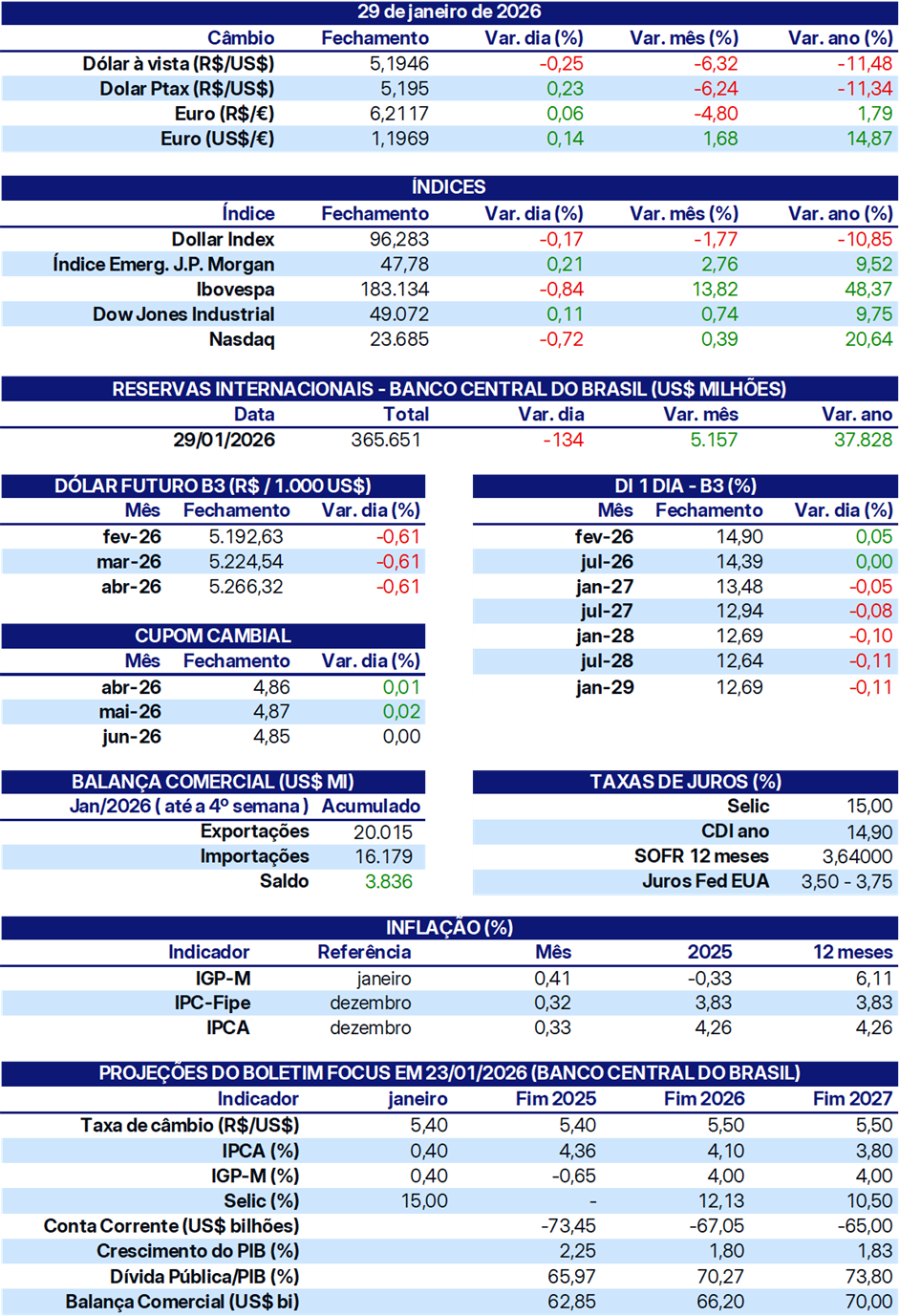
Sources: Central Bank of Brazil; B3; IBGE; Fipe; FGV; MDIC; IPEA and StoneX cmdtyView.