USDBRL to reflect U.S. payroll data and inflation in Brazil and the U.S.
- Bullish
- The expectation that the U.S. CPI will remain above the Federal Reserve’s target reinforces perceptions of inflationary resilience, reducing bets on interest rate cuts by the Fed.
- Domestic data should indicate a gradual economic slowdown and a moderating inflation trajectory, potentially increasing expectations for a faster rate cut cycle in Brazil.
- The appointment of a policymaker historically associated with a more contractionary stance helps limit expectations of more aggressive monetary easing in the U.S.
- Bearish
- The expectation that January’s payroll will confirm a faster deceleration of the U.S. labor market may intensify bets on quicker interest rate cuts by the Federal Reserve.
The week in review
- The Monetary Policy Committee (Copom) released the minutes of its last meeting, and as stated in the decision-day announcement, hinted at a possible rate cut in the next meeting on March 18, provided the current scenario remains unchanged. Despite the signal, the magnitude of the cut is uncertain and will depend on upcoming data.
- In the U.S., the main labor market indicator (payroll) was postponed to Wednesday (11) due to the recently concluded government shutdown. Nonetheless, the Job Openings and Labor Turnover Survey (JOLTS) and ADP private sector job creation figures were released, presenting a more deteriorated scenario than anticipated.
- Finally, throughout the week, Kevin Warsh’s nomination for Federal Reserve chair by Donald Trump continued to bolster the dollar. In Brazil, reports that Finance Minister Fernando Haddad supports Guilherme Mello and Tiago Cavalcanti to fill the two open Copom seats raised concerns among investors, particularly regarding Mello’s potential preference for lower interest rates.
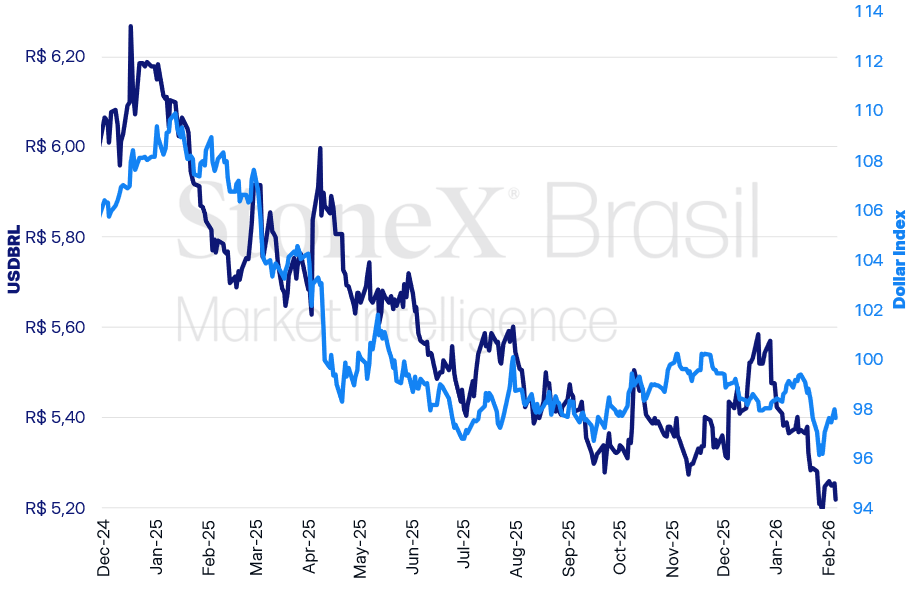
USDBRL and Dollar Index (points)
Source: StoneX cmdtyView. Design: StoneX.
USDBRL Variations
Daily: -0.68% | Weekly: -0.54% | Monthly: -0.54% | Annual: -15.53% | 12 Months: -9.48%
Dollar Index Variations
Daily: -0.35% | Weekly: +0.61% | Monthly: +0.61% | Annual: -9.72% | 12 Months: -9.35%
Key Focus: U.S. Employment Data
Expected Impact on USDBRL: Bearish
Last week, the release of critical indicators about the U.S. labor market was delayed due to the brief federal government shutdown, which lasted from January 31 to February 3.
- As a result, January’s Employment Situation Report ("payroll"), originally scheduled for Friday (6), was rescheduled to Wednesday (11).
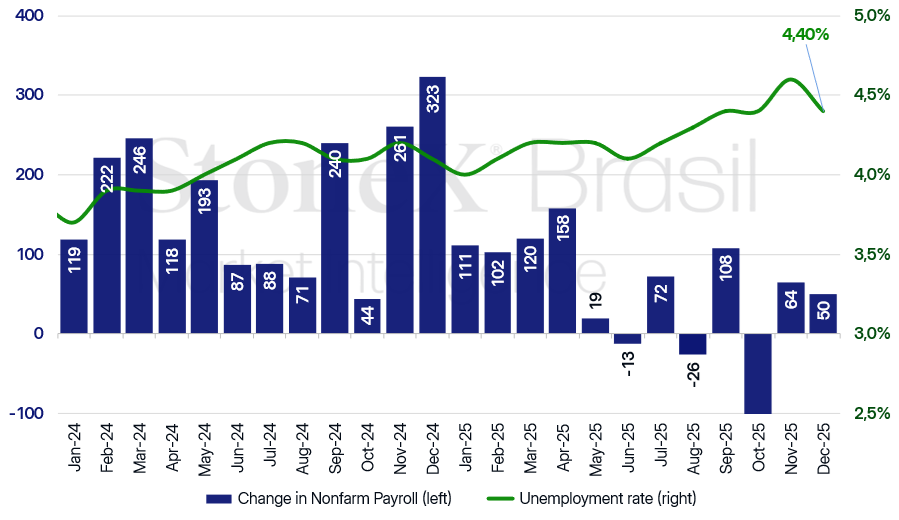
- Market consensus expects 68,000 new jobs to be created, surpassing the 50,000 added the previous month, while the unemployment rate is expected to remain stable at 4.4%.
- However, December’s JOLTS report, released last week, hinted at a sharper labor market slowdown than investors anticipated, raising concerns that the payroll might confirm a more pronounced deceleration in U.S. economic activity.
Change in Total Urban Employment (thousands) and U.S. Unemployment Rate (%)
Source: U.S. Bureau of Labor Statistics (BLS), Federal Reserve Bank of St. Louis. Design: StoneX.
Why This Matters: Economic activity, labor market trends, and inflation continue to have a decisive influence on Federal Reserve monetary policy decisions.
- If the payroll reinforces perceptions of deteriorating conditions in the U.S. labor market, expectations for faster rate cuts are likely to intensify, potentially impacting Treasury yields and weakening the dollar globally.
Outlook: The previous employment report for December showed net job creation of 50,000 positions, slightly below expectations but still aligned with a gradual and controlled labor market slowdown.
- Investors are now looking to January data for further insight into labor market conditions early in the year, especially given the contrasting economic indicators released since then.
- Recent statistics paint a mixed picture, with some suggesting economic momentum loss while others indicate resilience.
- In this context, new data releases are seen as crucial for providing clearer guidance on the U.S. economy’s trajectory and future monetary policy direction.
Labor market showing signs of deceleration: Additional U.S. labor market data released last week highlighted a slowdown in employment.
- On Wednesday (04), the ADP private sector employment report indicated net job creation of 22,000 positions in January, below the consensus estimate of 45,000.
- On Thursday (05), JOLTS job openings for December decreased to 6.542 million, while November’s figures were also revised down.
- Weekly initial unemployment claims, however, exceeded expectations, reaching 231,000 requests.
Inflation and Activity Data in Brazil
Expected Impact on USDBRL: Bullish
In Brazil, this week’s economic calendar features important indicators that could help investors adjust their expectations for the size of the rate cut at the next Copom meeting on March 18.
- The highlight is January’s National Consumer Price Index (IPCA), which is expected to continue signaling inflation moderation.
- According to the latest Central Bank Focus Report, the median forecast is for a 0.34% increase in the full index for the month, below the 0.52% rise seen in January last year.
- Additionally, monthly surveys of the services (PMS) and commerce (PMC) sectors, key indicators of economic activity, will also be released this week.
Why This Matters: At its last monetary policy meeting, Copom signaled it would likely lower the Selic rate in March, with the size of the cut dependent on upcoming economic data.
- Clearer signs of economic slowdown and, most importantly, inflation deceleration could strengthen bets on a larger rate cut.
- This, in turn, may negatively impact domestic asset yields and weaken the real.
Outlook: January’s most recent inflation data, the National Consumer Price Index 15 (IPCA-15), showed inflation slowing, with prices rising 0.20% compared to 0.25% in the previous month.
- The reading was considered moderate, particularly given the slower growth of services components (+0.19%) and the core indicator (+0.30%), which excludes volatile food and energy items.
- The latest Central Bank Focus Report projects a 0.34% increase for January’s full index, below the same month’s rise last year.
- Regarding economic activity, Brazil’s services sector, the country’s main economic driver, showed a slight decline of 0.1% in November, the first after nine consecutive months of growth.
- In commerce, the last two releases indicated growth of 1.0% and 0.5%, respectively, exceeding market estimates.
Inflation in the United States
Expected Impact on USDBRL: Bullish
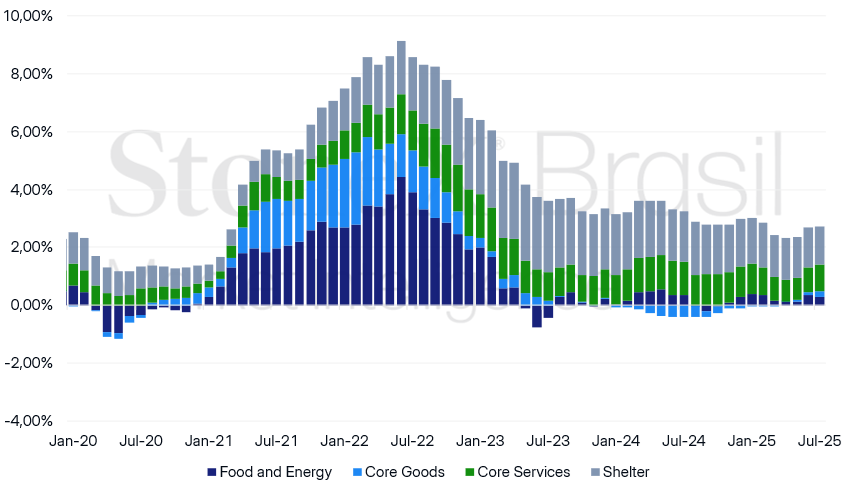
This Friday’s (13) Consumer Price Index (CPI) is expected to show stable U.S. inflation for January, with the median forecast projecting a 2.7% annual increase for the full index, matching December’s level.
- If confirmed, this result would highlight inflationary resilience in the country, remaining above the Federal Reserve’s 2% annual target.
Contributions to the U.S. Consumer Price Index (CPI) - monthly, seasonally adjusted
Source: Census. Design: StoneX.
Why This Matters: The likely persistently high CPI reading is expected to reduce bets on Federal Reserve rate cuts and support the outlook for U.S. Treasury yields, strengthening the dollar globally.
Outlook: During a press conference following the decision, Fed Chair Jerome Powell stated, “The upside risks to inflation and employment risks have diminished. But they still exist,” suggesting there is no urgency for further cuts.
- The decision was approved with a 10-2 vote, indicating a certain level of consensus among Committee members regarding the current economic scenario.
- Last week, it’s worth noting that price sub-indices in Purchasing Managers’ Indexes (PMIs) from ISM, both for manufacturing and services sectors, pointed to accelerating inflationary pressures, suggesting upcoming CPI readings may follow a similar trend.
Kevin Warsh’s Nomination as Federal Reserve Chair
Expected Impact on USDBRL: Bullish
Kevin Warsh was appointed on Friday (01/30) by Donald Trump as the new Federal Reserve Chair, set to assume the position in May pending Senate approval. Warsh is historically known for his more contractionary or “hawkish” monetary policy stance, prioritizing inflation control through higher interest rates.
Outlook: The key question for markets remains how susceptible Warsh might be to political pressure from President Trump to lower the U.S. benchmark interest rate, given recent criticisms of current Fed Chair Jerome Powell’s leadership.
- While his nomination has eased some market concerns regarding the growing trend of dollar diversification, Warsh’s actual policy impact remains uncertain, limiting his influence on the USDBRL pair.
Why This Matters: The appointment of a more orthodox figure to the Fed could curb the global trend of dollar diversification, potentially depreciating the real and risk assets.
- As such, investors should stay alert to any updates regarding the incoming Fed Chair throughout the week.

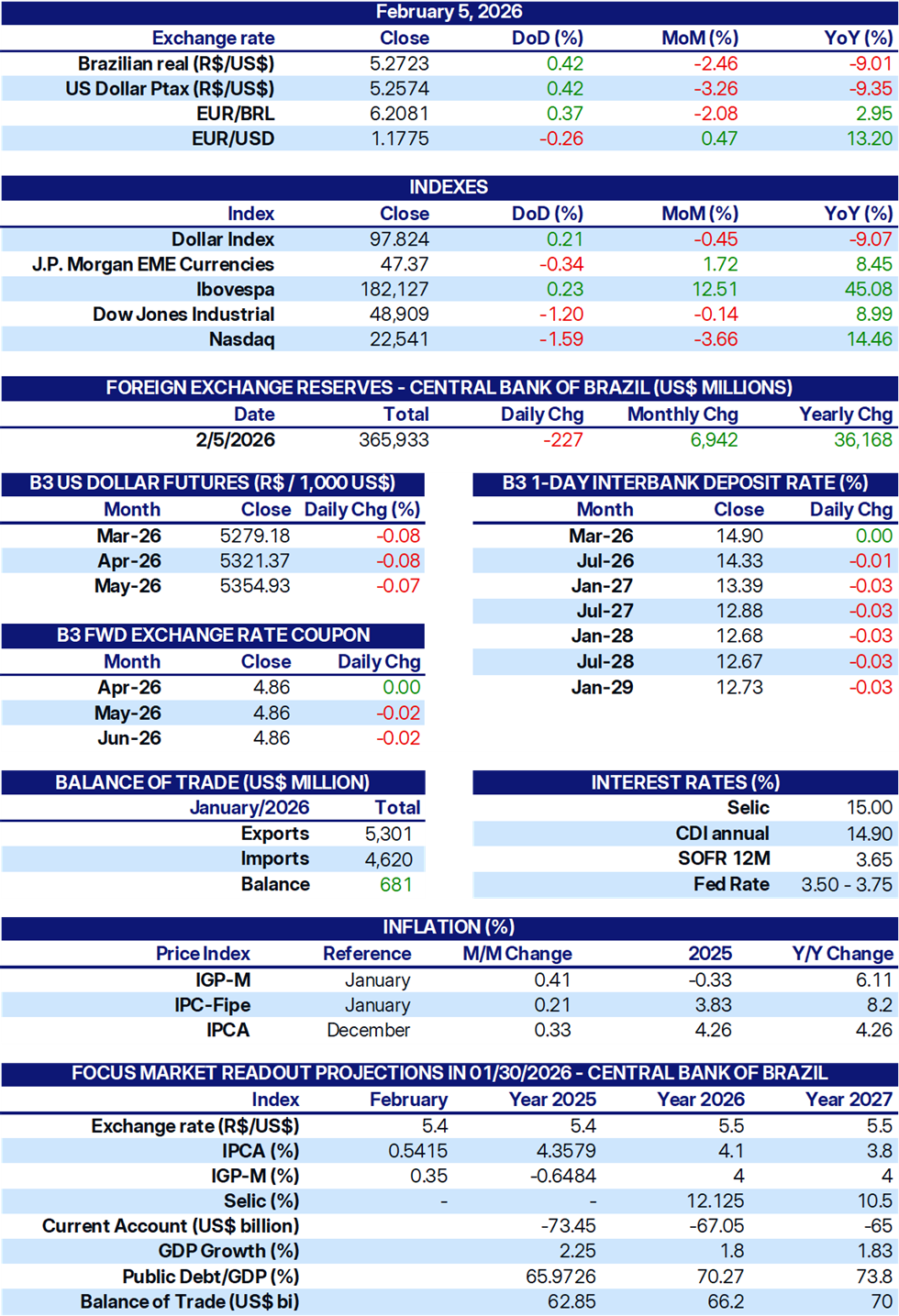
INDICATORS
Sources: Central Bank of Brazil; B3; IBGE; Fipe; FGV; MDIC; IPEA; and StoneX cmdtyView.