USDBRL Reflect Global Inflation Concerns, Middle East Conflict, and Brazilian Data
-
Notice: Starting this week, the Economic Indicators Schedule will be available in an interactive report format.
-
This new format allows for dynamic tracking of both past release dates and scheduled announcements through the end of the year.
-
To access it, click here.
- Bullish
- Statements from leading central banks, emphasizing the possibility of higher global interest rates due to the Middle East conflict, increase the appeal of central economy bonds and reduce capital flows to emerging markets, putting pressure on the Brazilian real.
- The ongoing Middle East conflict, coupled with attacks on energy infrastructure and persistent risks of disruptions in the Strait of Hormuz, keeps oil prices elevated and amplifies risk aversion, a scenario that typically disadvantages emerging market currencies like the real.
- Bearish
- The release of the Brazilian Central Bank’s Copom minutes and Monetary Policy Report could reinforce a more cautious stance by the Central Bank, supporting domestic yields and providing strength to the real.
- Data from the IPCA‑15 and PNAD may reveal persistently high inflation over the past 12 months and a resilient labor market, reducing expectations of aggressive rate cuts and favoring the real in the upcoming week.
The week in review
- Amid heightened volatility linked to the Middle East conflict, last week was also marked by monetary policy meetings of major global central banks.
- In the U.S., the decision was to maintain interest rates within the range of 3.50% to 3.75% per year, aligning with expectations. The Summary of Economic Projections (SEP) indicated greater consensus among FOMC directors toward a tighter monetary policy stance, which contributed to the global strengthening of the dollar.
- In Brazil, a 0.25 percentage point cut reduced the benchmark interest rate from 15.00% to 14.75% annually. The post-decision statement offered no clear forward guidance, merely signaling that new data would be assessed to enhance clarity on inflationary impacts stemming from the Middle East conflict.
- Monetary authorities from other major economies, including the Eurozone, the UK, and Japan, also held their rates steady. However, their communications were predominantly cautious, suggesting the possibility of prolonged monetary tightening in key economies.
USDBRL and Dollar Index (points)
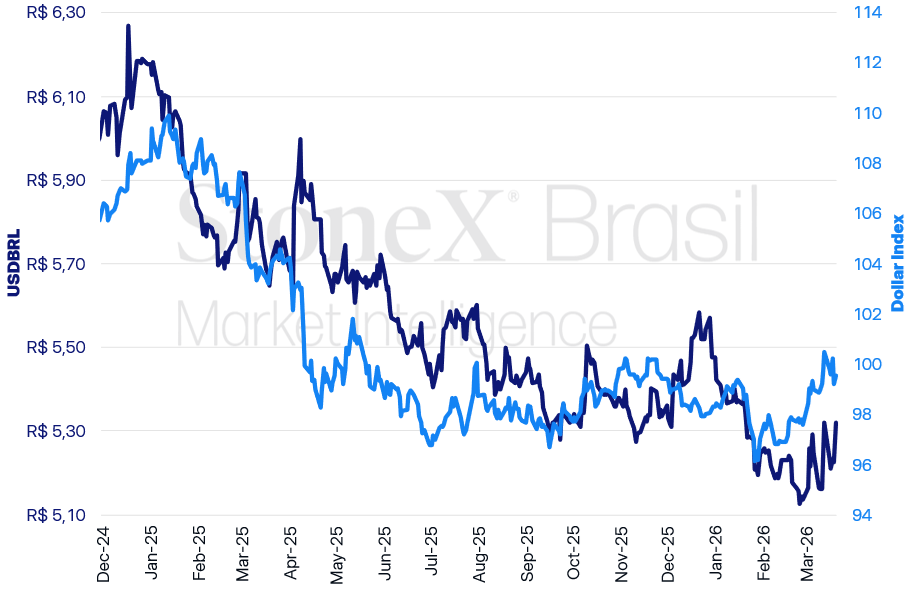
Source: StoneX cmdtyView. Prepared by: StoneX.
USDBRL Variations
Daily: +1.84% | Weekly: -0.01% | Monthly: +3.56% | Annual: -2.86% | 12 Months: -6.27%
Dollar Index Variations
Daily: +0.36% | Weekly: -0.90% | Monthly: +2.02% | Annual: +1.26% | 12 Months: -4.10%
KEY TAKEAWAY: Higher Global Interest Rate Outlook
Expected Impact on USDBRL: Bullish
Throughout the week, central banks of major economies held their interest rate decision meetings.
- One common theme across all statements was the recognition of inflationary risks associated with the Middle East conflict as a tangible threat to price stability, prompting a more cautious approach to future rate decisions.
Why This Matters: The expectation of higher interest rates in central economies, especially in an environment of heightened international uncertainty, tends to boost the appeal of sovereign bonds in these countries.
- This shift is likely to reduce capital flows to less resilient economies, such as emerging markets—including Brazil—placing downward pressure on the Brazilian real.
- Additionally, the outlook for higher global interest rates also contributed to the decline in gold prices. The asset saw over a 10% drop this week, marking its largest decline since the pandemic.
Context: On Thursday (19), for instance, the Bank of England’s (BoE) indication of potential rate hikes triggered a strong market reaction, penalizing higher-risk assets like the real. Later, the movement eased after the BoE’s governor stated that the market was prematurely pricing in an imminent rate hike, which he clarified remains a possibility rather than a certainty.
- Nonetheless, the probability of additional rate hikes by global central banks has risen significantly, reversing pre-conflict expectations that had anticipated easing as inflation slowed.
- This sentiment was echoed by Brazil’s Central Bank and appears to have influenced a more gradual start to its rate-cut cycle, with a 0.25 p.p. reduction instead of 0.50 p.p.
- Meanwhile, a significant portion of traders no longer expects rate cuts from the Federal Reserve this year, while futures markets now attribute over a 50% likelihood to a BoE hike next month. Sources also suggest that the European Central Bank may discuss rate hikes as early as April, with similar chances of tightening in June.
Middle East Conflict
Expected Impact on USDBRL: Bullish
The conflict in the Middle East shows no signs of resolution, raising concerns over the destruction of energy infrastructure and the potential continuation of closures in the Strait of Hormuz.
Why This Matters: The prolonged conflict keeps markets in a heightened state of caution and amplifies price volatility. The longer the standoff persists, the greater the risk of long-term inflationary impacts, even if hostilities eventually cease.
- A prolonged conflict also raises alarms for the fertilizer market, which could affect global crop yields and drive up food prices.
Trump Acknowledges Inflationary Impacts of the Conflict: This week, U.S. President Donald Trump expressed concerns about the inflationary effects of the war, stating that he requested Israel halt attacks on Iran’s energy infrastructure while Iran continues retaliating against facilities in neighboring countries.
- Inflationary pressures in the U.S. are particularly sensitive in a year marked by declining approval ratings and midterm elections.
Context: In recent days, Iran has attacked energy installations in Gulf countries following an Israeli strike on South Pars, the world’s largest gas field, shared with Qatar.
- In Kuwait, targeted refineries caught fire.
- In Saudi Arabia, drone and missile attacks on a refinery were intercepted.
- In Qatar, Iran targeted the Ras Laffan industrial complex, the world’s largest natural gas processing and export hub, which also reported fires.
- In the UAE, missile debris from intercepted attacks landed on local territory.
- In this environment, oil prices remain under pressure. European countries and Japan have expressed willingness to assist in reopening the Strait of Hormuz, though specific plans remain unclear.
Copom Minutes and Monetary Policy Report
Expected Impact on USDBRL: Bearish
Following Copom’s decision to lower the benchmark interest rate (Selic), investors will closely monitor two releases that are likely to shape expectations regarding the next steps in monetary policy.
- On Tuesday (24), the minutes from Copom’s latest meeting will be published.
- On Thursday (26), attention shifts to the Monetary Policy Report (MPR).
Why This Matters: Signals suggesting the Central Bank may adopt a more cautious approach to further Selic cuts could boost domestic bond yields and attract foreign capital, strengthening the real against the dollar.
Context: The post-decision statement recognized signs of slowing inflation and economic activity—factors that, under normal conditions, would support a clearer monetary easing process.
- However, uncertainties surrounding potential inflationary acceleration due to the Middle East conflict were highlighted as a concern.
- The statement avoided forward guidance, aligning with the Central Bank’s current practice of minimizing communication noise. The only explicit indication was that new data will be continuously incorporated into the committee’s assessment.
- Additionally, inflation projections for the IPCA at the end of 2026 shifted from 3.4% to 3.9%, underscoring that Copom is already factoring potential inflationary risks into its analysis.
What Are These Reports?: Copom minutes detail the discussions and analyses behind the committee’s decision, providing transparency on monetary policy drivers.
- The MPR offers a broader evaluation of domestic and international macroeconomic conditions, along with forecasts for key Brazilian economic indicators in the coming years.
- Tracking both documents will be critical for understanding the committee’s perspective on current conditions and the factors likely to influence future decisions.
IPCA-15 and Employment Data
Expected Impact on USDBRL: Bearish
This week’s key indicators focus on Brazil, particularly the IPCA‑15 inflation index—which may already reflect inflationary pressures from the Middle East conflict—and unemployment figures from the National Household Sample Survey (PNAD).
- Despite recent signs of deceleration, inflation remains above the Central Bank’s target, sustaining the need for monetary tightening.
- Meanwhile, the labor market has shown consistent resilience, even amid a restrictive monetary policy environment.
Why This Matters: Potential signs of inflationary pressure and continued low unemployment levels could dampen expectations for rapid interest rate cuts in Brazil, boosting public bond yields and supporting the real.
IPCA‑15: This index measures price variations from the 16th of one month to the 15th of the next. The March reading may already capture initial impacts of the conflict on prices.
- In the latest IPCA data, vehicle fuel prices fell by 0.47%.
Labor Market: Despite high interest rates, the labor market remains resilient, with the unemployment rate at 5.4%, close to the historical low of 5.1% recorded in December 2025.

INDICATORS
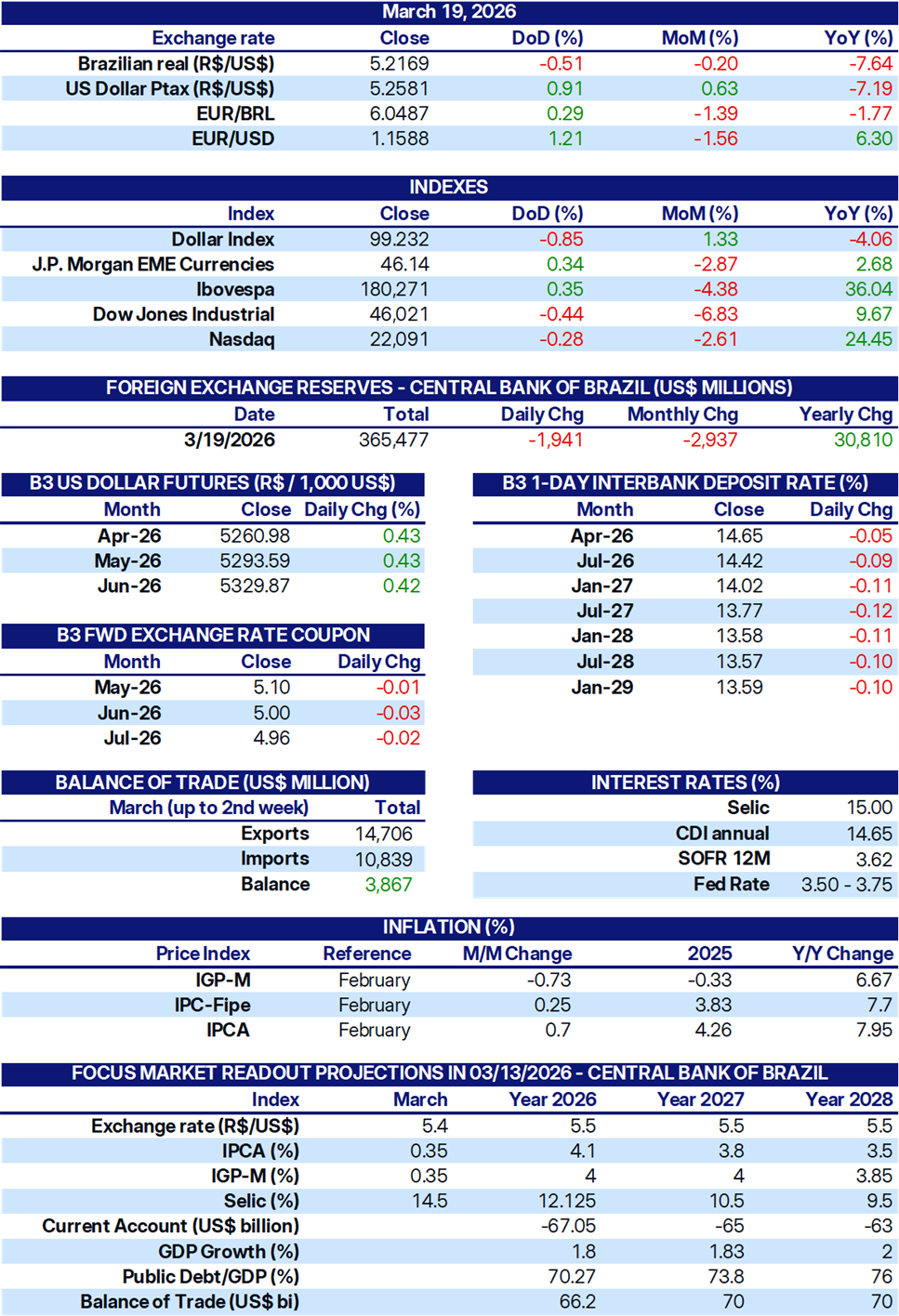
Sources: Brazilian Central Bank; B3; IBGE; Fipe; FGV; MDIC; IPEA; and StoneX cmdtyView.