USDBRL Expected to Reflect Copom Minutes and U.S. Economic Data
- Bullish
- U.S. economic data is likely to signal a stronger economy, reducing bets on interest rate cuts by the Federal Reserve and supporting the dollar's global strength.
- Bearish
- The Copom minutes are expected to reinforce the Brazilian Central Bank’s cautious stance amid challenging inflation dynamics, reducing bets on interest rate cuts in Brazil and supporting the real.
Th week in review
- The week’s focus was on interest rate decisions in the U.S., Brazil, and other major global economies.
- In the U.S., the Federal Open Market Committee (FOMC) chose to keep the policy rate steady in the range of 3.50% to 3.75% annually.
- In addition to the decision, markets reacted to signals that Jerome Powell may remain on the Board of Governors after his term ends, until he feels confident that government attacks on the Federal Reserve’s independence and his leadership have ceased.
- In Brazil, the Monetary Policy Committee cut the policy rate (Selic) by 0.25 percentage points, lowering it from 14.75% to 14.50% annually. The accompanying statement hinted at potential adjustments to the pace of Selic changes.
- On the geopolitical front, the ongoing impasse between the U.S. and Iran continued to fuel uncertainty in financial markets. The lack of progress kept oil premiums and geopolitical risk perceptions high.
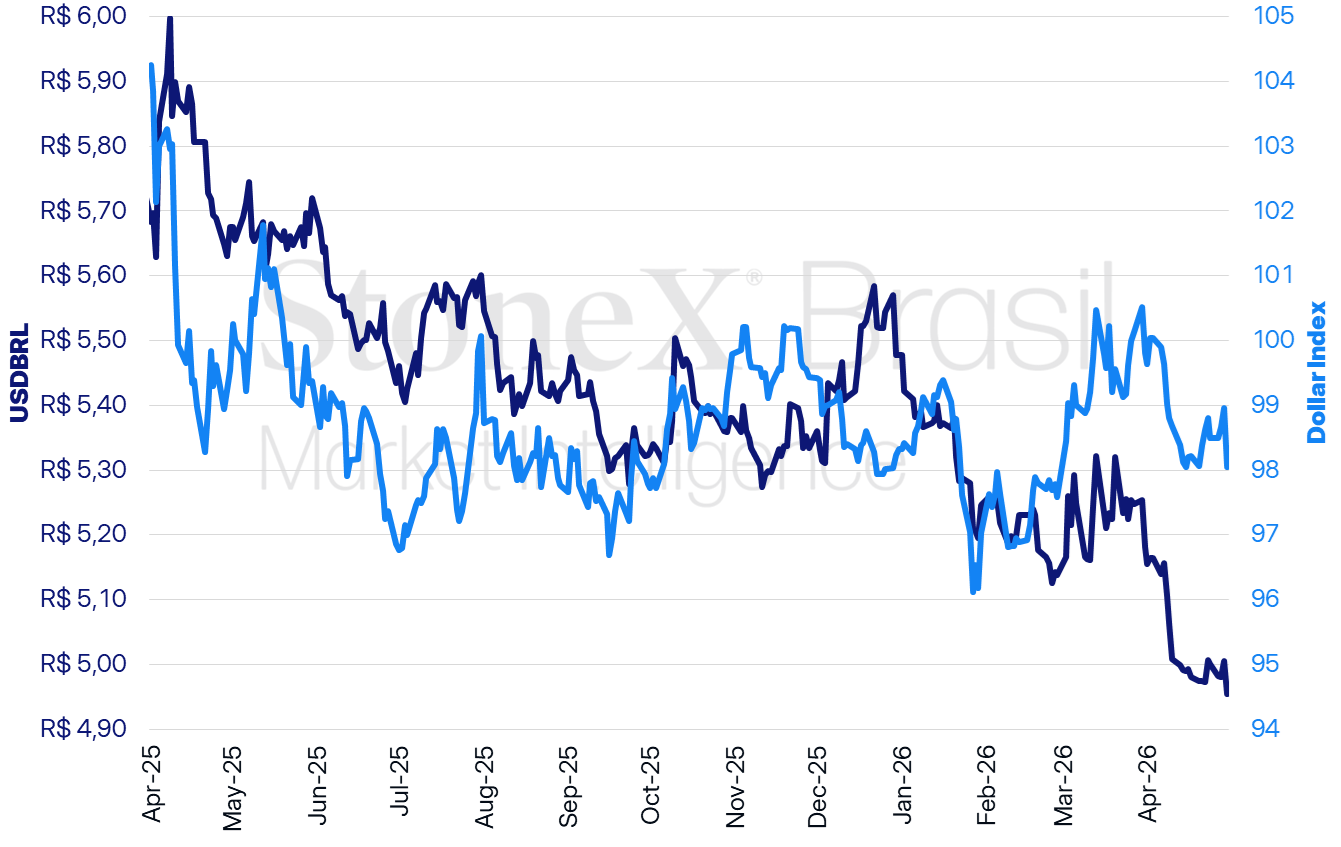
USDBRL and Dollar Index (points)
Source: StoneX cmdtyView. Prepared by: StoneX.
USDBRL Variations | Daily: -1.00% | Weekly: -0.94% | Monthly: -4.38% | Annual: -9.54% | Over 12 Months: -12.71%
Dollar Index Variations | Daily: -0.92% | Weekly: -0.45% | Monthly: -1.77% | Annual: -0.27% | Over 12 Months: -1.49%
KEY EVENT: U.S. Economic Data
Expected Impact on USDBRL: Bullish
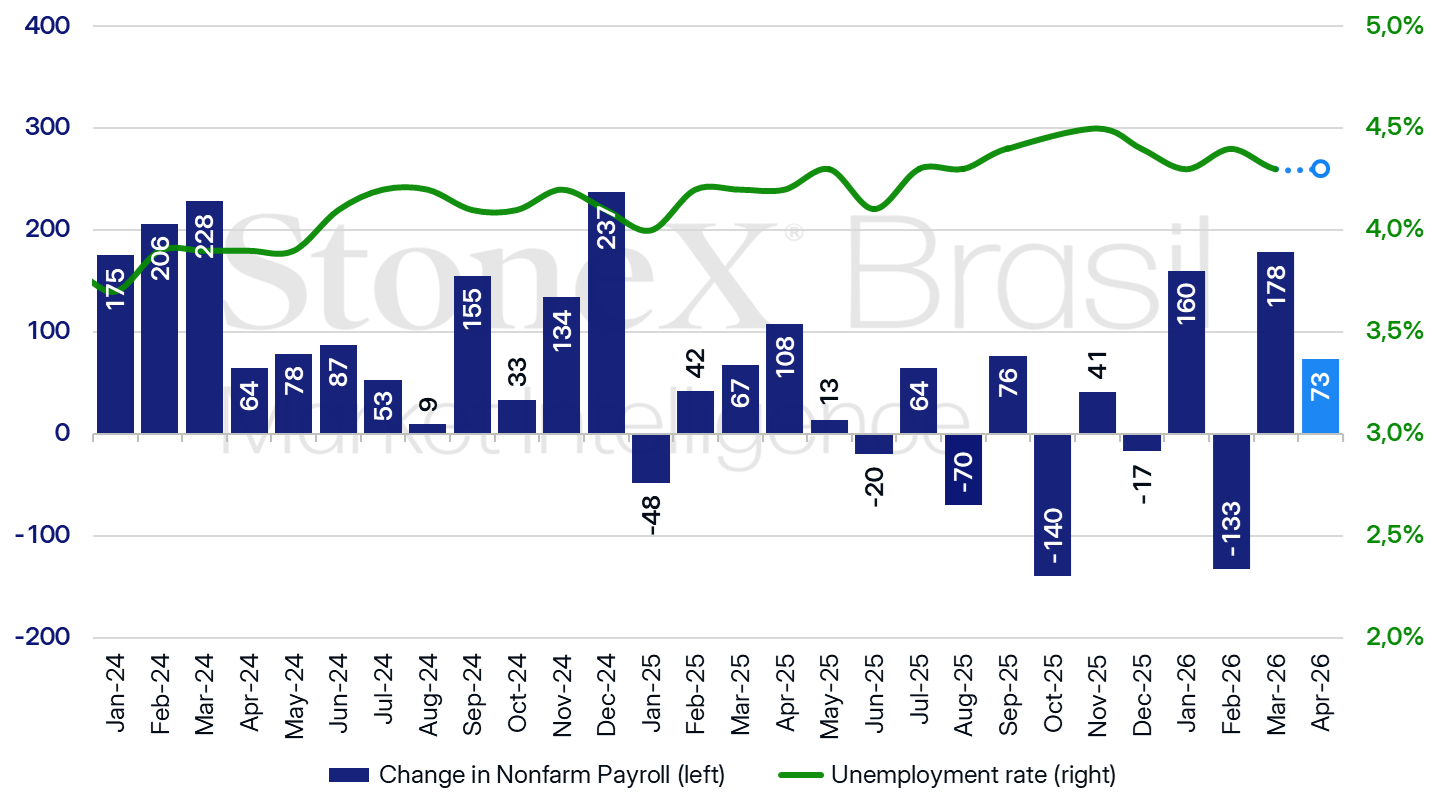
Changes in Nonfarm Payroll (thousands) and Unemployment Rate (%) in the United States
Source: U.S. Bureau of Labor Statistics (BLS), Federal Reserve Bank of St. Louis. Design: StoneX.
This week’s packed agenda includes the release of key U.S. economic indicators, particularly the Employment Situation Report and April’s Services Purchasing Managers’ Index (PMI).
Why It Matters: These indicators are likely to continue signaling a robust U.S. economy, which, combined with inflationary pressures stemming from global oil supply constraints, may reduce the odds of Fed interest rate cuts.
- This would, in turn, boost U.S. Treasury yields and contribute to global dollar strength.
What to Expect: The median forecast for the Employment Situation Report predicts net job creation of 73,000 in April, exceeding the six-month average of 15,000.
- Additionally, the unemployment rate is projected to remain steady at 4.3%, reinforcing a healthy labor market outlook.
- The median forecast for ISM’s Services PMI in April stands at 54.0 points, matching March’s result and signaling moderate expansion in the largest segment of the U.S. economy.
- Strong labor market performance and productive activity suggest financial conditions in the U.S. are not restrictive, negating the need for short-term Fed rate cuts.
- These interpretations align with last week’s preliminary Q1 GDP data, which indicated stronger-than-expected annualized household consumption growth of 1.6%, driven by demand for services like healthcare and financial services.
Copom Minutes
Expected Impact on USDBRL: Bearish
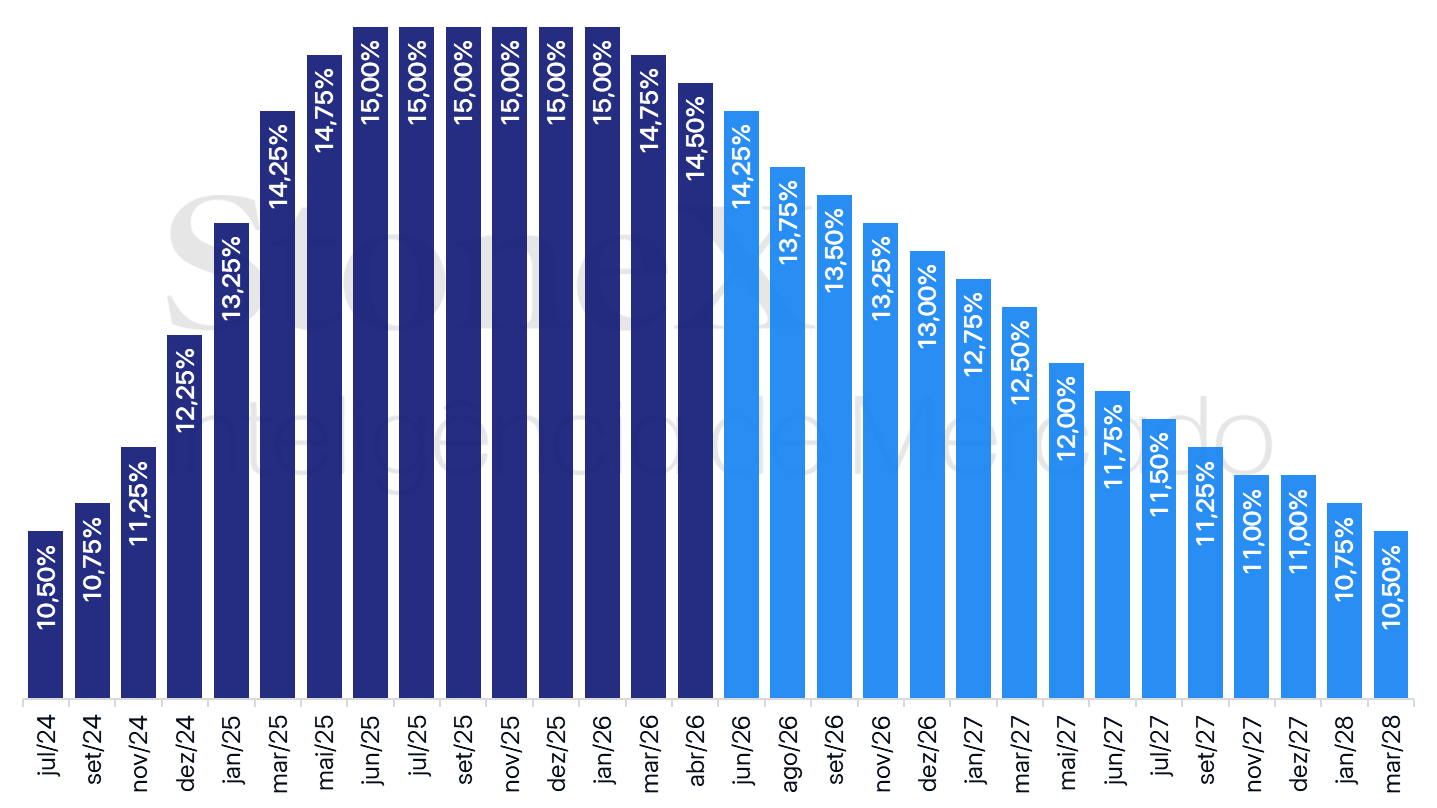
U.S.: Historical and Projected Interest Rate Trends – Updated April 24, 2026
Source: Brazilian Central Bank. Design: StoneX.
Investors are closely monitoring the release of minutes from the Brazilian Central Bank’s latest Copom meeting, where the Selic rate was reduced from 14.75% to 14.50% annually.
- In its statement, the monetary authority raised inflation projections and indicated potential adjustments to the pace of Selic movements, pending further information on the conflict’s impact on domestic prices.
- The minutes may offer deeper insights into policymakers’ current economic assessments and outlooks, helping investors refine their expectations.
Why It Matters: Signals of greater caution and a potential slowdown in Selic rate cuts could lead to higher interest rate expectations, strengthening the real.
Shifting Expectations: Since the onset of the Middle East conflict in late February, inflation expectations for the 2026 year-end IPCA have risen from 3.91% to 4.61%, exceeding the target ceiling.
- As a result of anticipated inflationary pressures from oil price shocks, year-end Selic rate projections have climbed from 12.00% to 13.00% annually.
- This suggests financial institutions are recalibrating their forecasts, particularly given the lack of resolution in the geopolitical impasse.
- Consequently, near-term bets on further Selic cuts have diminished.

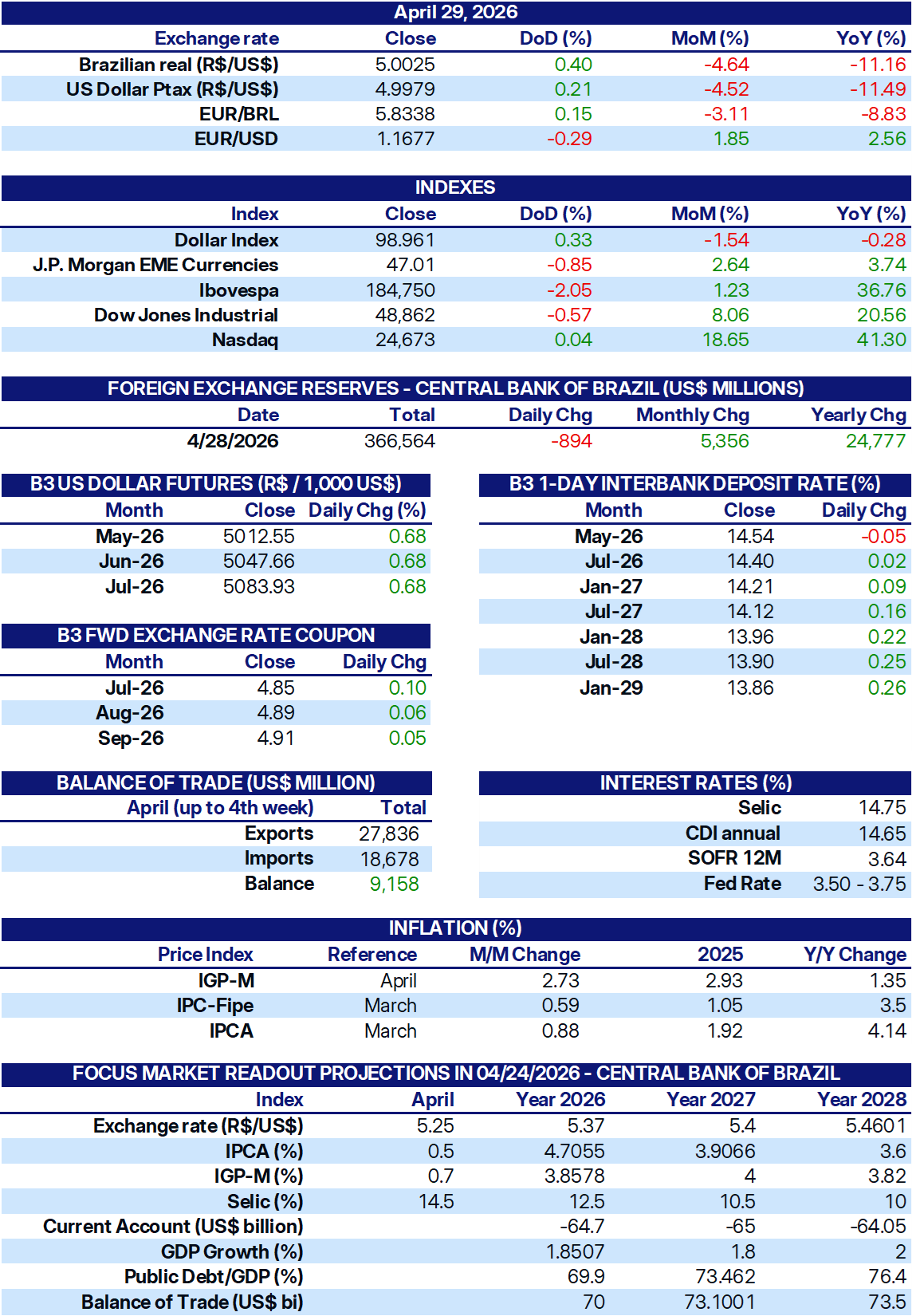
INDICATORS
Sources: Brazilian Central Bank; B3; IBGE; Fipe; FGV; MDIC; IPEA; and StoneX cmdtyView.
The StoneX Group Inc. group of companies provides financial services worldwide through its subsidiaries, including physical commodities, securities, exchange-traded and over-the-counter derivatives, risk management, global payments and foreign exchange products in accordance with applicable law in the jurisdictions where services are provided. References to over-the-counter (“OTC”) products or swaps are made on behalf of StoneX Markets LLC (“SXM”), a member of the National Futures Association (“NFA”) and provisionally registered with the U.S. Commodity Futures Trading Commission (“CFTC”) as a swap dealer. SXM’s products are designed only for individuals or firms who qualify under CFTC rules as an ‘Eligible Contract Participant’ (“ECP”) and who have been accepted as customers of SXM. StoneX Financial Inc. (“SFI”) is a member of FINRA/NFA/SIPC and registered with the MSRB. SFI is registered with the U.S. Securities and Exchange Commission (“SEC”) as a Broker-Dealer and with the CFTC as a Futures Commission Merchant and Commodity Trading Adviser. References to securities trading are made on behalf of the BD Division of SFI and are intended only for an audience of institutional clients as defined by FINRA Rule 4512(c). References to exchange-traded futures and options are made on behalf of the FCM Division of SFI . StoneX is a trading name of StoneX Financial Ltd (“SFL”). SFL is registered in England and Wales, Company No. 5616586. SFL is authorized and regulated by the Financial Conduct Authority [FRN 446717] to provide to professional and eligible customers including: arrangement, execution and, where required, clearing derivative transactions in exchange traded futures and options. SFL is also authorised to engage in the arrangement and execution of transactions in certain OTC products, certain securities trading, precious metals trading and payment services to eligible customers. SFL is authorised & regulated by the Financial Conduct Authority under the Payment Services Regulations 2017 for the provision of payment services. SFL is a category 1 ring-dealing member of the London Metal Exchange. In addition SFL also engages in other physically delivered commodities business and other general business activities which are unregulated and not required to be authorised by the Financial Conduct Authority. StoneX Group Inc. acts as agent for SFL in New York with respect to its payments services business. StoneX APAC Pte. Ltd. acts as agent for SFL in Singapore with respect to its payments services business. ‘StoneX’ is the trade name used by StoneX Group Inc. and all its associated entities and subsidiaries.
Trading swaps and over-the-counter derivatives, exchange-traded derivatives and options and securities involves substantial risk and is not suitable for all investors. Past performance of any futures or option is not indicative of future success. Indicators are not a trading system and are not published as a specific trade recommendation. The information herein is not a recommendation to trade nor investment research or an offer to buy or sell any derivative or security. It does not take into account your particular investment objectives, financial situation or needs and does not create a binding obligation on any of the StoneX group of companies to enter into any transaction with you. You are advised to perform an independent investigation of any transaction to determine whether any transaction is suitable for you. No part of this material may be copied, photocopied or duplicated in any form by any means or redistributed without the prior written consent of StoneX Group Inc.
© 2026 StoneX Group Inc. All Rights Reserved.