

FX Weekly Overview (Brazil Issue)
Dollar expected to reflect the first round of elections, FOMC minutes, and IPCA

Leonel Mattos
- Currencies
By: Leonel Mattos, Market Intelligence Analyst • BRAZIL PRS

USDBRL and Dollar Index (points)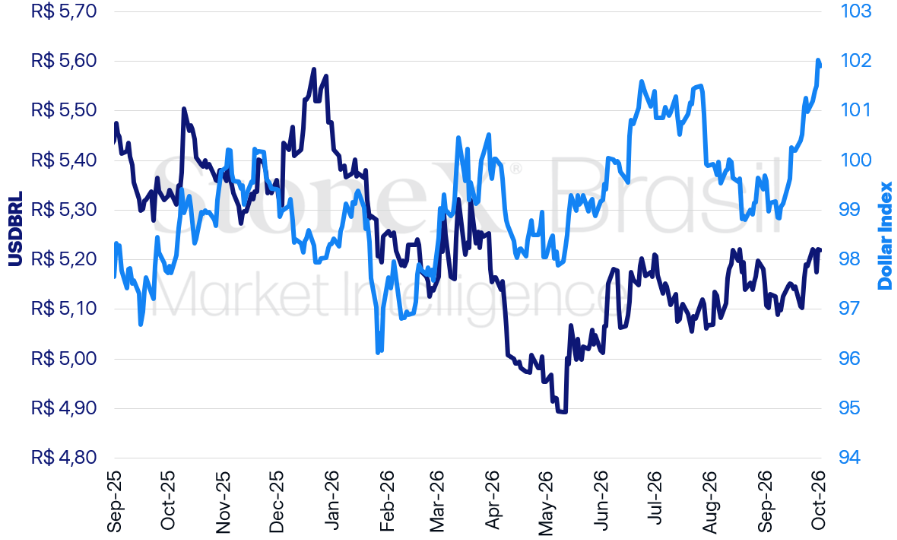
USDBRL Variations | Daily: -0.03% | Weekly: +0.63% | Monthly: +0.86% | Annual: -4.70% | Over 12 months: -2.25%
Dollar Index Variations | Daily: -0.11% | Weekly: +0.91% | Monthly: +0.40% | Annual: +3.65% | Over 12 months: +4.12%
Over the weekend, investors are expected to monitor the results of the first round of presidential elections, which should conclude by Sunday night (04).
Why this matters: A tight electoral race could reduce predictability regarding Brazil’s economic policies over the next four years, increasing the perception of risks for national assets, amplifying volatility, and weakening the BRL.
Voter intention poll: On Thursday (01), Datafolha released its voter intention survey, showing Lula and Flavio Bolsonaro in a technical tie both in the first and second rounds, strengthening perceptions of tight elections.
First-round victory? Despite voter intentions being concentrated between Lula and Flavio, a first-round outcome seems unlikely.
US: Historical and expected interest rates – updated on October 2, 2026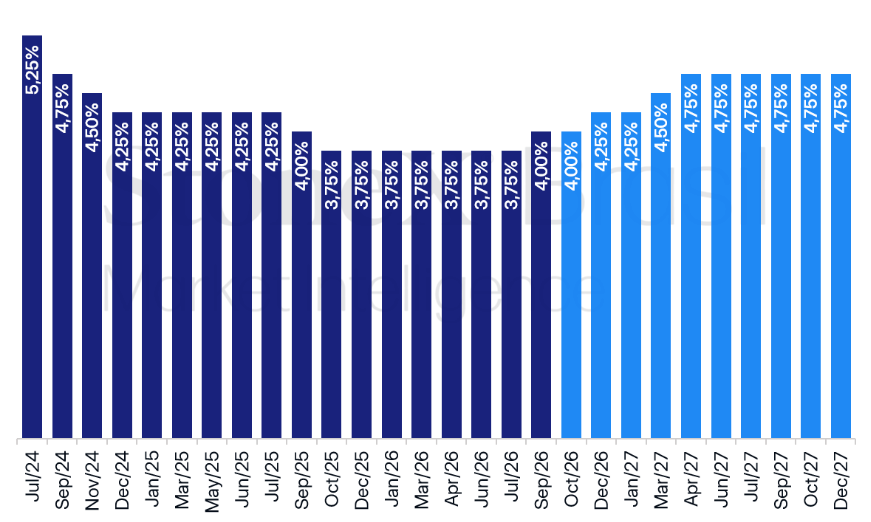
On the international stage, investors are expected to react to the release of minutes from the Federal Reserve’s Federal Open Market Committee (FOMC) last interest rate decision. The Fed raised US interest rates to the 3.75%-4.00% range and showed a firmer stance than expected in seeking price stability.
Why this matters: The document may reinforce the expectation of higher interest rates for longer in the United States, which tends to raise the yield on US Treasury bonds and attract foreign capital, strengthening the dollar globally.
Strong stance against inflation: Although the minutes are published just three weeks after the FOMC decision, the document gains greater importance due to Kevin Warsh’s enigmatic communication style as Fed Chairman since May.
Mixed data in the US: Last week, US economic indicators presented a mixed scenario, with some readings suggesting a robust economy and others a more stable outlook.
“Low fire, low hire”: Additionally, the September Employment Situation Report also presented a mixed picture for the country’s labor market.
Change in total US non-farm payroll – three-month average ('000 of people)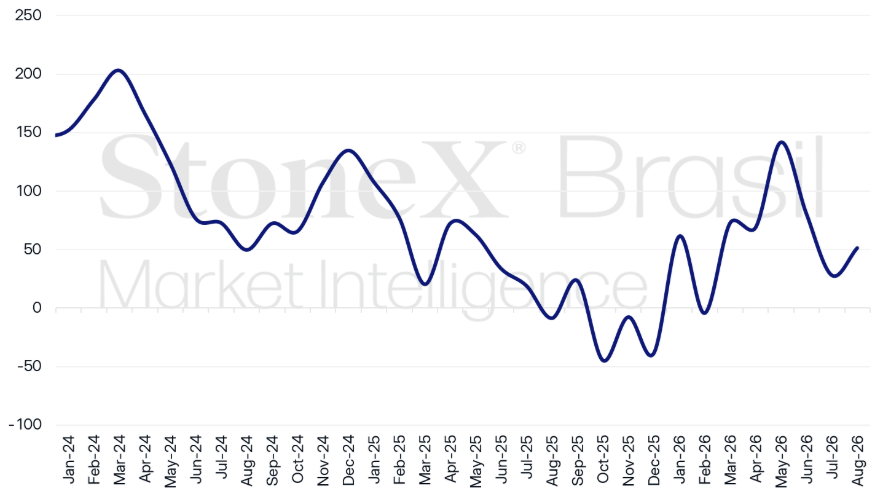
Slower rate hikes: In practice, these indicators do not fundamentally change the Federal Reserve’s risk balance, which includes a heated productive activity, a resilient and healthy labor market, and persistent inflation.
Purchasing Managers’ Index (PMI): Additionally, investors are expected to monitor the services sector PMI, released by the ISM Institute, which should provide clues about the level of activity in the main sector of the U.S. economy.
Brazil: Historical and expected interest rates – Focus bulletin as of September 25, 2026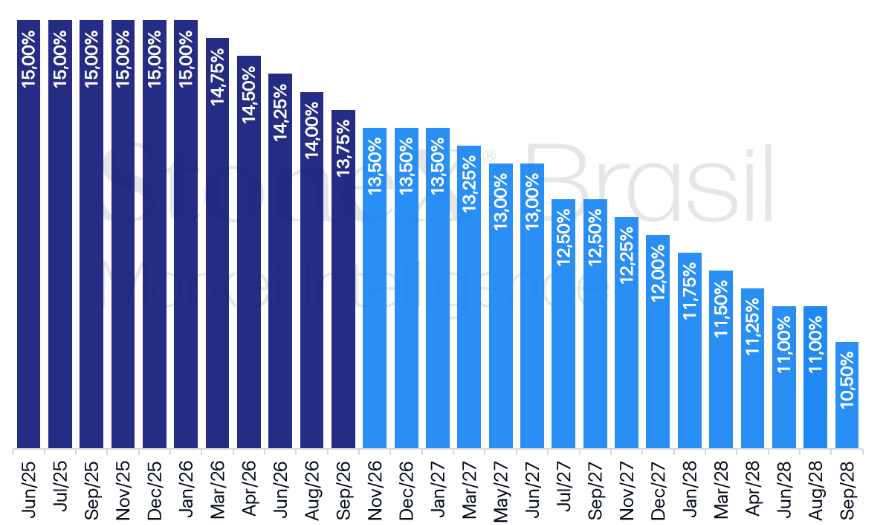
On the domestic agenda, investors are expected to react to September’s reading of the Broad National Consumer Price Index (IPCA), which should influence investor expectations for the trajectory of Brazil’s basic interest rate (Selic).
Why is this important: A stronger IPCA reading is likely to heighten concerns about the domestic inflationary scenario, reducing the odds of further Selic rate cuts.
Open next steps: In its latest interest rate decision, Brazil’s Monetary Policy Committee (Copom) acknowledged a scenario of high uncertainty, reinforcing a cautious tone for future steps without committing to any specific actions.

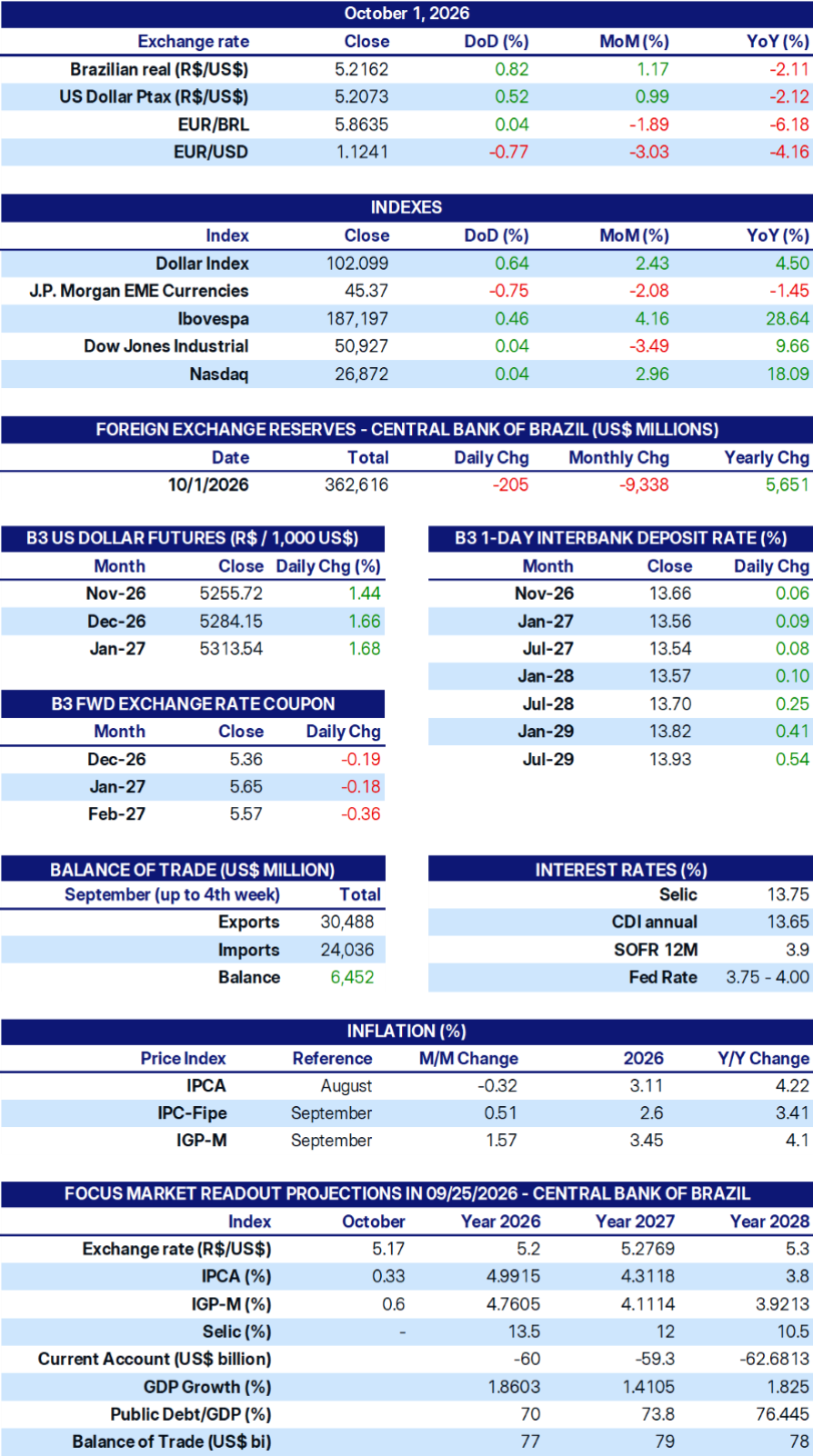
ECONOMIC INDICATORS
The StoneX Group Inc. group of companies provides financial services worldwide through its subsidiaries, including physical commodities, securities, exchange-traded and over-the-counter derivatives, risk management, global payments and foreign exchange products in accordance with applicable law in the jurisdictions where services are provided. References to over-the-counter (“OTC”) products or swaps are made on behalf of StoneX Markets LLC (“SXM”), a member of the National Futures Association (“NFA”) and provisionally registered with the U.S. Commodity Futures Trading Commission (“CFTC”) as a swap dealer. SXM’s products are designed only for individuals or firms who qualify under CFTC rules as an ‘Eligible Contract Participant’ (“ECP”) and who have been accepted as customers of SXM. StoneX Financial Inc. (“SFI”) is a member of FINRA/NFA/SIPC and registered with the MSRB. SFI is registered with the U.S. Securities and Exchange Commission (“SEC”) as a Broker-Dealer and with the CFTC as a Futures Commission Merchant and Commodity Trading Adviser. References to securities trading are made on behalf of the BD Division of SFI and are intended only for an audience of institutional clients as defined by FINRA Rule 4512(c). References to exchange-traded futures and options are made on behalf of the FCM Division of SFI . StoneX is a trading name of StoneX Financial Ltd (“SFL”). SFL is registered in England and Wales, Company No. 5616586. SFL is authorized and regulated by the Financial Conduct Authority [FRN 446717] to provide to professional and eligible customers including: arrangement, execution and, where required, clearing derivative transactions in exchange traded futures and options. SFL is also authorised to engage in the arrangement and execution of transactions in certain OTC products, certain securities trading, precious metals trading and payment services to eligible customers. SFL is authorised & regulated by the Financial Conduct Authority under the Payment Services Regulations 2017 for the provision of payment services. SFL is a category 1 ring-dealing member of the London Metal Exchange. In addition SFL also engages in other physically delivered commodities business and other general business activities which are unregulated and not required to be authorised by the Financial Conduct Authority. StoneX Group Inc. acts as agent for SFL in New York with respect to its payments services business. StoneX APAC Pte. Ltd. acts as agent for SFL in Singapore with respect to its payments services business. ‘StoneX’ is the trade name used by StoneX Group Inc. and all its associated entities and subsidiaries.
Trading swaps and over-the-counter derivatives, exchange-traded derivatives and options and securities involves substantial risk and is not suitable for all investors. Past performance of any futures or option is not indicative of future success. Indicators are not a trading system and are not published as a specific trade recommendation. The information herein is not a recommendation to trade nor investment research or an offer to buy or sell any derivative or security. It does not take into account your particular investment objectives, financial situation or needs and does not create a binding obligation on any of the StoneX group of companies to enter into any transaction with you. You are advised to perform an independent investigation of any transaction to determine whether any transaction is suitable for you. No part of this material may be copied, photocopied or duplicated in any form by any means or redistributed without the prior written consent of StoneX Group Inc.
© 2026 StoneX Group Inc. All Rights Reserved.
Our subscribers have access to comprehensive market analysis from StoneX spanning commodities, equities, currencies and more.
Dollar expected to reflect the first round of elections, FOMC minutes, and IPCA

Rising French and Spanish bond yields are pushing European market stress into the euro, which has lost ground to the Swiss franc and sterling. The currency market, rather than European stocks, is where that nervousness is most visible.


The European Central Bank has hiked twice, but a deteriorating growth outlook is narrowing its room to go further. With the Federal Reserve tightening at a faster pace, the policy balance continues to favor the U.S. dollar over the euro.

Our market expertise, advanced platforms, global reach, culture of full transparency and commitment to our clients’ success all set us apart in the financial marketplace.
Reach
With access to 40+ derivatives exchanges, 180+ foreign exchange markets, nearly every global securities marketplace and numerous bi-lateral liquidity venues, StoneX’s digital network and deep relationships can take clients anywhere they want to go.
Transparency
As a publicly traded company meeting the highest standards of regulatory compliance in the markets we serve; our financials and record of accomplishment are matters of public record. StoneX’s commitment to “doing the right thing over the easy thing” sets us apart in the industry and helps us build respect, client trust and new partnerships.
Expertise
From our proprietary Market Intelligence platform, to “boots on the ground” expertise from award-winning traders and professionals, we connect our clients directly to actionable insights they can use to make more informed decisions and achieve their goals in the global markets.