FX Outlook: Key Events of the Week
- Bearish factors
- The minutes of the Copom meeting and the Monetary Policy Report are expected to reinforce the outlook of higher interest rates for a longer period in Brazil, which could attract foreign investment and strengthen the real.
- A higher IPCA-15 may worsen inflation expectations in Brazil and reinforce the likelihood of further increases in the Selic rate, which would contribute to attracting foreign investment and tend to strengthen the real.
- Bullish factors
- The PCE index may reinforce the perception of more persistent inflation in the US, likely increasing bets that US interest rates will remain high for longer, thereby strengthening the dollar globally.
The week in review
The week was marked by interest rate decisions from the Federal Reserve, which pointed to a scenario of greater uncertainty, more persistent inflation, and slower growth in the US, and from the Central Bank of Brazil, which maintained its warning on inflation risks and signaled another Selic hike in May.
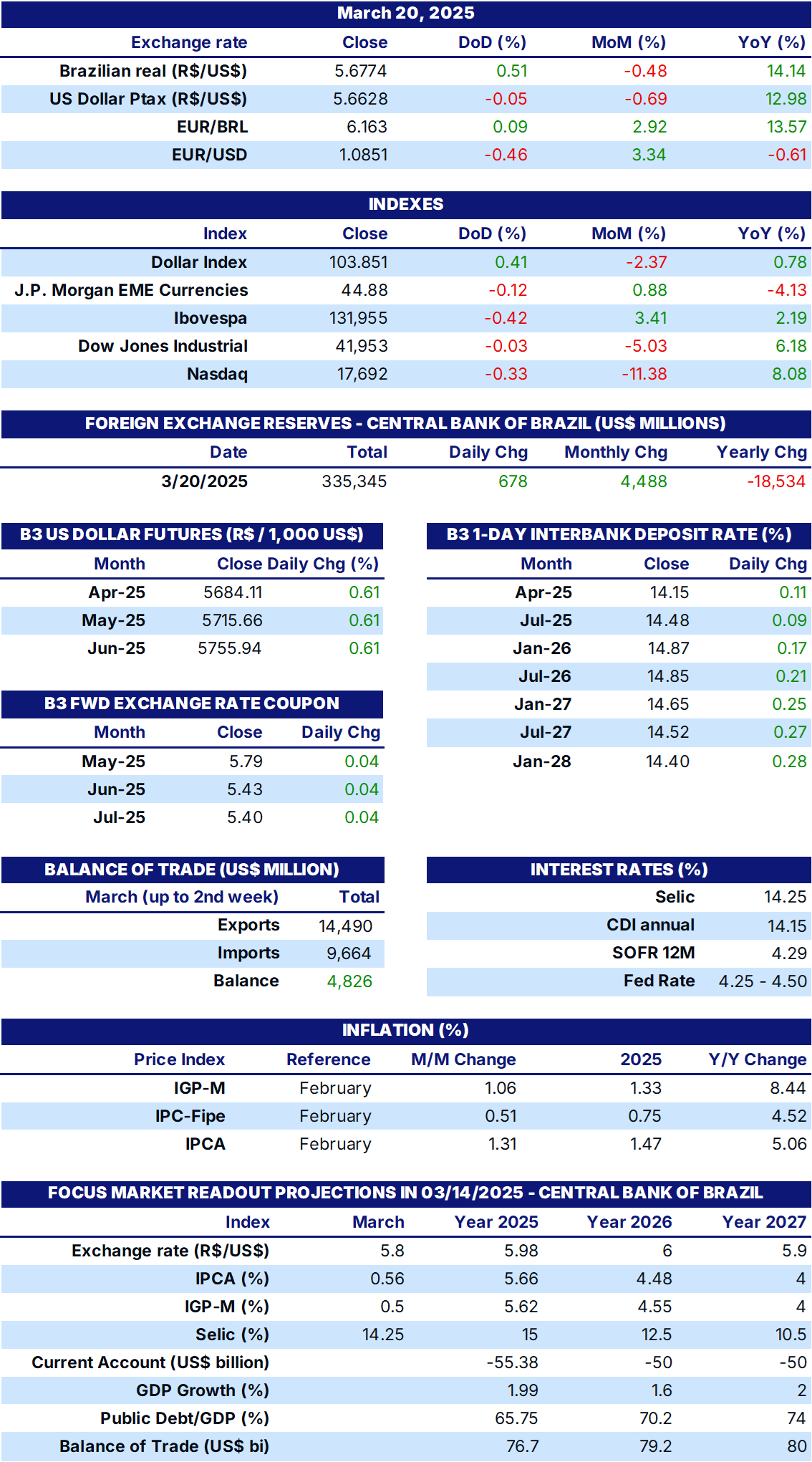
The Brazilian real ended the session on Friday (21st) at BRL 5.7156 per US dollar, down 0.5% on the week, 3.4% for the month, and 7.5% for the year. Meanwhile, the Dollar Index closed Friday’s session at 104.1 points, up 0.4% for the week, down 3.2% for the month, and down 3.7% for the year.
USDBRL and Dollar Index (points)
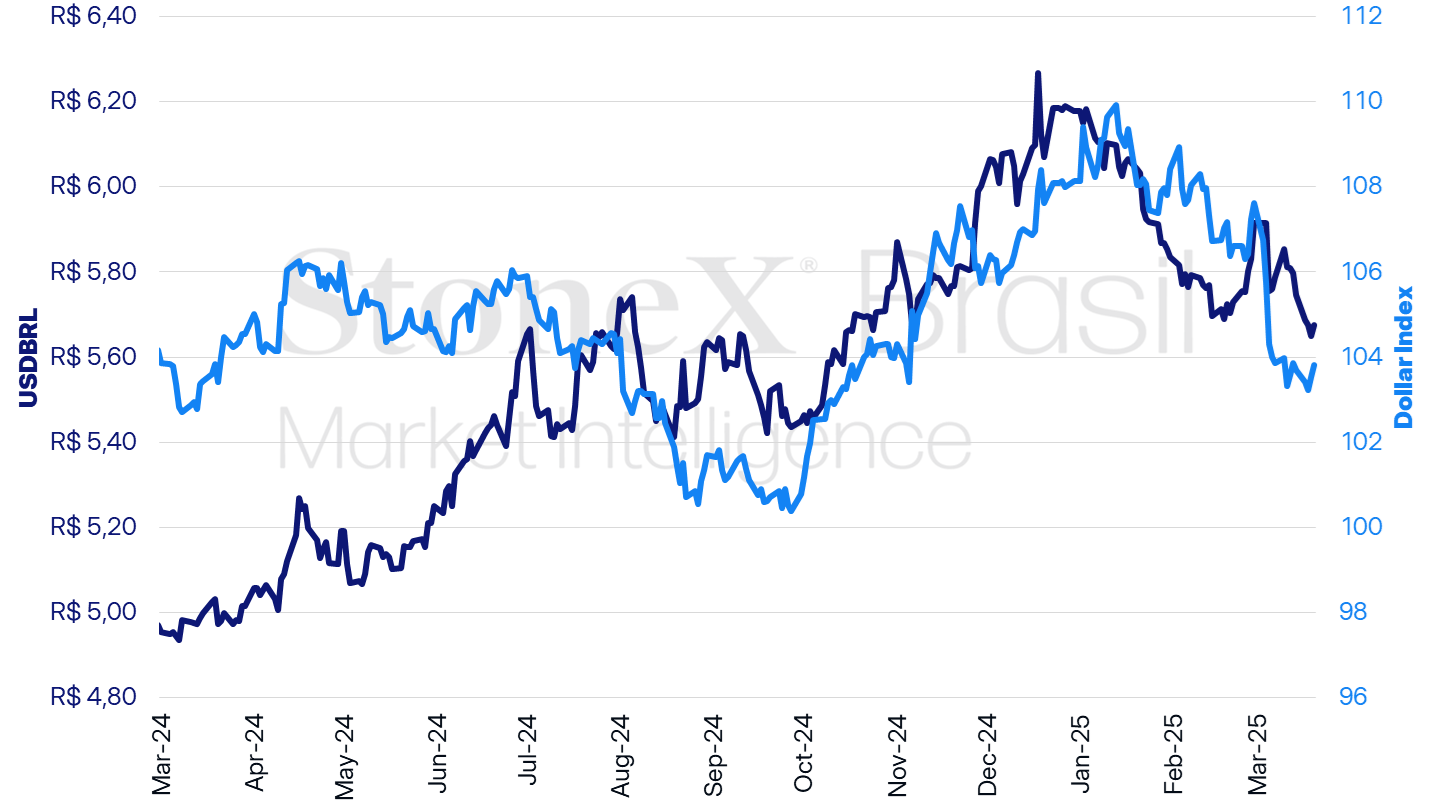
Source: StoneX cmdtyView. Prepared by: StoneX.
KEY EVENT: Copom Meeting Minutes and Monetary Policy Report
Expected impact on USDBRL: Bearish
In Brazil, investors will be awaiting the release of the minutes of the Central Bank's Monetary Policy Committee (Copom) meeting on Tuesday (25th), in which the Committee decided to raise the Selic rate from 13.25% to 14.25% per year, as widely expected by the market. However, the inclusion in the statement of a likely new Selic hike of smaller magnitude at the May meeting surprised some analysts. According to the Committee, the continuation of the tightening cycle is justified "in light of the persistence of an adverse scenario for inflation convergence, high uncertainty, and the inherent lags of the current monetary tightening cycle."
Additionally, the Copom reiterated that recent indicators of economic activity and the labor market still show dynamism, "although some signs point to an incipient moderation in growth." Therefore, investors will look to the minutes for signals on how the Committee views its risk balance, particularly regarding how it intends to act amid persistent inflation and "incipient signs" of economic slowdown.
Furthermore, the Central Bank will release the Monetary Policy Report on Thursday (27th), replacing the previous Quarterly Inflation Report. This is the institution’s most comprehensive document analyzing both domestic and international macroeconomic conditions, with projections for key variables in the coming years. The release will be followed by a press conference with Central Bank President Gabriel Galípolo and Economic Policy Director Diogo Guillen.
Both the tone of the Copom minutes and statements from Central Bank officials are expected to strongly reaffirm the monetary authority’s commitment to price stability, which should solidify expectations of further Selic hikes throughout 2025 and support the strengthening of the real.
Inflation in the US
Expected impact on USDBRL: Bullish
Last week, concerns about a potential slowdown in the US economy were driven by the upcoming implementation of several import tariffs on April 2nd, and the Federal Reserve's monetary policy decision, which highlighted a more uncertain economic outlook and greater risks of both higher inflation and lower growth. This week, investors will closely monitor February’s Personal Consumption Expenditures (PCE) Price Index to gauge future US interest rate movements. Median forecasts point to a 0.3% increase in both the headline and core PCE index (excluding food and energy), the same as in January. This would keep the three-month annualized inflation above 3.0%, potentially reducing the odds of rate cuts by the Fed this year. However, this effect may be weaker than usual, as investors’ current concerns are more focused on economic output dynamics than on inflation itself.
Inflation in Brazi
Expected impact on USDBRL: Bearish
In Brazil, special attention should be given to the February IPCA-15 (Extended National Consumer Price Index-15), for which the median forecast suggests a 0.7% increase. If confirmed, this would represent a deceleration compared to the 1.23% rise in February, when the index reached its highest level since April 2022 (1.73%). Last month, the end of the “Itaipu energy bonus” significantly pushed up the index, contributing to a 16.33% increase in electricity tariffs from the previous month, alongside adjustments in public transportation fares, school tuition fees, and fuel and food prices. Although a slowdown is expected for the index, a 0.7% increase would result in a 12-month accumulated rise above 5%, remaining well above the Central Bank’s inflation target ceiling of 4.5%. Such a scenario could worsen inflation expectations for the year, reinforcing the possibility of further hikes in the Selic rate. In turn, this would increase the appeal of Brazilian assets, encouraging foreign capital inflows and strengthening the real.

INDICATORS