Foreign Scenario
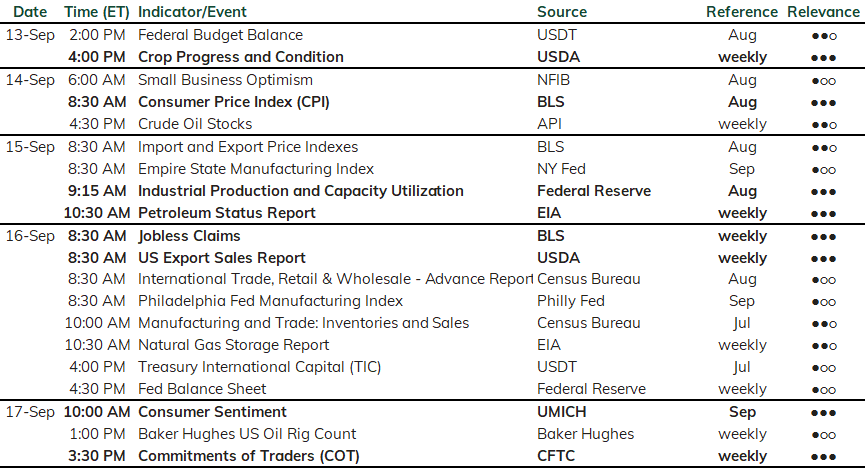
Markets will continue to track inflation indications in the United States this week ahead of the Federal Reserve's September monetary policy decision. This Tuesday, the Bureau of Labor Statistics (BLS) will publish the Consumer Price Index (CPI) data. After a 0.5% rise in July, analysts expect the CPI to advance with less intensity in August, with a projected change of +0.4%, accumulating an annual change of 5.3%. For the core CPI, calculated by excluding food and fuel prices, the median of analysts' estimates indicates an increase of 0.3% in August, repeating the variation registered in July and 4.2% in 12 months.
Last week, the Producer Price Index - Final Demand (PPI-FD), released by the BLS on Friday, registered a deceleration in August, compared to the previous month, but continued to maintain an upward trajectory in 12 months. The indicator advanced to 8.3% in the year-to-date, its highest value since the beginning of the producer-level price survey in 2010. The continued rise in business costs is an important antecedent of consumer inflation. It signals the possibility that the price level dynamics in the US economy will remain supported for longer.
Still, in the United States, this week's highlights are industrial production, retail sales and consumer sentiment data. In addition, the Department of Labor (DOL) will publish the weekly update of first-time claims for unemployment benefits on Thursday (16), which should incorporate the effects of Hurricane Ida, which hit the states of Louisiana and Mississippi as a category four storm and advanced through the Southeast and Northeast of the country between late August and early September. The flooding, transportation shutdown and infrastructure damage caused by the weather phenomenon may timely impact the number of new unemployment claims.
With the beginning of the blackout period, in which members of the Federal Open Market Committee (FOMC) cannot make public statements, the next news from the Federal Reserve will only come out next week, with the release of the September monetary policy decision and the publication of the quarterly projections. Last week, the New York Fed president, John Williams, said that he considers it appropriate for the Fed to begin tapering later this year if the US economy shows signs of improvement. This signal, which could occur at the meeting on November 2-3, would not mean, however, a green light to raise interest rates. “I don't see any decision we make in terms of tapering as indicative of what the timing" will be for lifting rates.
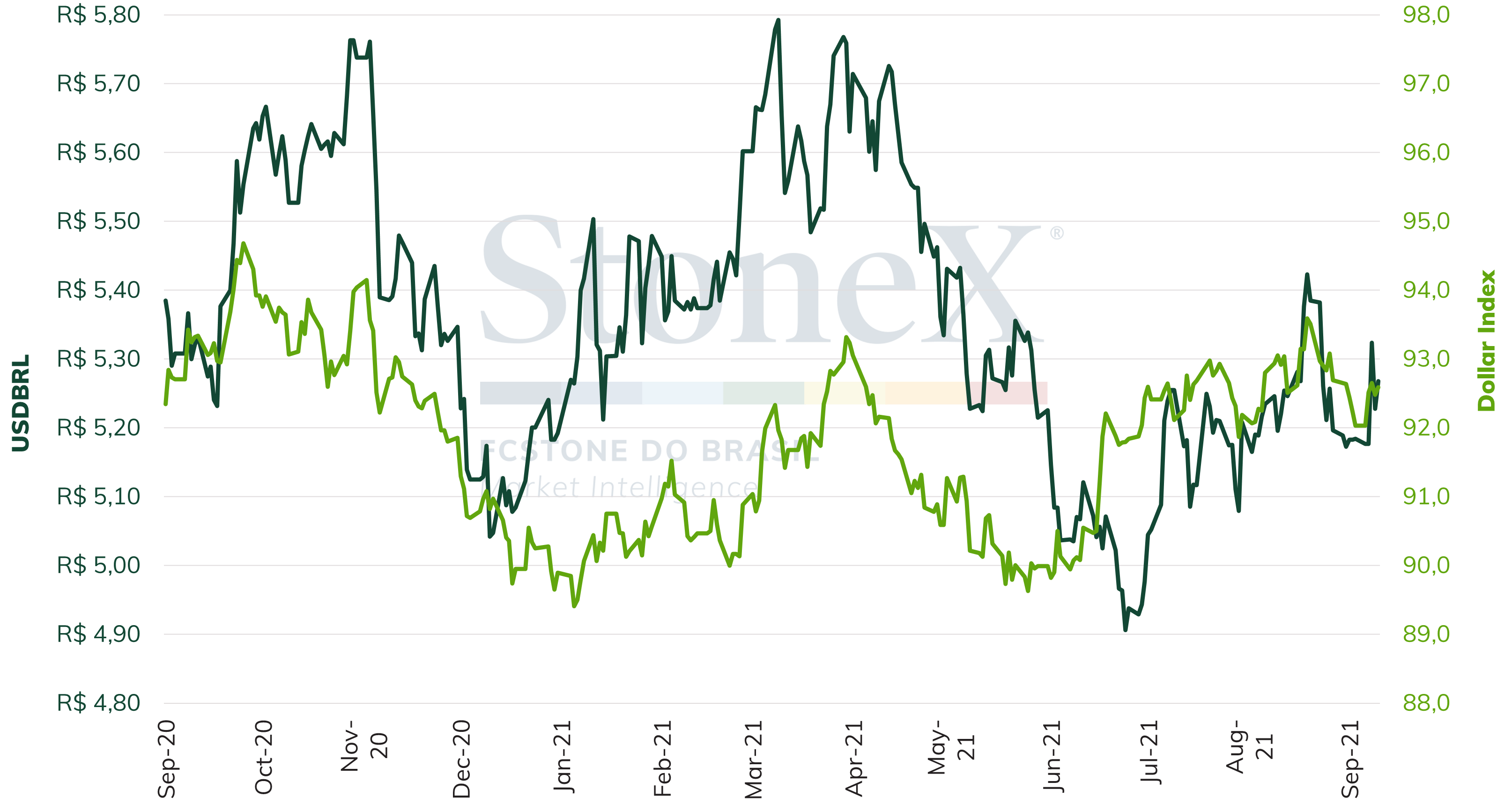
The reading that inflation may be less transitory than the Fed initially expected and the possibility of early withdrawal of part of the stimulus adopted by the monetary authority during the pandemic boosted the dollar against a basket of advanced currencies on Monday. The dollar index approached 93 points at the day's highs, hovering around its highest values since August 27.
Earlier this week, a dovish speech by European Central Bank (ECB) executive committee member Isabel Schnabel also favored the dollar against the euro. Commenting on the revised long-term inflation projections for the eurozone, which were raised at the ECB's last monetary policy meeting last week, Schnabel said that "the prospect of persistently excessive inflation, as feared by some, remains highly unlikely."
Domestic Scenario
The real/dollar pair retreated on Monday, returning to near BRL 5.22 after a very volatile week marked by the heightening and easing of tensions between the branches of government. Following the relatively positive external scenario, and still reflecting President Jair Bolsonaro's walk back after a letter to the nation was released late Thursday afternoon (9), the US currency ended the day down by 0.8%.
As mentioned in previous reports, the market quickly adjusted its expectations for the general price level dynamics and the Selic benchmark rate path, given the strong variation of the Broad National Consumer Price Index (IPCA) in August.
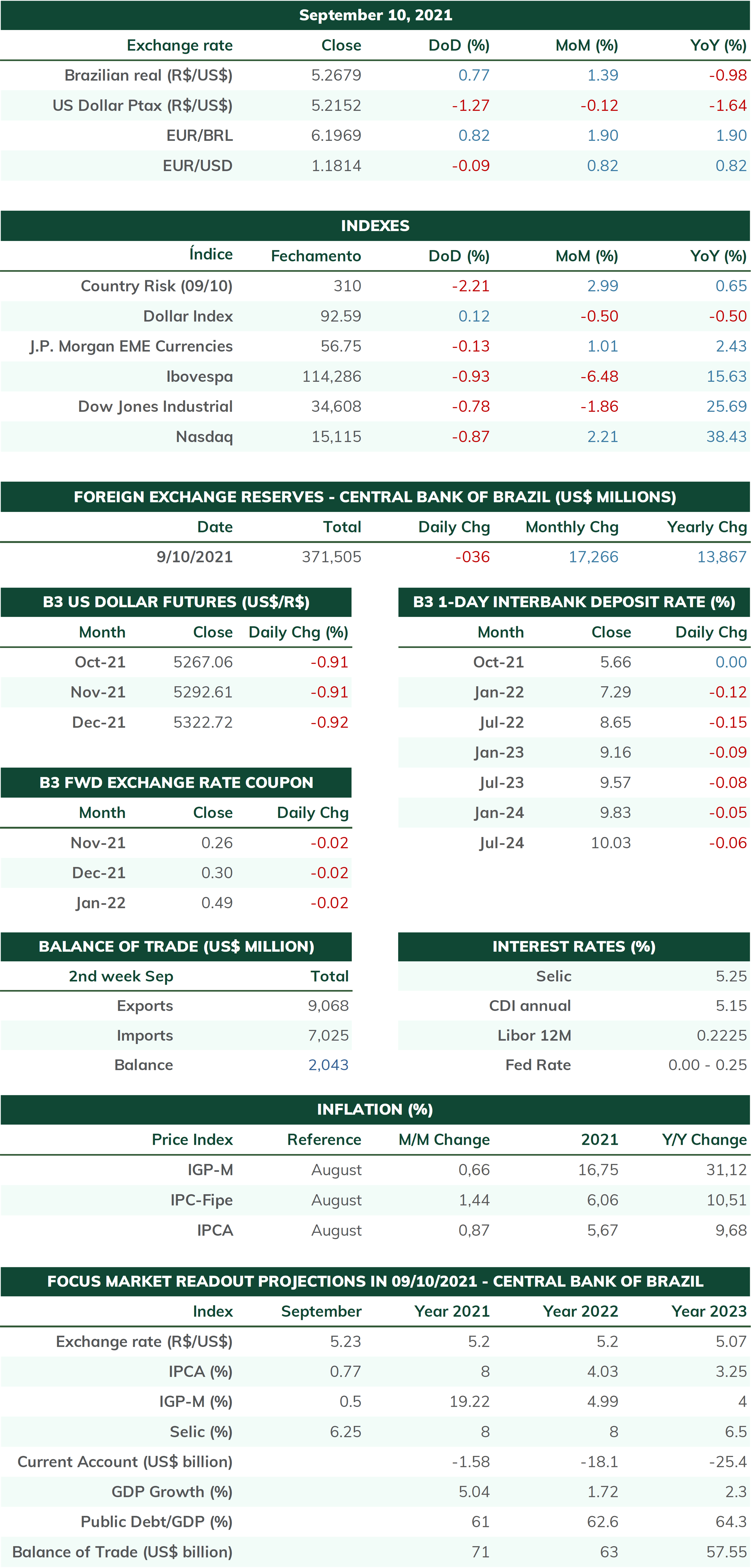
According to the Focus Bulletin published earlier this Friday, the median of economists' projections consulted by the Central Bank of Brazil started pointing to the IPCA at 8.00% at the end of 2021, up from 7.58% a week earlier. Let's consider the median of the most recent updates in the inflation projections, submitted to the Focus survey over the last five business days, representing 60% of the institutions participating in the survey. The consensus suggests that the IPCA may end the year at 8.20%, more than 1 p.p. above the projections collected a month ago.
The estimates also perceive the inflationary acceleration for the index in the coming months. For September, the Focus projections indicate an IPCA change of +0.77%, against +0.61% a week ago and +0.43% a month ago. Considering only the most recent projections, which also correspond to nearly 60% of the statistics that make up the median presented by the Bulletin, the IPCA hike for September is already projected at 0.92%, which would be its highest value for the month since 1995. For October and November, the projections for the index still point to more moderate variations, but still significant, given the context, between 0.40% and 0.50%.
Given the prospect of persistent inflation, analysts once again revised their expectations for the next Monetary Policy Committee (Copom) decisions. Since last week, the projection for the benchmark interest rate at the end of the year was raised to 8.00%, which would be reached by two hikes of 100 basis points in September and October and 75 basis points in December. The most recent adjustment took place in the bets for the last Copom meeting of 2021, raised by 50 basis points in the last few weeks.
Looking at the futures interest market, the projections embedded in the values of the contracts suggest the same trajectory for the Selic. For December, the DI futures pointed on Monday afternoon to an implicit rate of 8.138%, in line with the target expected for the Selic rate by the Focus Bulletin. However, the surprise with the higher than expected figures for the IPCA resulted in considerable changes in the short end (until the end of 2022) of the futures yield curve, which contributed to weighing on the exchange rate.
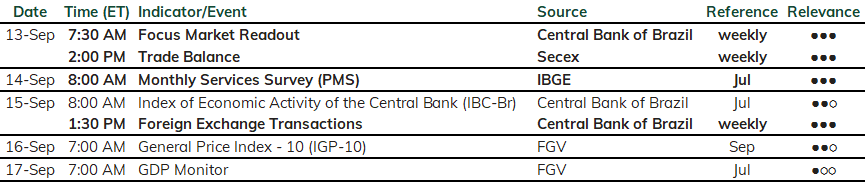
For the next few days, attention should turn to data from the Monthly Services Survey (PMS) to be released on Tuesday (14) and the Central Bank's Economic Activity Index (IBC-Br), both for July. For the PMS, the median of the analysts' estimates points to a growth of 1.0% in the volume of services rendered, less expressive than the 1.7% advance registered in June.
The week in Brasilia should also be busy, after a week marked by important political events. At the Chamber of Deputies, after the end of the term for collective examination, the proposed constitutional amendment of the Administrative Reform (PEC 32/2020) should be voted on and approved in its Special Committee this Tuesday and forwarded to the Plenary and may be examined as early as the first half of October.
The House's Finance and Taxation Committee (CFT) will also put on the agenda the bill that extends the payroll exemption for 17 sectors that benefited during the pandemic (bill 2541/2021), with high chances of approval. The proposal is being resisted by the government's economic team, which does not see a room in the budget for extending the exemption. If the bill passes, adjustments to the Annual Budget Law (PLOA) would be necessary due to the projected reduction in tax collection.
With the escalating tensions between the Executive and the Judiciary in recent weeks, the National Council of Justice (CNJ) and the Supreme Federal Court (STF) have yet to take a position on the agreement negotiated with the Ministry of Economy to extend the payment of judiciary bonds that will expire in 2022. The increase in judicial debt forecast for next year, from BRL 34 billion to BRL 89 billion, has made the government's project to institute a new cash transfer program to replace Bolsa Família unfeasibly. Therefore, it will be necessary to approve the PEC 23/2021, which authorizes the installment payment of judiciary bonds for the following years, to accommodate it in the public accounts. While awaiting the response from the Judiciary, the PEC must go through the Chamber of Deputies' Commission on Constitution, Justice and Citizenship (CCJC) (CCJC), with the possibility of approval of its admissibility in the coming days.
In the Senate, President Rodrigo Pacheco is expected to return the Provisional Measure (MP) 1.068/2021 presented by President Jair Bolsonaro last week that limits the removal of content and profiles of social networks that violate its rules, creating the requirement of "just cause" and "motivation" for such decisions. However, in an opinion to the STF, the Attorney General's Office (PGR) defended the MP effects' suspension until it is fully debated in Congress and by the Court.