Foreign scenario
After the Federal Open Market Committee's (FOMC) monetary policy decision, the focus is fiscal policy. The US Congress needs to pass a resolution before October 1 to extend the Executive's debt ceiling to avoid a government shutdown. The House of Representatives has already approved a resolution that expands this spending capacity until December 3, adding a provision that suspends the public debt limit until December 2022. The measure was approved exclusively with votes from Democratic members (220 votes) in the House, with all Republicans opposing the measure. However, for the resolution to take effect, it must also be approved in the Senate, where 60 votes are needed in an equally divided assembly of 50 Democratic and 50 Republican senators. However, Republicans are refusing to pass a resolution containing this provision.
The debt limit is a law established in 1917 that sets the maximum that the US Treasury Department can issue to pay its expenses. According to that Department, since 1960, Congress has on 78 occasions authorized raising or temporarily suspending the debt limit. The last suspension of the debt limit came in 2019 under the Trump administration. With the fiscal stimulus for recovery from the Covid-19 pandemic, Joe Biden's administration argues that it needs a further extension to bring the public budget into line. Moreover, he justifies that the impacts of measures adopted in the Trump administration still impact the current budget, such as the fiscal stimulus against the pandemic itself, the 2017 tax reform, and the increase in military and defense spending.
Republicans added more than USD 7.8 trillion to the public debt in four years in the Trump administration, but they are resistant to approving the suspension of the public debt ceiling until December 2022 because they argue that the Democrats will use the measure to unilaterally approve their infrastructure stimulus package of up to USD 3.5 trillion over ten years. Since there are no indications that ten Republican senators will support the Democratic resolution, the expectation is that it will be put to the vote in plenary and fail by the end of this week, forcing a government shutdown and provoking swings in the foreign exchange market. After this failure, the most viable alternative seems to be to pass a version of the resolution in the Senate that contains only the extension of the Executive's debt ceiling and that the senators return to the negotiating table regarding public debt.
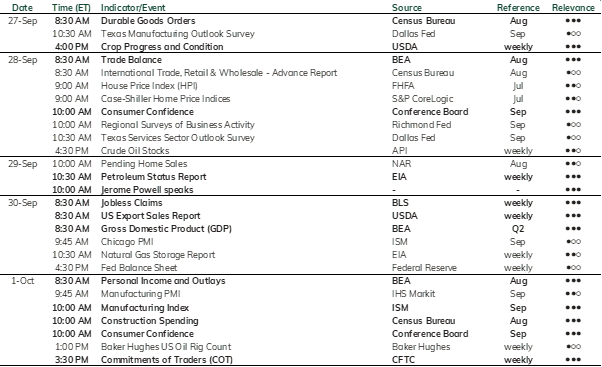
It is also noteworthy that no fewer than thirteen speeches and media appearances by FOMC members such as Jerome Powell, Charles Evans, John Williams, James Bullard, Raphael Bostic, and Patrick Harker are scheduled this week. It will be important to watch how these members will describe the debate surrounding the reduction of the Federal Reserve's asset purchase program, especially about the time horizon for such cuts. As Powell said in an interview last week, such a reduction could be announced at the next FOMC meeting, and the asset purchase program could be terminated by the middle of next year. Depending on the topics covered in these appearances, there may be occasional volatility in the foreign exchange market.
Finally, the foreign exchange market is following with concern the financial situation of the Chinese property developer Evergrande, one of the most indebted companies in the world, with debts exceeding USD 300 billion. According to Reuters, the company failed to pay the interest on dollar-denominated bonds that matured last Thursday (23) after missing the payment of other bonds that matured last Monday (20). The bonds have a 30-day grace period before they are considered effectively unpaid. In addition, the subsidiary China Evergrande New Energy Vehicle Group, an electric car producer, disclosed that without the injection of cash liquidity or the sale of assets, it would lose the ability to pay suppliers and employees, affecting its production capacity.
On Monday (27), in a statement released after the quarterly meeting of the Chinese Monetary Policy Committee, the People's Bank of China (PBoC) made no mention of Evergrande. Still, it included a sentence promising to "safeguard the legitimate rights and interests of housing consumers." Furthermore, according to Reuters, the Shenzhen Financial Regulatory Bureau has sent a letter to investors informing them that it has opened a "thorough investigation" into China's Evergrande and Evergrande Wealth's problems in response to investor demand. In the letter, regulators also urge the company to deal with investors to honor its obligations.
Market analysts debate the contagion effects if the contractor declares bankruptcy since its liabilities are organized in a complex web of financing with banks, bondholders, suppliers, and homeowners. So far, the company's crisis appears to have had little effect on the Chinese credit market. According to Bloomberg, the Chinese central bank acted heavily last week, injecting USD 71 billion in liquidity into the financial system to calm investors. However, the silence of the country's authorities – and the company itself – on the subject contributes to the tone of uncertainty in financial markets since there are no guarantees that the Chinese monetary authority will act to contain Evergrande's bankruptcy. On the one hand, some argue that the Chinese Communist Party will not allow a large-scale crisis in its financial sector. On the other hand, recent interventions by Chinese regulators have been to curb excessive appetite and risk in the sectors, and some argue that saving Evergrande could be misconstrued within the Chinese economy. Therefore, it is believed that if there is an intervention by the PBoC to help the company, it will likely be limited.
Domestic scenario
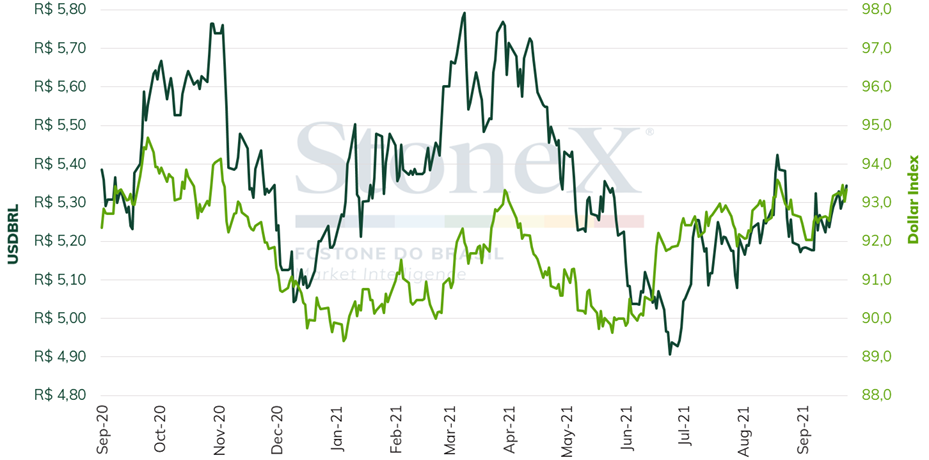
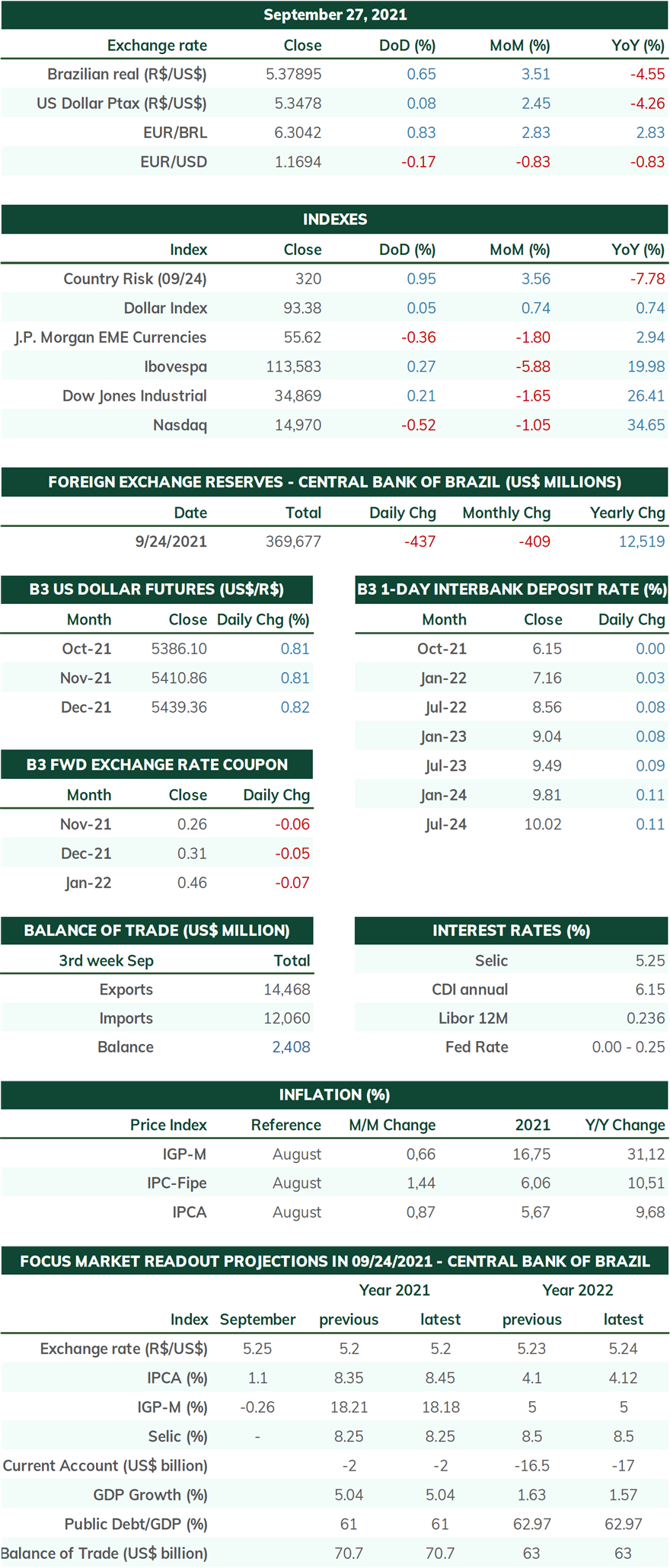
The real/dollar pair appreciated on Monday, ending the day at BRL 5.379, an increase of 0.6% compared to Friday's close (24). The currencies market reflected a strengthening dollar scenario as investors bet on an upcoming monetary contraction by the US monetary authority. As a result, yields for 10-year Treasuries reached 1.516% on Monday, its highest level in three months. On the domestic front, the announcement of a Petrobras press conference for this afternoon raised fears about a change in the fuel pricing policy and contributed to the BRL devaluation. However, the president of the state-owned company, General Silva e Luna, stated that this would not happen, which helped the exchange rate retreat slightly before the end of the session.
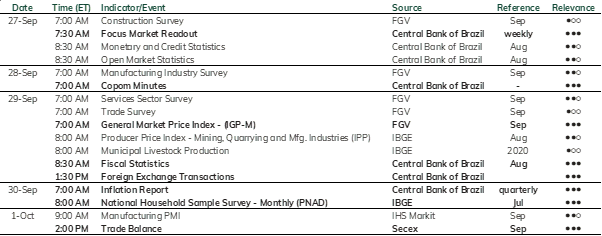
On Tuesday (28), the Central Bank of Brazil is expected to release the minutes for the Copom meeting in which the Committee raised the Selic rate from 5.25% per year to 6.25% per year and indicated that it should make another adjustment of the same magnitude in the next monetary policy decision meeting to be held in October. The decision was made due to the high inflation rates, which are more persistent than previously anticipated. In a statement following its decision, Copom explained that the acceleration in price levels has several underlying causes, such as i) the increase in prices of industrial goods, which, in turn, are the result of logistical bottlenecks and supply restrictions in the face of strong demand; ii) pressure from volatile commodities, such as fuels and food; iii) the water crisis, which raises the cost of food production and electricity; and iv) a devalued exchange rate, which puts pressure on the cost of imported inputs and goods. "Copom considers that, at the current stage of the interest rate hikes, this pace of adjustment is the most appropriate to ensure the convergence of inflation to the target over the relevant horizon and, simultaneously, to allow the Committee to obtain more information about the economy and the degree of persistence of shocks.", said the Committee.
The readjustment was in line with recent statements by the BC's president, Roberto Campos Neto, that it does not intend to change its action plan with each new inflation data but that the central objective of its actions is the economy's price stability. By indicating that "at this moment, it is appropriate that the monetary tightening cycle advances in contractionary territory," the Monetary Policy Committee (Copom) stated that it would act firmly to bring the level of price increases to the center of the institution's target.
This week, it will be important to pay attention to the General Price Index - Market (IGP-M) release on Wednesday and the Quarterly Inflation Report on Thursday. The IGP-M, which accumulates an increase of 31.12% in the last 12 months, should present a rare negative acceleration this month due to the strong retraction in the price of iron ore and its high weight within the Wholesale Price Index. The median of the Focus Bulletin, which collects the expectations of financial institutions, points to a change of -0.26%. Meanwhile, the Quarterly Inflation Report will provide detailed information on the analyses that underpin Copom's decisions and the outlook for the near future.
Finally, this week will hold the release of data for the labor market in Brazil. On Thursday (30), both the General Cadastre for Employed and Unemployed (Caged) from the Ministry of Labor and Social Security and the Continuous National Household Sample Survey (PNADc) will be published. Caged reveals only the reality of the formal job market and should be highlighted by the government since the numbers are likely to be positive. At the same time, the PNADc data expresses in greater depth the labor market by considering all occupation categories used to measure the official unemployment rate.