Foreign scenario
The spotlight is on the Capitol. Last week, the US Congress avoided the risk of a government shutdown by agreeing in the last hours on a resolution to extend the spending capacity of the Executive. Should no resolution be passed before Friday (01), most American public services would be forced to stop operating due to lack of funding. To that end, the Democrats gave in by separating the approval of the Executive's spending capacity from the suspension of the public debt limit, originally proposed until December 2022. The debt limit is a law established in 1917 that sets the maximum that the US Treasury Department can issue to pay its expenses. According to that Department, since 1960, Congress has on 78 occasions authorized raising or temporarily suspending the debt limit. The last suspension of the debt limit came in 2019 under the Trump administration. With the fiscal stimulus for recovery from the Covid-19 pandemic, Joe Biden's administration argues that it needs a further extension to bring the public budget into line.
Moreover, he justifies that the impacts of measures adopted in the Trump administration still impact the current budget, such as the fiscal stimulus against the pandemic itself, the 2017 tax reform, and the increase in military and defense spending.
Before the House Financial Services Committee, Treasury Secretary Janet Yellen warned members of US Congress that unless the debt limit is raised or suspended by October 18, the country will default for the first time in its history – it will fail to honor its obligations to investors. Yellen warned that any US debt default would cause irreparable damage, as well as a financial crisis and recession. The Secretary even supported the removal of the public debt limit, stating that if Congress approves taxes and public spending, it is "very disruptive to put the president [Biden] and myself, the Treasury secretary, in a situation where we might be unable to pay the bills that result from those past decisions [of congressmen]." One measure considered the last option would be carrying out a so-called "reconciliation" of the budget to raise the debt limit. However, this move can only be done with the votes of Democrats and takes between two and three weeks, approximately, because it is not a usual procedure. As a result, Democratic senators are seeking to avoid the measure.
The Republicans, whose during Trump administration added more than USD 7.8 trillion to the public debt, are resistant to approving the suspension of the public debt limit until December 2022 as they argue that Democrats will use the measure to unilaterally approve their infrastructure stimulus package of up to USD 3.5 trillion over ten years. The Democratic congressmen seek to make the infrastructure package viable, one of President Biden's promises, but it will be funded over ten years. For the resolution to take effect, it must be passed in the House, where the Democrats have enough votes to pass the measure, and in the Senate, where 60 votes will be needed in an equally divided assembly of 50 Democratic and 50 Republican senators. Apparently, since there are no indications that ten Republican senators will support the resolution, that would force the Democrats to use budget "reconciliation," a bureaucratic maneuver, which takes one to two weeks to accomplish, and which could raise (but not suspend) the government's debt ceiling provisionally. Due to the deadline to avoid a debt default, this should occur at the beginning of this week.
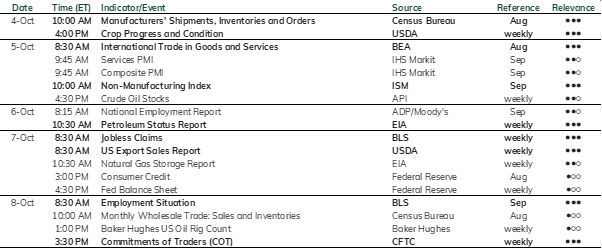
This week, the foreign exchange market will follow the release of the US employment situation report. After a below expectations result in August, when net job creation stood only at 235,000, expectations for September are more moderate, with the median pointing to 475,000 new jobs created. The creation of new jobs should be moderated by the effects of the delta variant on economic activity and the aftermath of Hurricane Ida, which passed through the southern US in early September. However, these effects should cool down in the last months of the year, resulting in the acceleration of job creation in the country. Another important indicator for the United States this week will be the Services Index, published by ISM. It will allow an updated reading on the impacts of the pandemic on the speed of reopening of the US economy. The median of expectations points to a slowdown in the pace of growth, going from 61.7 points in August to 59.9 points in September (readings above 50 indicate expansion in the sector).
In any case, unless the results are much lower than expected, the week's indicators should not affect the Federal Reserve's plans to start reducing the pace of its asset purchase program, one of its main instruments for monetary stimulus. The US central bank is currently buying USD 120 billion of securities from market players, USD 80 billion of Treasury bonds and USD 40 billion in mortgage-backed securities monthly. Although it has only indicated that such a reduction will begin "soon," many analysts believe the Fed should begin this cut as early as November, reducing purchases of Treasury bonds by USD 10 billion, and USD 5 billion in mortgage-backed securities.
Finally, the foreign exchange market is following with concern the financial situation of the Chinese property developer Evergrande, one of the most indebted companies in the world, with debts exceeding USD 300 billion. On Monday, the company's shares trading was suspended in Hong Kong after the company missed payment of another dollar-denominated bond, the second in two weeks. On the other hand, the Chinese state media Global Times announced that the suspension of trade was a request by the company due to the sale of majority control of one of its property management companies. According to the state media, Hopson Development, which reportedly requested the suspension of trading of its shares while it finalizes this acquisition, would acquire 51% of Evergrande Property Services Group for about USD 5 billion in local currency. Although no statement has been issued by the companies involved, analysts fear that Evergrande is liquidating assets at prices below their true value to get an immediate cash flow and not go bankrupt.
Market analysts are increasingly close to default and debate the contagion effects if the contractor declares bankruptcy since its liabilities are organized in a complex web of financing with banks, bondholders, suppliers, and homeowners. So far, the company's crisis appears to have had little effect on the Chinese credit market. However, the silence of the country's authorities – and the company itself – on the subject contributes to the tone of uncertainty in financial markets since there are no guarantees that the Chinese monetary authority will act to contain Evergrande's bankruptcy. On the one hand, some argue that the Chinese Communist Party will not allow a large-scale crisis in its financial sector. But, on the other hand, recent interventions by Chinese regulators have been to curb excessive appetite and risk in the sectors, and some argue that saving Evergrande could be misconstrued within the Chinese economy. Therefore, many believe that if there is an intervention by the Chinese Central Bank to help the company, it will probably be limited.
Domestic scenario
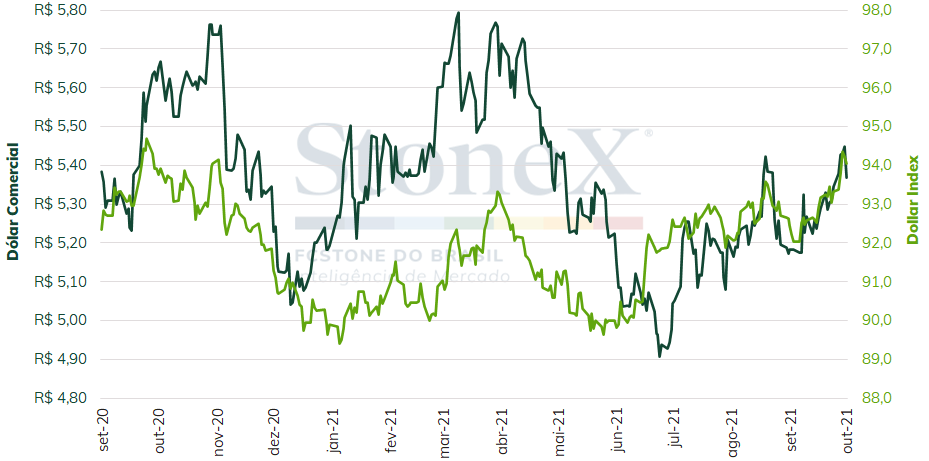
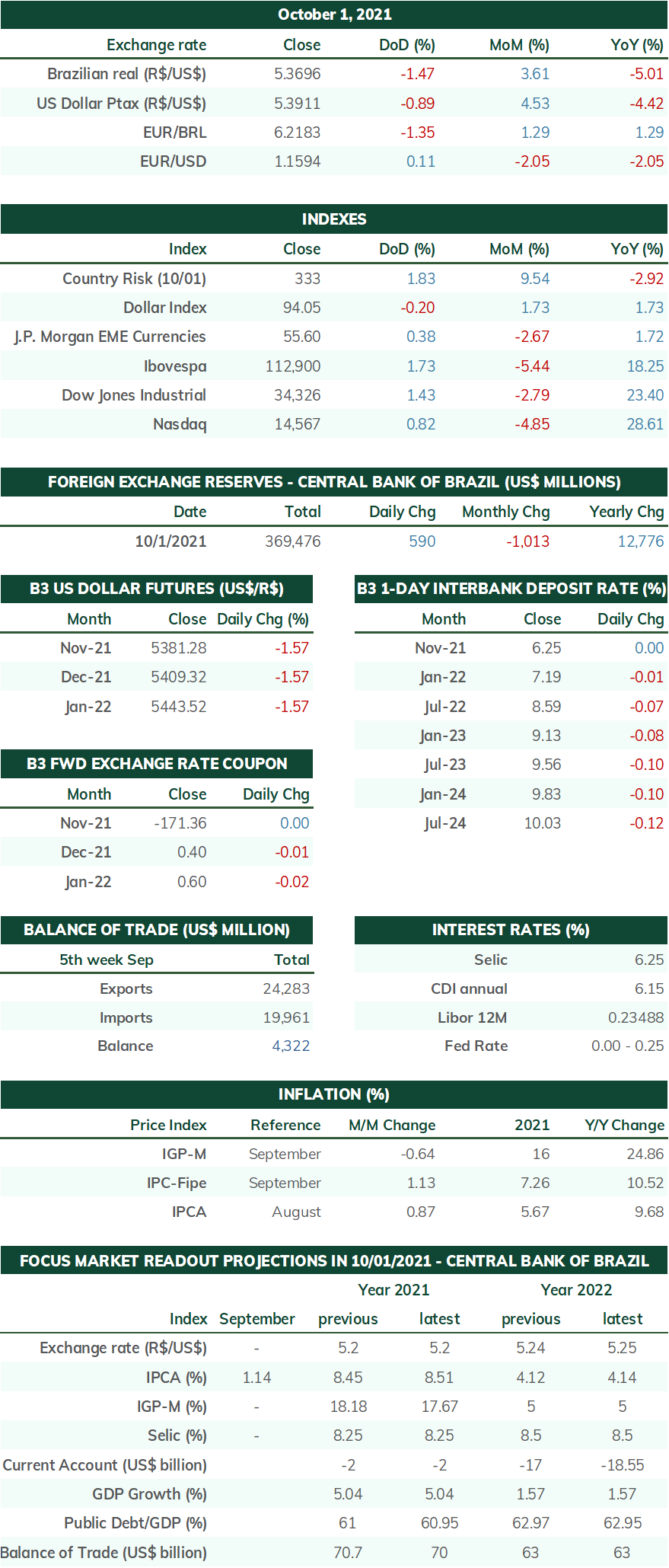
The real/dollar pair appreciated on Monday, ending the day at BRL 5.447, an increase of 1.4% compared to Friday's close (01). The foreign exchange market reflects the cautious environment, with the barrel of oil reaching its highest value in four years, which will put pressure on energy costs globally. In addition, the uncertainty about the public debt limit in the US contributed to the lower risk appetite of investors, while the disclosure of the "Pandora Papers" leaked financial documents about investments in tax havens of world leaders and authorities also caused noise worldwide.
Almost one year before the elections, the fuel issue has become the main agenda of President Jair Bolsonaro and one of his main allies, the president of the Chamber of Deputies, Arthur Lira (PP-AL). A few weeks ago, Lira had summoned the president of Petrobras, General Joaquim Silva e Luna, to testify before the Chamber plenary about the situation of fuel and LPG prices, something quite unusual. Last week, the president of the Chamber met with the president of the Senate, Rodrigo Pacheco (DEM-MG) and with representatives of the Executive to discuss alternatives to contain the rise in fuel prices.
The idea with the largest adhesion is the one that seeks to fix the value of the ICMS instead of calculating it as a tax rate. This proposal can be worked on through the bill PLP 11/2020, presented by Congressman Emanuel Pinheiro Neto (PTB-MT), although the proposal faces much resistance from governors. Last week, Economy Minister Paulo Guedes advocated for creating a repayment fund composed of dividends from state-owned companies, exactly as discussed in the proposed constitutional amendment (PEC) of judiciary bonds, since these funds count as extraordinary revenues and are not accounted for within the spending cap.
In the Federal Senate, this may be the last week of depositions of the Parliamentary Commission of Inquiry (CPI) of the Covid-19 pandemic, which is heading towards its conclusion. Since its beginning on April 27, it has worked for almost 20 weeks, each with about three deponents. Given the number of witnesses and investigated, it is already expected that Senator Renan Calheiros' (MDB-AL) report will also be very long. So far, the information is that it is about 1500 pages, divided into five sessions. The vote on the text is scheduled for October 20.
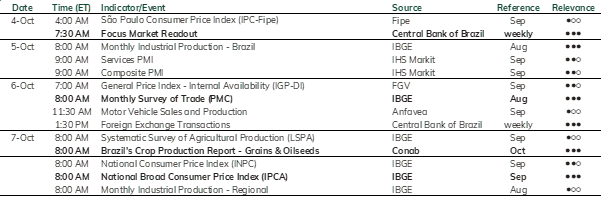
On Monday, the president of the Central Bank of Brazil, Roberto Campos Neto, reinforced that the commitment to the sustainability of public accounts and clear communication about the country's reforms are necessary to combat inflation. "At this moment, we need more credibility. We need to communicate what the fiscal and medium-term plans will be. I think it is important to turn the page on the issue we have, which is the continuation of what was done in terms of the confrontation program until the end of the government", stated Campos Neto at an event. The president of the Central Bank argued that this would be the time to "turn the page" regarding the fiscal programs established to combat the pandemic, such as the emergency aid. "So it's not about understanding that I'm going to keep injecting money into the economy and that this is going to be the great gold rush. There is no such thing. On the contrary, there comes a time when you reach an inflection point that doing more means less." This week, the Broad Consumer Price Index (IPCA) publication should increase the debate about the Central Bank's contractionary monetary policy stance. In particular, whether the pace of increases made by the Monetary Policy Committee will be fast enough to bring the price level for 2022 within the monetary authority's target.
Finally, it is worth noting that over the weekend, a leak of sensitive financial documents indicated that both Paulo Guedes and Roberto Campos Neto maintain investments in "offshore" companies, i.e., in tax havens. As of January 2019, Guedes would own USD 9.55 million, and Campos Neto would own USD 1.09 million. Although investing in accounts or companies abroad is not illegal (as long as it is declared to the tax agencies), the presence of investments by public officials abroad can give the impression of conflicts of interest. Campos Neto said in a note distributed by the Central Bank's press office that the companies mentioned in the journalistic investigation were established more than 14 years ago and that the assets were declared to the Revenue, the Public Ethics Commission, the Federal Senate and the Central Bank, with the collection of the due taxes. Furthermore, the Ministry of Economy said that all Guedes' activities in the private sector before taking over the portfolio were declared to the Internal Revenue Service, the Public Ethics Commission, and other competent bodies.