Foreign scenario
Next week's focus will be on the Omicron variant (B.1.1.529) of Sars-CoV-2, detected for the first time in South Africa on Wednesday (24) from genetic sequencing of a November 9 sample. Other cases of the same variant have been identified in Botswana, Hong Kong, Israel and Belgium. Global authorities are alarmed by the number of mutations in this particular variation, which could mean, in theory, differences in its ability to infect, symptoms caused, mortality, and resistance to vaccines. However, according to a note released by the World Health Organization today, preliminary data suggests that the risks of reinfection are higher. For that reason, it has classified it as a variant of concern – only the fifth to be so classified out of more than a hundred variations of the coronavirus that have been identified so far.
On Friday, countries including the United States, Canada, the European Union, Britain, Israel, Japan, India, and Singapore imposed restrictions or bans on flights from South Africa and neighboring countries, despite protests from South African Health Minister Joe Phaahla, who called the measure unjustified. However, the authorities have warned that it may take weeks to learn more relevant information about the new B.1.1.529, and caution should be exercised until then. They also warn of the difficulties in advancing vaccination rates on the African continent. The pandemic will only cool off globally when vaccination is spread to all countries, precisely to reduce the risk of mutations.
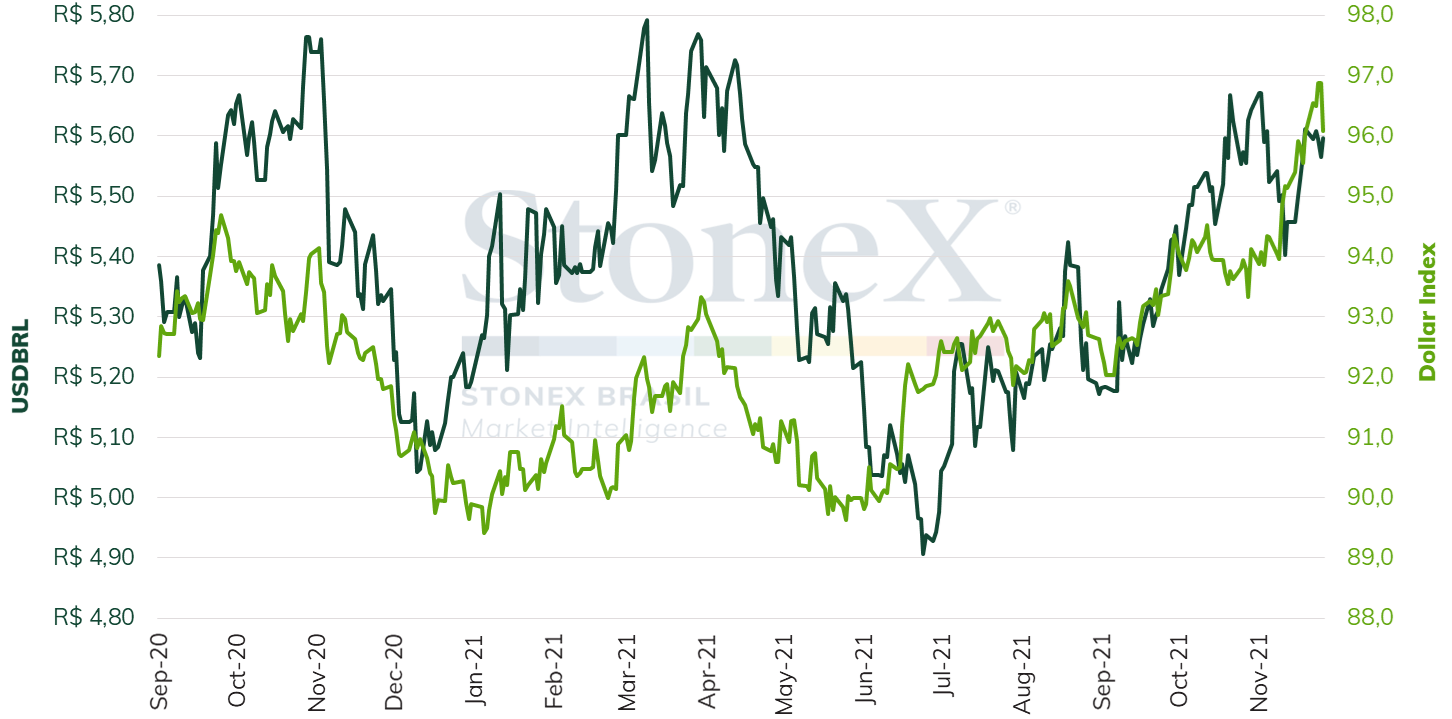
The degree of concern from health authorities and the intensity of responses by countries threw global asset markets into a search for safety and strong risk aversion during Friday's session. As a result, riskier assets, such as emerging countries' currencies, linked to hospitality, tourism and out-of-home food services and linked to energy matrices were heavily penalized, with pronounced declines throughout the session.
Next week, the Federal Reserve (Fed) Chairman, Jerome Powell, will testify to the US Congress after being nominated for a second term at the head of the institution by US president Joe Biden. If before we could expect questions about the acceleration of inflation in the country and its recovering labor market, likely, questions about the uncertainty caused by the wave of coronavirus in Europe and by such an aggressive coronavirus mutation will occupy much of his speech. Before the Omicron, there were questions about the speed at which the US central bank was withdrawing its monetary stimulus and whether price levels might not justify faster monetary contraction. However, at this point, the world's monetary authorities may adopt a more cautious stance before proceeding with changes.
It is important to highlight that the US Congress returns from recess next week with a full schedule, including extending the federal government's spending capacity to avoid another shutdown, tackling again the public debt limit, which runs out in mid-December, and passing the "Build Back Better" bill, a USD 1.75 trillion package to fund the expansion of public health care, childcare, housing, and renewable energy production, in the Senate.
Domestic scenario
Next week's schedule will be loaded with important indicators for the macroeconomic reading of the country. Inflation markers will be released with the General Price Index - Market (IGP-M), Fipe's Consumer Price Index and Producer Price Index, unemployment rate, occupation level and income with the National Household Sample Survey and economic activity data with the third-quarter GDP, monthly industrial production and Purchasing Manager's Index (PMI) for industry, services and consolidated data. However, the political news should also be important for the foreign exchange market movement next week, with three major projects being voted on in the Senate.
The most sensitive topic is scheduled for November 29, in a rare Monday plenary session, which usually only occurs in cases of great parliamentary interest. On this day, the joint act written by the Board of Directors of the Chamber and the Federal Senate is scheduled to be examined, which proposes changes to the resolution that regulates the Joint Budget Committee (CMO) and, in theory, determines that the names and actions of congressmen who indicate amendments to the Public Budget through the general rapporteur (RP-9), known as "secret budget," will be published on the CMO's website. However, in disobedience to the decision of the Supreme Court (STF) to give broad publicity to the rapporteur-general amendments committed during 2020 and 2021, the text makes it explicit that it will not open the retroactive information on which parliamentarians made indications for sending resources to their bases. In it, Lira and Pacheco argue that, before the deliberation of the STF, "[there was] no law to formally register the thousands of demands received by the General Rapporteur with the suggested allocation of resources by parliamentarians, mayors, governors, Ministers of State, associations, citizens, formulated in the day-to-day dynamic exercise of the mandate." They suggest, therefore, that there was no record of the requests made by letter by these parliamentarians to the general rapporteur of the Public Budget in Congress, as revealed by the newspaper O Estado De São Paulo in May this year.
The disobedience to an order of the Supreme Court, in a collegiate decision, can again lead to an institutional crisis between powers, especially since it has already been suggested by the President of Brazil himself, Jair Bolsonaro, in September that he, too, could disregard orders from the STF. Pacheco and Lira read the act and tried to vote on it immediately on Thursday night in the Senate Plenary but failed due to pressure from senators who demanded familiarity with the proposal. Thus, the consideration was rescheduled for Monday (29). For the president of the Chamber, however, it is not up to any other Power, except the Legislative, to deal with the rules of the Budget, which is public, even though all the STF ministers have ruled on the subject and ordered otherwise. "Budget execution is carried out by the Executive Branch, in common agreement with the law approved by the Legislature. Legislating on the Budget is an essential, unique and specific function of the Legislative Power, and it is not up to any other Power to deal with its rules", he said today in an interview. The budgetary execution of these amendments has been suspended since November 5, and their resumption depends on the judgment of the motion for clarification filed by Congress with Minister Rosa Weber.
Institutional conflicts, in general, increase the degree of insecurity for investors and can result in higher risk premium requirements, which, in turn, can harm the entry of foreign exchange into the country and increase the exchange rate level.
This week, the government leader and rapporteur of the PEC dos Precatórios, senator Fernando Bezerra Coelho (MDB-PE), read in the Senate's Commission on Constitution, Justice and Citizenship (CCJC) its opinion containing seven changes compared to the basic text approved in the Chamber of Deputies, with three changes in the wording and four amendments of merit, namely: (i) the forecast to make the adjustment of USD 400 for Auxílio Brasil permanently (and not only until December 2022); (ii) the "explicit link" that the funds to be released with the proposed constitutional amendment (PEC) will be used for the social program and obligatory expenses (and not for civil servants' adjustment); (iii) the mandatory provision of spending on court orders until April 2 for inclusion in the Budget Guidelines Law (LDO); (iv) the creation of a joint commission responsible for the "analytical and partial examination of the acts, facts and procedures that generated the judiciary bonds"; (v) the use of third-party rights, "liquid and certain", as a possibility to settle court orders, as long as recognized by the creditor party; (vi) the "preservation" of priorities approved in the Chamber of Deputies, maintaining the payment of Small Value Requisitions (RPV) of the elderly, for the Fundeb judiciary bonds; and (vii) the payment of Fundef's court orders through a salary bonus to "prohibit the incorporation" of this resource "in remuneration, retirement or pension".
However, even with the changes previously negotiated with the leaders of other parties, the government could not move forward with the proposal in the Commission. Several senators requested more time to read the new version, to which collective views were granted to the text, which will only return for a vote in the CCJ next Tuesday (30). Now, the government must sit down again for negotiations, seeking to secure support for the project, considered one of the most important for the Planalto Palace this year. Today, the president of the Senate, Rodrigo Pacheco (PSD-MG), did not guarantee that the measure would be voted on next week. "I can't guarantee [appreciation next week]. It has to fulfill the stage of the Constitution and Justice Commission. Finished in the Commission, it goes to plenary and, as soon as it arrives, I will have a sense of urgency concerning the PEC because it needs to be appreciated," said Pacheco at a press conference.
Finally, the Senate needs to consider the Provisional Measure (MP) 1061/21, which created the Auxílio Brasil basic income transfer program to replace Bolsa Família by December 7. An MP has immediate validity, but it loses its effect when not validated by the Chamber and Senate within 120 days. This week, the Plenary of the Chamber of Deputies approved the basic text of Deputy Marcelo Aro for the MP by 344 votes in favor and none against it. However, the approved text does not define the value of the program's benefit (this definition is left to the PEC of judiciary bonds, currently being processed in the Senate), nor does it establish its indexation, i.e., its automatic correction by the National Consumer Price Index (INPC). The text also removed the limit of 5 beneficiaries per family stipulated in the original provisional measure, included nursing mothers as possible beneficiaries, and increased the income limits for inclusion of eligible families from BRL 100 to BRL 105 as the extreme poverty threshold and from BRL 200 to BRL 210 for the poverty threshold. With the new limits, Auxílio Brasil will serve 17 million families.
Moreover, the approved text prevents queues from forming for the inclusion of families if they meet the conditionalities required for registration in the program, such as completion of prenatal care, compliance with the national vaccination schedule and monitoring of nutritional status, and minimum school attendance. Finally, another point removed from the text, in a nod to the opposition, was the possibility of beneficiaries contracting payroll loans. The original proposal allowed up to 30% of the benefit to be discounted directly to pay off a loan.