Foreign scenario
This week, attention should turn to the US Senate confirmation hearings of Jerome Powell for Federal Reserve chair on Tuesday and Lael Brainard for vice-chair. Powell has been nominated for a second term, while Brainard would be elevated to vice-chair. The monetary policy decision minutes released last week were markedly tough on inflation, indicating that the monetary authority should use a combination of measures – interest rate hikes along with a reduction in the size of the institution's asset balance – to reduce the economy liquidity and contain price acceleration. The hearings will allow Powell and Brainard to provide more detail on how they envision these policies playing out over the year and how the Federal Open Market Committee (FOMC) is envisioning reducing these balance sheet assets. The market analysts expect the first interest rate readjustment to occur as early as the March FOMC meeting. The balance sheet contraction will be carried out passively as of September, that is, with the Fed allowing the bonds to mature not be replaced by new ones.
In addition to the hearings, next week holds the Consumer Price Index (CPI) data for the United States, which should maintain its pace of acceleration and validate the concerns of the US central bank. The CPI is expected to surpass the 7.0% threshold on a twelve-month accumulated basis. Although the wave of infections of the Covid-19 omicron variant may have negatively impacted the price of some service sectors, the automobiles and electronic goods prices should continue to rise due to the prolonged shortage of inputs. Food and energy, volatile categories that have accumulated significant increases in recent months, should also contribute to the increase of the indicator.
Domestic Scenario
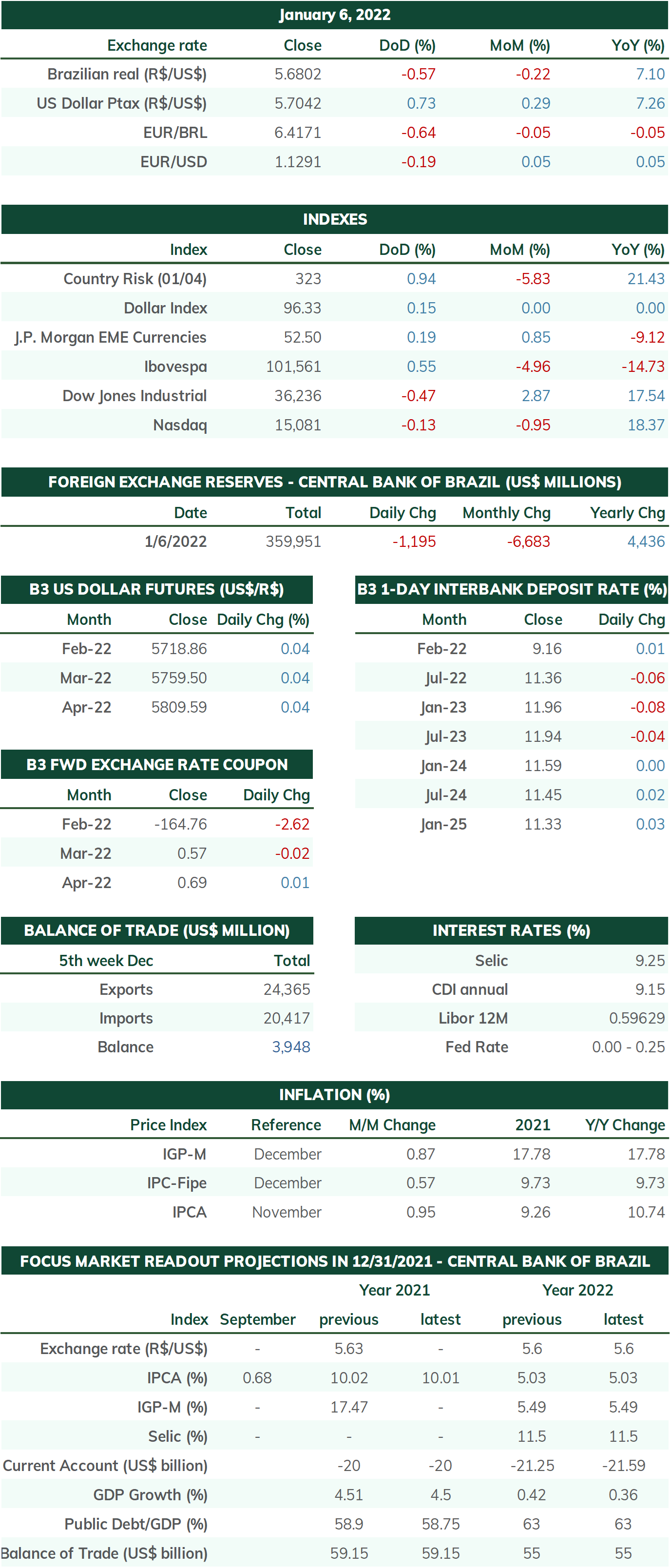
Inflation will also be a highlight in the domestic scenario, with the release on Tuesday (11) of the National Broad Consumer Price Index (IPCA) for December. The median of the financial institution's estimates collected by the Central Bank of Brazil's Focus survey points to an increase of 0.68% in December, which would bring the 2021 index to 10.01%, its highest value since 2015. As the IPCA will be above the 5.25% target for the year, by determination of the decree that establishes the target regime (decree No. 3088/1999), the president of the Central Bank, Roberto Campos Neto, will write an open letter to the Minister of Economy, Paulo Guedes, detailing the causes of non-compliance, the measures he intends to take to converge inflation within the established limits and in what timeframe he expects this convergence. For 2022, the Focus expects a reduction in the IPCA rate to 5.02% for the year, which would, however, exceed the upper limit of the 5.00% inflation target.
Another topic that should remain relevant is the impasse over the 2022 Budget due to the pressures of several civil service categories for an adjustment this year. After a request by President Jair Bolsonaro, the Annual Budget Law, approved by Congress on December 21, 2021, included BRL 1.7 billion for the adjustment of only the federal security categories, that is, the Federal Police, the Federal Highway Police, and the National Penitentiary Department. However, the reaction among other public servants was not positive: the Special Department of Federal Revenue of Brazil, which had been promised a readjustment this year, was the first to mobilize, approving in assembly the paralysis of all national and regional projects of the body, the adoption of standard operation in customs, the indicative shutdown of activities, the target zero (not reaching any target), the non-filling of management reports and the support of the apparent surrender of all positions in commission and management positions of the Federal Revenue. Subsequently, the Permanent National Forum of State Typical Careers (Fonacate), which brings together 37 associations and unions and represents about 200 thousand public servants, defined a first general strike on January 18 and, if there is no progress in the negotiations, another strike on January 25 and 26. If there is still no progress, Fonacate intends to hold new assemblies in the first week of February to deliberate on a general strike. Subsequently, other categories adhered to the strike indicative on January 18 and the resignation of management, leadership, and commission positions, such as the Central Bank employees and the Labor auditors.
Finally, it should be noted that cases of Covid-19 have been increasing in Brazil at the same time as a flu epidemic, but that it is difficult to keep up with official statistics due to the unavailability and instability of systems affected by the December 10 cyberattack, such as e-SUS Notifica, SI-PNI, and ConecteSUS. Furthermore, no data released after that date are on the Ministry of Health platforms, which claims they are being recorded but cannot display them.