Foreign Scenario
Financial markets continue to watch the war between Russia and Ukraine, which has entered its second month with little clarity on how it may evolve going forward or what alternatives may shorten its conclusion. Still, its headlines will certainly bring volatility to these markets. Last week, an extraordinary summit between the G7 countries, the European Union and the North Atlantic Treaty Organization (NATO) brought another round of economic sanctions against Moscow, as well as statements from the leaders of these nations warning the Kremlin against the use of biological, chemical and nuclear weapons on Ukrainian territory. Nearly four million Ukrainians have already fled the country. On the battlefront, the situation appears to be at a standstill, with neither side able to gain much ground, and the Russians persist in an inhumane strategy of besieging cities, depriving them of basic supplies, and maintaining a long-distance assault of artillery, missiles, and bombs against civilian and military targets.
In reaction to the dozens of sanctions imposed by what it calls "hostile nations," Russia has declared that it will require payment in rubles for its oil and natural gas exports destined for these nations instead of the currencies originally stated in the contracts. This is an attempt to "decentralize" the role of the Russian Central Bank, i.e., to pass on to private banks the task of transforming foreign currency into Russian rubles, perhaps as a way to evade sanctions or perhaps to increase demand for Russian currency and help its international value recover. However, whether European banks will accept this imposition is unclear, as is whether Russia would stop supplying these products if it does not receive them in rubles.
In the United States, next week will bring some relevant economic indicators that could affect the domestic currency market. Firstly, the release of the March employment situation report should indicate the maintenance of high hiring of new employees and the unemployment rate below 4.0%, signaling a heated labor market and close to full employment, resulting in the growth of the average hourly wage. In addition, there will be the release of the Personal Consumption Expenditure Price Index (PCE), the Federal Reserve's preferred indicator for assessing inflation in the US, whose median expectation is for a new acceleration from 6.1% to 6.5% in the accumulated over twelve months.
Attention should also continue to the public statements made by members of the Federal Reserve (Fed) as analysts try to gauge the degree of support for one or more adjustments of 0.50 percentage points in the basic interest rate in the United States, the federal funds rate. Normally, the adjustments are made at a pace of 0.25 p.p., but the price acceleration that the country is going through is the biggest in four decades, with the prospect of worsening (increasing) in the short term due to the appreciation of the international prices of agricultural, metal and energy commodities, with few exceptions. This rise in the prices of so many products simultaneously should make the production chains of several segments of goods and services more expensive, which, to a greater or lesser extent, will be passed on to consumer prices and may raise the inflationary level. Thus, the authorities that make up the Fed are frequently taking firmer positions in defense of a tight monetary policy that pursues price stabilization.
Domestic Scenario
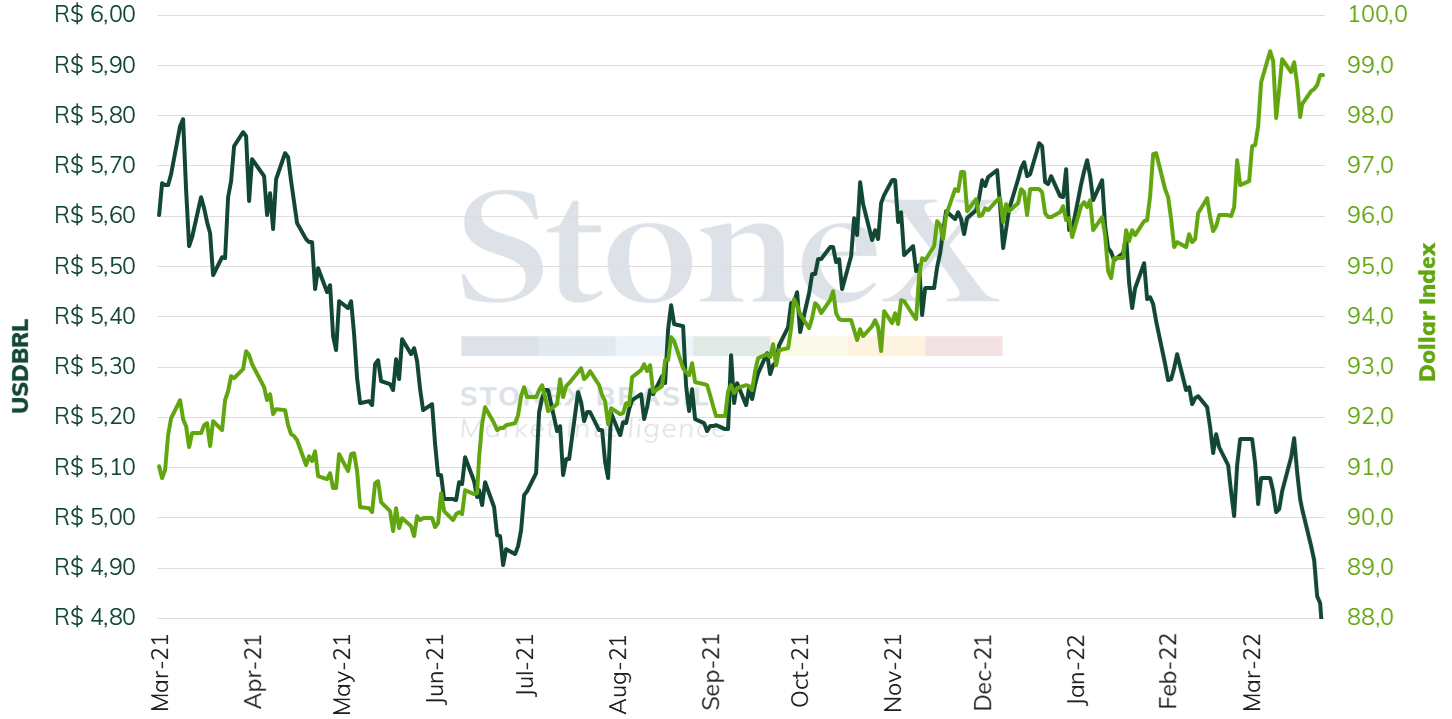
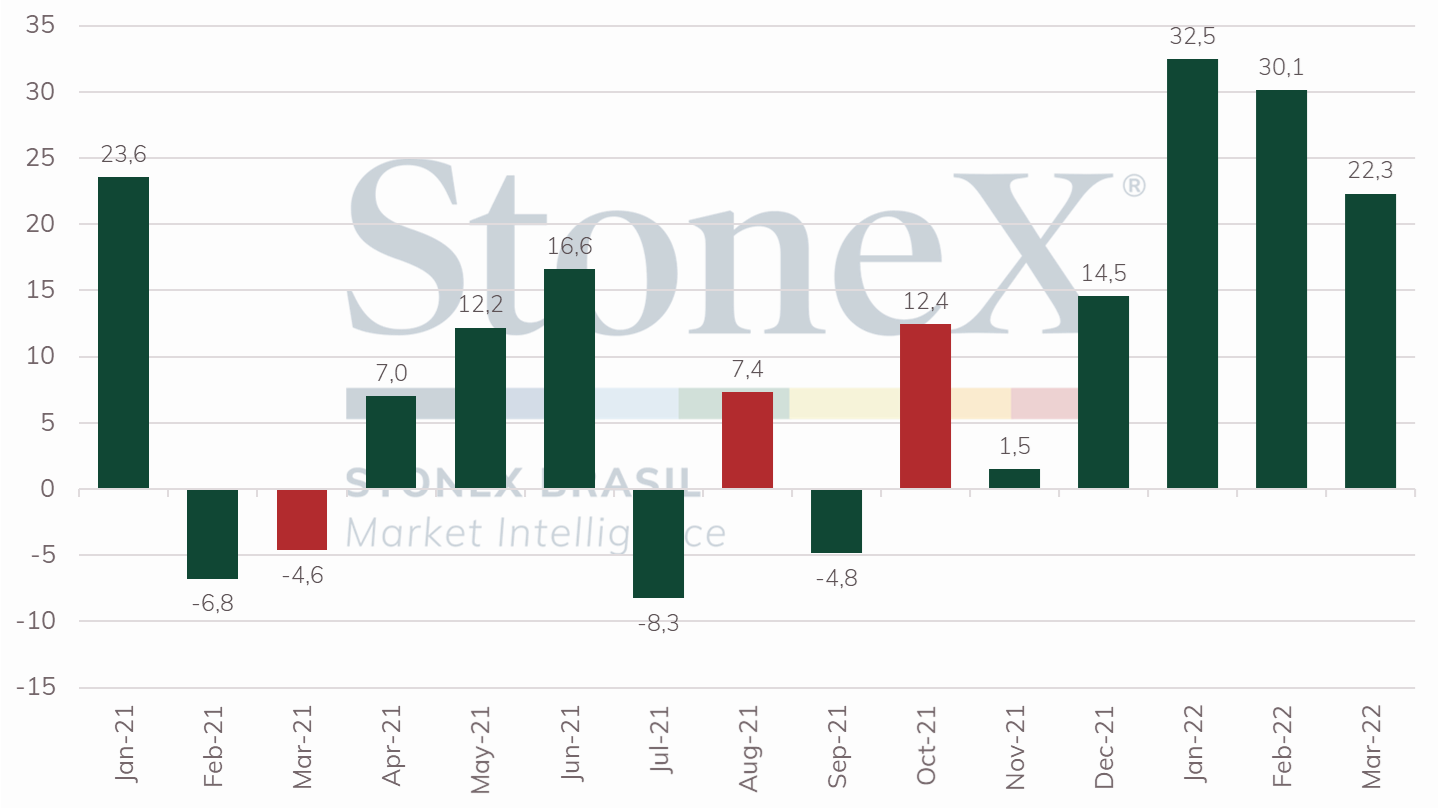
This week, attention should turn again to the strong foreign appetite for Brazilian assets and the appreciation of the exchange rate that this strong inflow of funds provides. The Brazilian currency presents an outstanding performance in 2022. In twelve weeks, the Real appreciated against the dollar in ten of them and has already accumulated an appreciation of 14.8% this year, the best performance among the relevant emerging currencies. In a context of an upward trend in the international commodities prices, the diversified export capacity of primary products, the low exposure, in relative terms, to the risks offered by the Russian-Ukrainian conflict, and the low price of Brazilian assets in foreign currency terms have attracted many foreign investors. It is possible to glimpse this inflow of capital through the spot market of B3 shares, whose net inflow of foreign funds already exceeds BRL 81 billion in 2022, the highest value in three months since 1994, the beginning of the historical series. The balance of investments is BRL 32.491 billion in January, BRL 30.129 billion in February and BRL 20.973 billion up to March 22.
BALANCE OF FOREIGN CAPITAL FLOW ON THE B3 - AS OF MARCH 23 (BRL BILLION)
Source: B3. Design: StoneX.
On the other hand, the large differential between Brazilian and developed countries' interest rates also contributes to the inflow of foreign capital. Facing a rapid inflation acceleration, the Brazilian Central Bank has carried out an intense monetary tightening process that has readjusted the basic interest rate (Selic) from 2.0% p.a. to 11.75% p.a. in just twelve months. Today, the real interest rate – the difference between the nominal interest rate minus inflation – in Brazil is only lower than that of Russia. As a result, this country faces difficulties in attracting foreign investors. On the other hand, this wide Brazilian interest differential helps attract investors looking for "carry trade" strategies - taking financing in a low-interest country to invest in a high-interest country.
The trend of inflow of these foreign funds should remain in the coming weeks since the conflict between Russia and Ukraine does not appear to be close to a solution, thus maintaining the pressure on commodity prices and the cycle of high basic interest rates (Selic) will continue at least until May, according to the Central Bank.
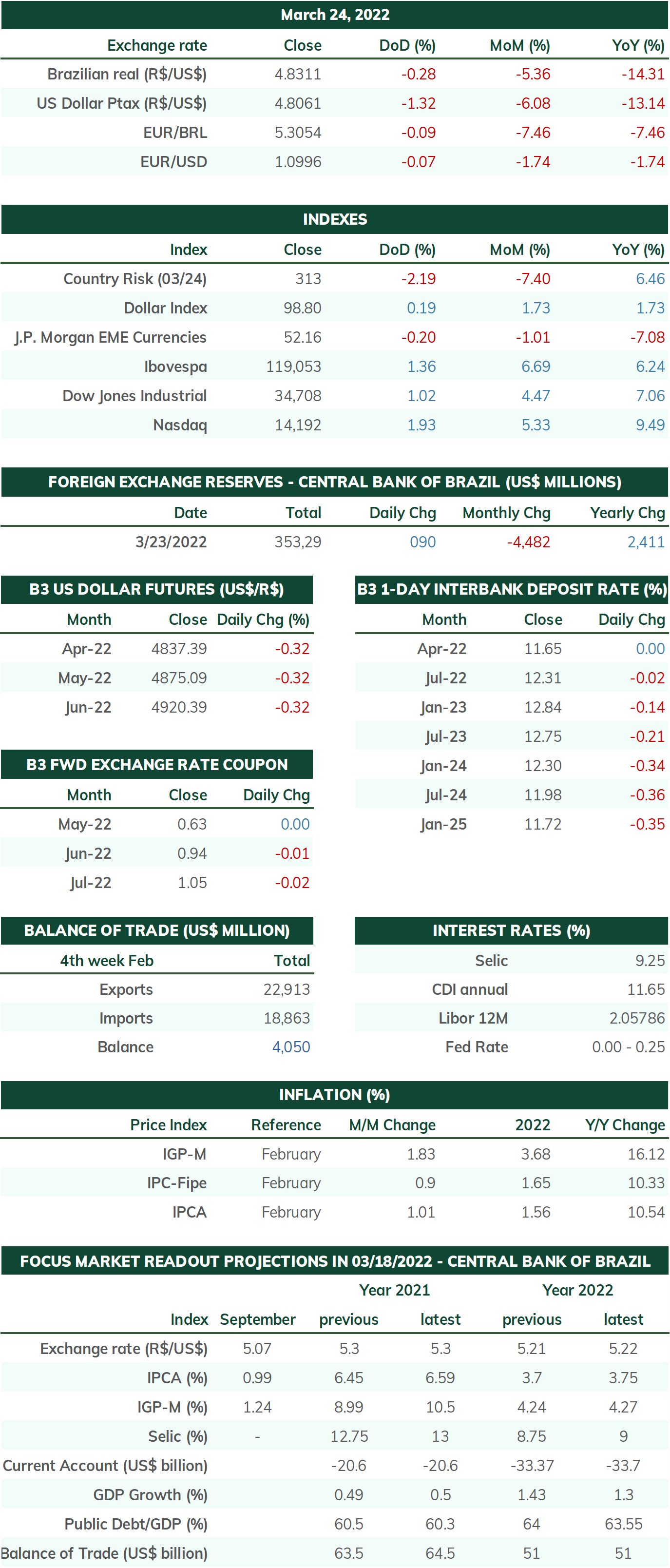
This week, several relevant indicators of economic activity and prices will be released, starting with the General Price Index - Market (IGP-M) for March, whose median forecast is 1.24% for the month.
The Producer Price Index for February will also be released. Although it will not fully capture the effect of the Russian-Ukrainian war, it helps measure the cost pressure that producers are facing and which could result in a pass-through to the final consumer. Also worthy of note will be the publication of the labor market statistics for February, emphasizing the unemployment rate and average labor income, both of which are expected to fall. Finally, the Central Bank of Brazil will update February's fiscal, open market, monetary and credit and foreign sector statistics. Given the recent exchange rate movement, the foreign sector statistics should be analyzed in more detail to see which assets are being bought by foreigners.