Foreign Scenario
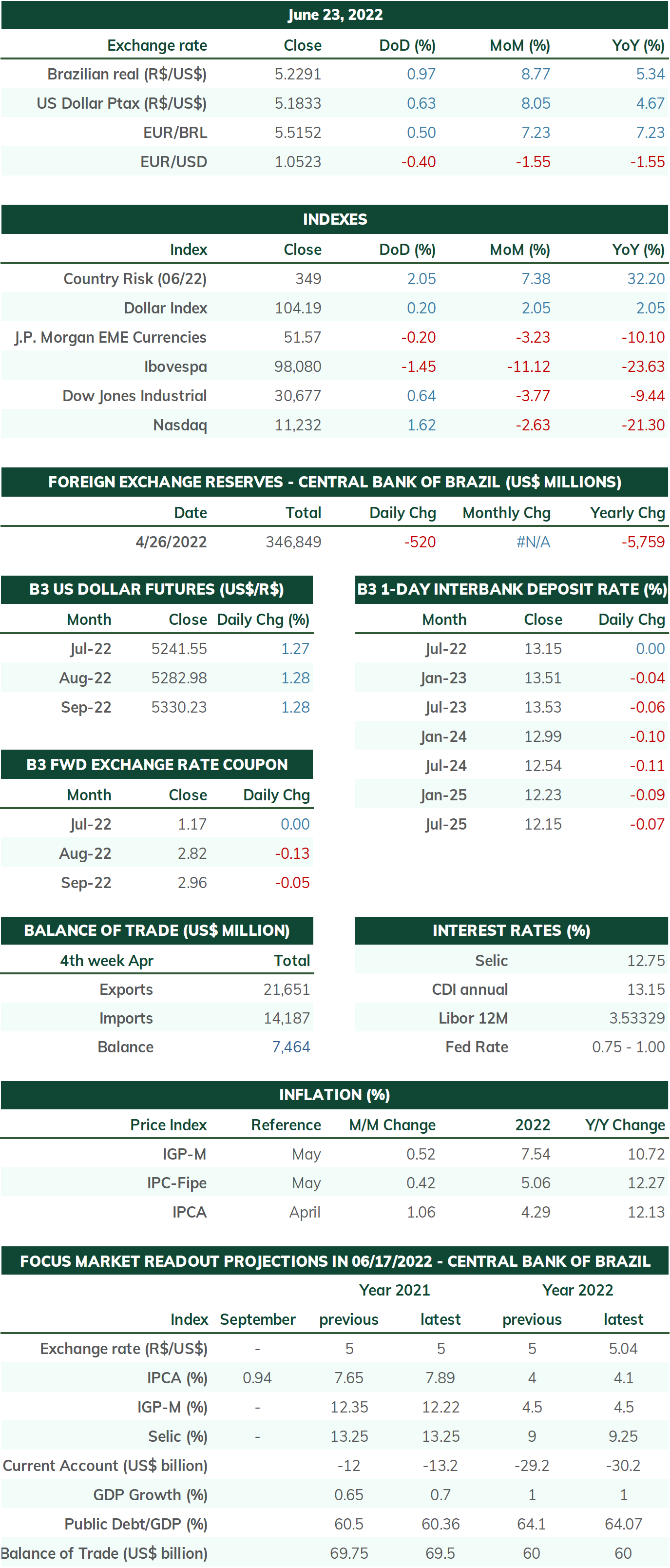
This week, the focus should be on the Personal Consumption Expenditure Price Index (PCE) for the United States for May next Friday (01). The median of expectations for the May reading points to an increase of 0.9%, accumulating a 6.7% rise in 12 months. For the core indicator, which excludes the volatile food and energy categories, a smaller increase of 0.3% is expected for the month and 4.8% for 12 months. Recent readings of economic indicators have registered values above analysts' expectations for inflation rates and below estimates for productive activity, deepening fears that an intense economic slowdown could occur in the short term (6 to 12 months). In this sense, the release of the manufacturing Purchasing Manager's Index (PMI) for the US by the ISM institute, also on July 1, will be followed by investors and may have repercussions on the foreign exchange market.
Next week, officials belonging to the Federal Reserve (Fed) are also expected to speak to the market in speeches, lectures and interviews about their view of the appropriate monetary policy path for the country. Last week, Fed Chairman Jerome Powell testified twice to the US Congress and set a very strict scenario for the conduct of monetary tightening by the central bank, stating that the institution's commitment to fighting inflation is "unconditional" and that interest rates will be raised to a restrictive level quickly and that an economic recession is "certainly a possibility." As a result, on Friday (24), the interest rate futures market was betting mostly that interest rates will be at a level between 3.25% and 3.50% by the end of 2022, representing a 1.75 percentage point increase in four decisions. Speakers this week include San Francisco Fed President Mary Daly, Cleveland Fed President Loretta Mester, and St. Louis Fed President James Bullard. Louis Fed President James Bullard.
There will also be the "ECB Forum on Central Banking” this week, an event hosted by the European Central Bank (ECB), which will feature speeches by several of the world's central bank authorities, such as Fed President Jerome Powell, ECB President Christine Lagarde, ECB Chief Economist Philip Lane, the President of the Bank of England, Andrew Bailey, among others. The number of ECB speakers and the relevance of the topics discussed may mean that new details or context regarding the institution's monetary policy path will be revealed, as well as regarding the economic projections envisioned by its members.
The conflict between Russia and Ukraine saw reasonable advances last week - considering the slow standards hitherto - by the Russian army in the Donbas region. Moscow has practically consolidated its hold on the city of Severodonetsk and is preparing to advance towards Lysychansk. The region is more open terrain, and numerical superiority in artillery and missiles favors the Russian advance, which is razing everything in its path. Kiyv continues receiving fresh supplies from the Western alliance, and it is too early to determine if there is any bias in the war.
As announced a couple of weeks ago, natural gas supplies from Russia to Germany through the Nordstream 1 pipeline have been reduced by about 60%. According to the Russian company Gazprom, equipment needed to repair and maintain the pipeline has been prevented from being exported by the Canadian government. This has been the reason for the reduction. Analysts are concerned that Moscow will use the sanctions as an excuse to shut off gas supplies to Germany, claiming that it cannot carry out the safety maintenance required for the pipeline's operation. A new pipeline, Nordstream 2, is already ready for operation, but sanctions against Moscow have also prevented its use. The second half of the year is crucial for building up stocks for the winter season, a move that this reduction may threaten. To make matters worse, Russia threatened to retaliate against the Lithuanian government when this government stated that it would prohibit the rail transportation of goods sanctioned by the European Union (EU) up to Kaliningrad, a Russian exclave surrounded by EU countries.
Finally, it is worth mentioning the Covid-19 situation in China. An analysis by Nomura bank on June 20 estimated that 5 Chinese cities are in partial or total lockdown, affecting a total of 54.1 million people, a weekly drop of almost 20% in the number of people in lockdown. However, this still corresponds to approximately 3.8% of the Chinese population and 7.6% of China's Gross Domestic Product.
Domestic Scenario
Next week's focus should be on political news and its impacts on Brazil's business stability perceptions. This was a troubled week for Jair Bolsonaro's government, and its themes should be repeated in the coming days. After a public, an aggressive and persistent campaign by the leaders of the Executive and Congress against Petrobras and its directors, the company's CEO, José Mauro Coelho, resigned last Monday (20). Coelho had already been informed that he would be replaced on May 23, but the new nominee for the position has not yet been approved by the Board of Directors of the state-owned company. Therefore, the Board should meet this Monday (27).
Jair Bolsonaro's government decided to give up on zeroing state fuel taxes, a topic that the leaders of the Executive and Congress had been working for weeks to make feasible through a proposed constitutional amendment (PEC 16/2022) was also surprising this week. In its place, the Administration decided to increase the value of the Auxílio Brasil and Auxílio Gás programs and create a benefit for self-employed truck drivers. Senator Fernando Bezerra Coelho (MDB-PE) said he will be the rapporteur of this proposal, which will keep the same procedure in Congress (16/2022), and will present the report on Monday (27). According to him, the text will include in the Constitution a BRL 200 increase in the Auxílio Brasil, a readjustment "around BRL 70" for the Auxílio Gás, and the creation of a "trucker voucher" worth BRL 1000. According to the senator, all initiatives will be valid until the end of 2022 and have a financial impact of BRL 39.8 billion for the Union. In justifying the government's change of stance, Bezerra Coelho said that the incentives would be "better used" if they were granted directly to the population. The government's initiative will be made through a proposed constitutional amendment (PEC) to avoid the restrictions imposed by electoral legislation, the Fiscal Responsibility Law, and to exceed the limit imposed by the spending cap.
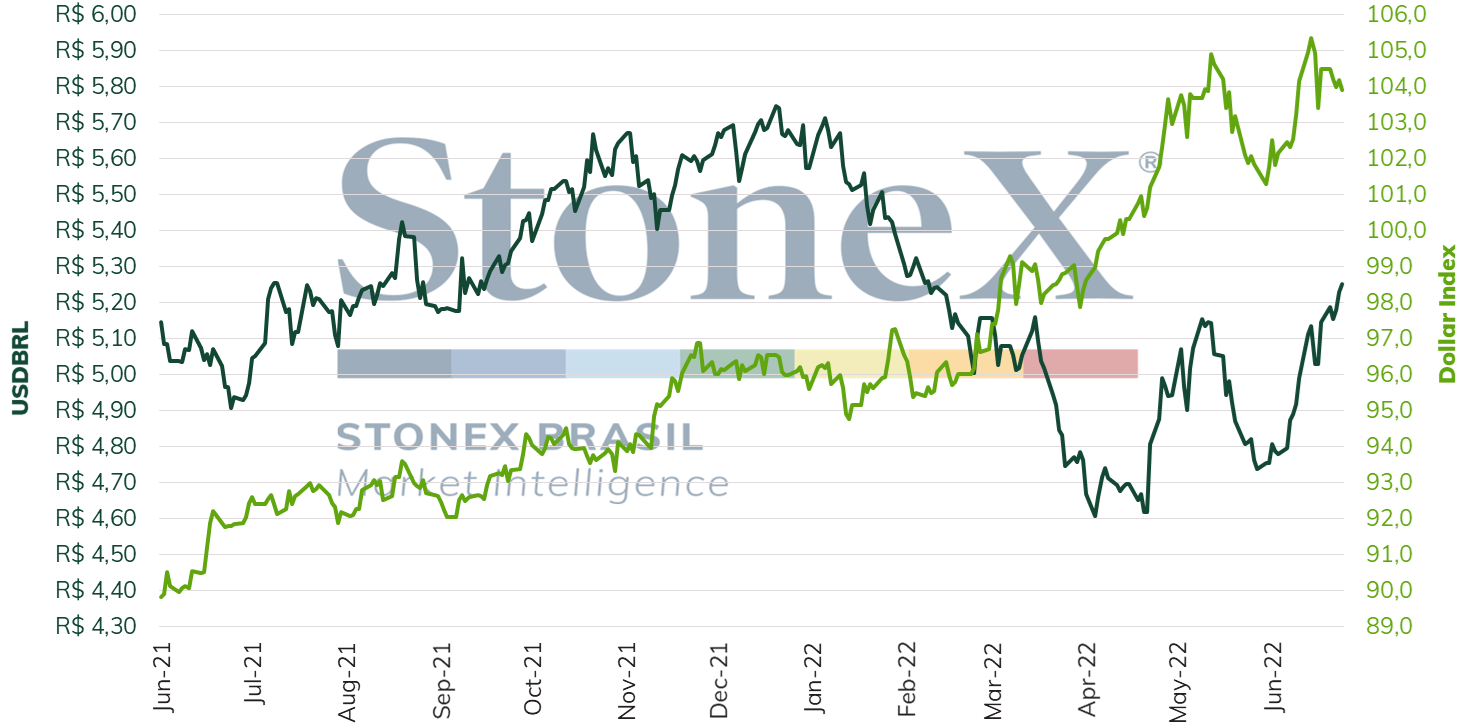
Besides the direct interventions in management positions with the power to influence Petrobras' pricing policy, the heated public statements may amplify the political risks associated with Brazil. On the other hand, improvisations and changes in the public budget, with lost revenues and increased spending in the order of tens of billions of reais four months before an election, evading the spending cap, may also raise the perception of fiscal risk associated with Brazil. Both risks could result in higher risk premium demands by investors, which could reduce the flow of foreign capital into the country and weaken the BRL.
It is also worth mentioning the release of the quarterly inflation report by the Central Bank (BC) on Thursday (30). In a moment of lack of information due to the institution's servers' strike, the report may provide some context for the monetary authority's outlook for the domestic and external economic environment, as well as its projections and details for inflation for the coming years. On the same day, the Brazilian Institute of Geography and Statistics (IBGE) publishes data for the labor market for May, including the unemployment rate and real income.