Foreign Scenario
This week, the focus will be on the monetary policy decision of the Federal Reserve’s (Fed) Federal Open Market Committee (FOMC). While there is a high degree of consensus for this Wednesday's measure - an adjustment of 0.75 p.p., raising the federal interest rate from a range between 3.00% p.a. and 3.25% p.a. to a range between 3.75% p.a. and 4.00% p.a. - there is great divergence regarding the next decision, on December 14.
Although inflationary indicators have shown little progress in recent months, a report in The Wall Street Journal on October 21 speculated that Fed officials are considering how to signal to investors that they want to slow the pace of interest rate increases starting in December without giving the impression that they will stop pursuing price stability. After this report, the bets in the futures market for the December adjustment became divided, with a slight preponderance for 0.50 p.p. The past week has been driven by a greater appetite for risk based on this hope that the U.S. central bank may moderate the pace of its monetary tightening from now on. However, it seems more likely that Chairman Jerome Powell will prefer not to commit to any specific adjustment and keep his options open since between November 2 and December 14, there will be two readings of the Consumer Price Index (CPI) and the Employment Situation Report to inform the decision of the FOMC members better.
Bets for the Federal Reserve's interest rate decision on December 14
Source: CME FedWatch Tool. Design: StoneX. Futures market interest rate probabilities as of October 28, 2022
Additionally, before the newspaper report (which occurred on the last day before the period of silence required by the 2nd meeting), several Fed officials publicly defended the need not to hastily reduce the Fed's monetary tightening, warning that a failure to contain price acceleration now could cause further economic difficulties in the future. And indeed, with price acceleration higher, more persistent and more widespread than initially projected, with economic activity still expanding and the labor market heated up, it is hard to justify moderation right now.
The week will also be full of relevant indicators for economic activity. Initially, the September job openings and turnovers survey, the October private sector employment report, and the October employment situation report will be informed for the labor market. Most of the analyses point to a labor market that continues to expand, but at a slower pace, with a drop in the number of job openings and new jobs, maintenance of the low unemployment rate, and an increase in the average value of salaries. In addition, the Purchasing Managers' Indexes (PMI) measured by the ISM institute are expected to retreat, both for manufacturing (from 50.9 points in September to a median estimate of 49.9 points in October) and services (from 56.7 points in September to a median projection of 55.4 points in October). This reading is consistent with a slow and progressive reduction in U.S. economic activity.
Finally, the legislative elections in the United States are only a week away - they take place on Tuesday, November 8 - which may bring more volatility to the financial markets because of the political news. Recent polls have indicated a high probability that the Republican Party, in opposition to President Joe Biden, will get a majority in the House of Representatives. At the same time, the odds for the Senate race are virtually tied at 50 representatives for each party.
In Europe, attention should turn to the Bank of England's (BoE) monetary policy decision on Thursday (03). After weeks of turmoil and upheaval in British financial markets, the challenge facing the BoE has become significantly more complex in five weeks. With the failure of the so-called "Trussonomics" of former Prime Minister Liz Truss, the central bank needs to balance a financial market that has suffered strong capital outflows, with risks to financial stability due to lack of liquidity at certain times, greater fiscal fragility due to higher government debt financing rates, and the same inflationary pressure. Thus, there is a perception that the monetary authority needs to keep a contractionary policy in place to contain price acceleration but that it would be important to reduce the pace of interest rate hikes to soften the negative impacts on asset markets, particularly mortgage bonds.
Finally, regarding the war between Russia and Ukraine, the week was one of stability in the lines of confrontation, with a reduction in the pace of Russian bombing and airstrikes on Ukrainian civilian infrastructure. Still, the damage to basic electricity, heating, and water and sewage services was extensive, in addition to the pre-existing damage to logistical infrastructure, which should mean a rather difficult winter for the country's population. Furthermore, it is worth noting the more than three-hour speech by Vladimir Putin at the Valdai Discussion Club institute, in which the Russian president reaffirmed the initial maximizing goals of the war, argued that "it is a historical fact" that Ukrainians and Russians are one people and that "the only real guarantee for Ukrainian sovereignty" can only be achieved by uniting with Russia, which "created" Ukraine. After eight months of conflict, this kind of mentality of the Kremlin leader practically nullifies the possibility of negotiation between the parties.
Domestic Scenario
In Brazil, the week's highlight should be the result of the second round of elections for the President of the Republic. The latest polls indicate a stable advantage for Luiz Inácio Lula da Silva over Jair Bolsonaro of approximately six percentage points of valid voting intentions. However, considering the deviation between the votes received by Bolsonaro in the first round and those attributed to him in the polls - almost ten p.p. on average -it is not possible to anticipate the result. It is believed, however, that, whoever is elected, victory will occur by a narrow margin.
It is worth noting that several political analysts warn of the risk of Bolsonaro contesting an eventual victory by Lula, especially if the difference between their votes is too narrow. On several occasions over the past two years, the current president has attacked the electoral institutions and cast doubt on the reliability of the electronic ballot boxes. It is impossible at the moment to anticipate what would happen in the event of a challenge to the result, either from a political or currency point of view.
A point of interest for investors will be the composition of the economic team of the elected candidate. Press reports state that Lula is considering Henrique Meirelles and Alexandre Padilha for the Ministry of Economy. The first name would be a way to nod to financial markets and get closer to the center, while the second is more aligned to the left and would give the president more comfort in negotiations with Congress.
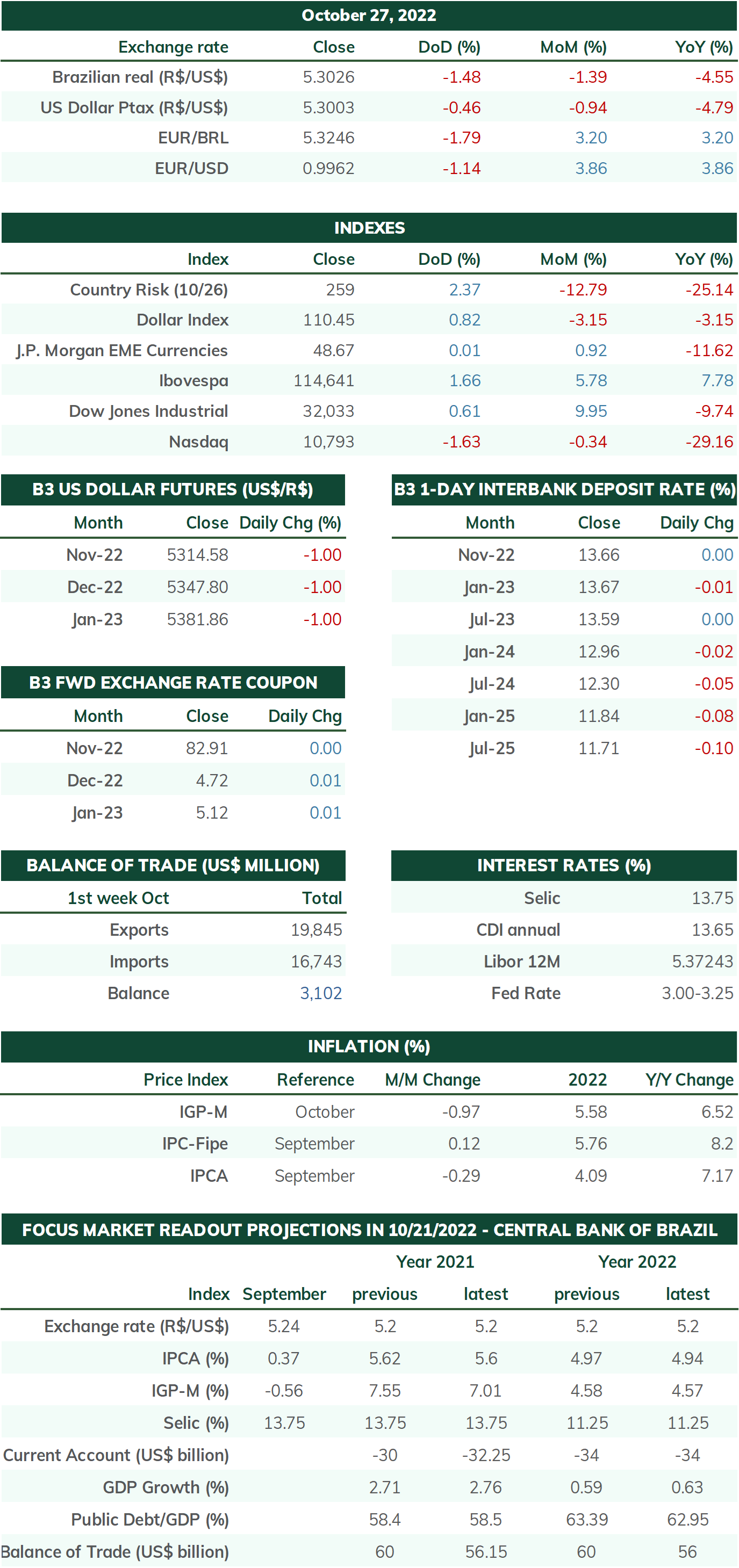
Finally, this week will bring the minutes of the decision of the Monetary Policy Committee of the Central Bank of Brazil. Normally it is a highly anticipated document, but expectations are a little lower because of the competitive presidential race and the almost unanimous option to maintain the basic interest rate (Selic) at 13.75% p.a. The communiqué of the decision was almost unchanged from the previous version. There is more interest in possible signals about the beginning of Selic reductions. Still, it is imagined that the Central Bank will avoid this topic, reaffirming its commitment to keep interest rates high until inflationary expectations return toward the institution's targets.