The most important: technical and political criteria in Brazilian economic policy
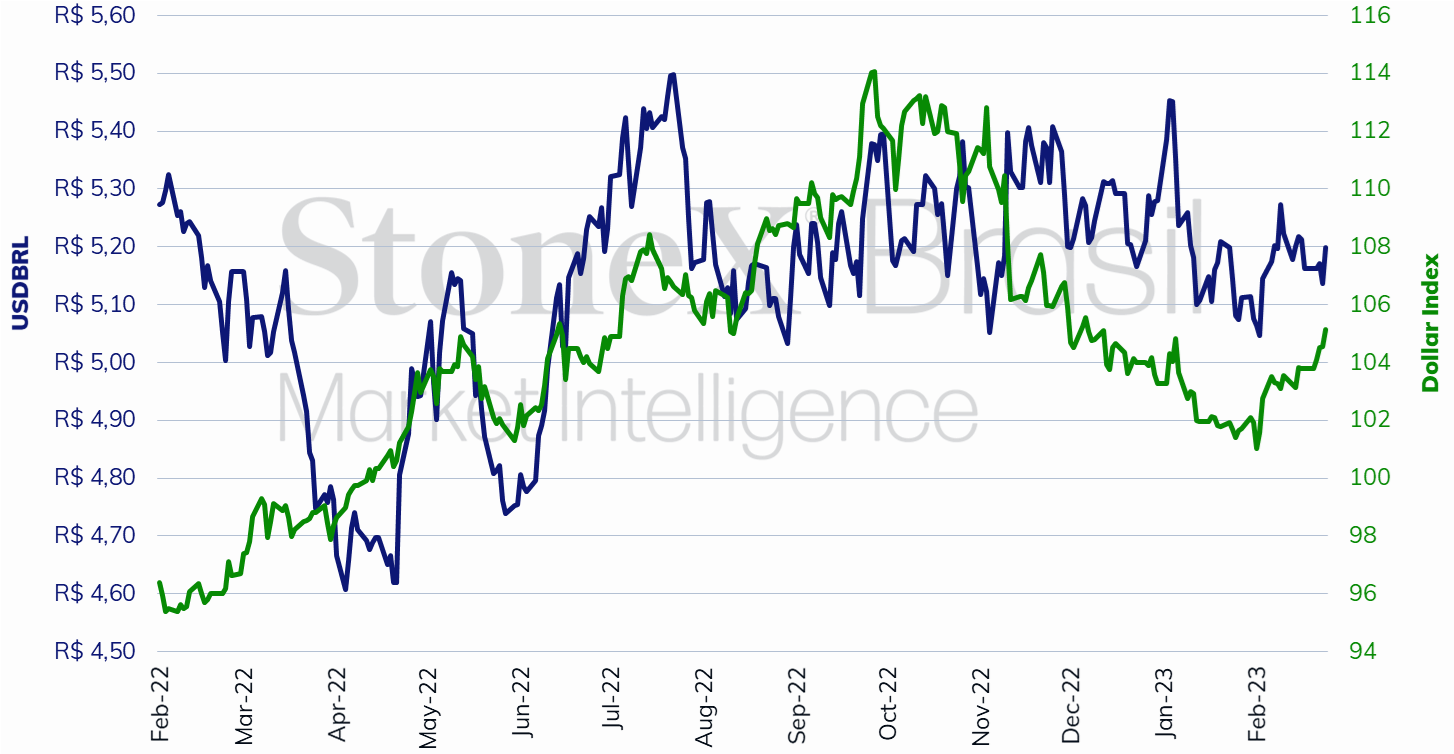
Impact on USDBRL: bullish
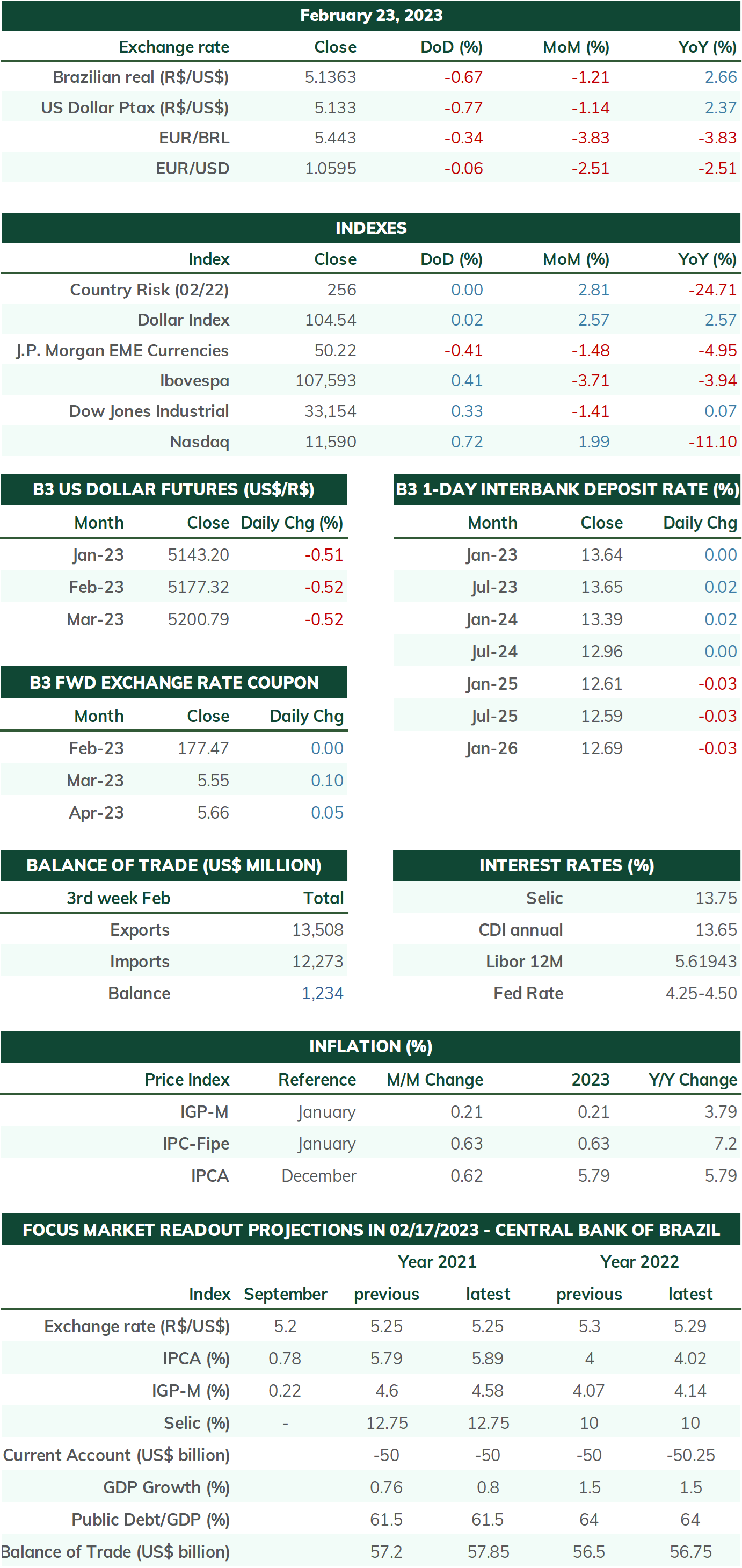
This week, the focus should be on the dispute between internal wings of the federal government on important fiscal and monetary policy decisions. Firstly, there is uncertainty about the taxation on gasoline and hydrous ethanol, even though the Provisional Measure that extended its exemption ends next Tuesday (28). While the Ministry of Finance argues that taxes should be re-imposed immediately, other authorities advocate extending the exemption until April. On Thursday and Friday of last week (February 23 and 24), the President of Brazil, Luis Inácio Lula da Silva, had an agenda with the president of Petrobras, Jean Paul Prates, the Minister of Mines and Energy, Alexandre Silveira, the Executive Secretary of the Treasury, Gabriel Galípolo, and the Minister of the Civil House, Rui Costa. The taxation will bring inflationary impacts, either in March or April. Still, the exemption extension harms public sector revenue and may convey a message of little concern with fiscal sustainability purely out of political desire. According to the Treasury's calculations, the PIS/Cofins exemption alone costs the public coffers BRL 28.9 billion monthly.
Additionally, on Tuesday (28), the term of office of the Central Bank's Monetary Policy and Supervision directors, namely Bruno Serra Fernandes and Paulo Souza, will end. Amidst a recent context of friction between the Executive Branch and the Central Bank (despite the recent truce during Carnival week), the choice of the new Monetary Policy director worries analysts since it is a position with, in theory, responsibilities and the ability to influence the path of the basic interest rate (Selic) for the next four years. Serra, in turn, has already shown himself willing to remain interim until Congress approves the next candidate.
Hard-line speech by members of the Federal Reserve
Impact on USDBRL: bullish
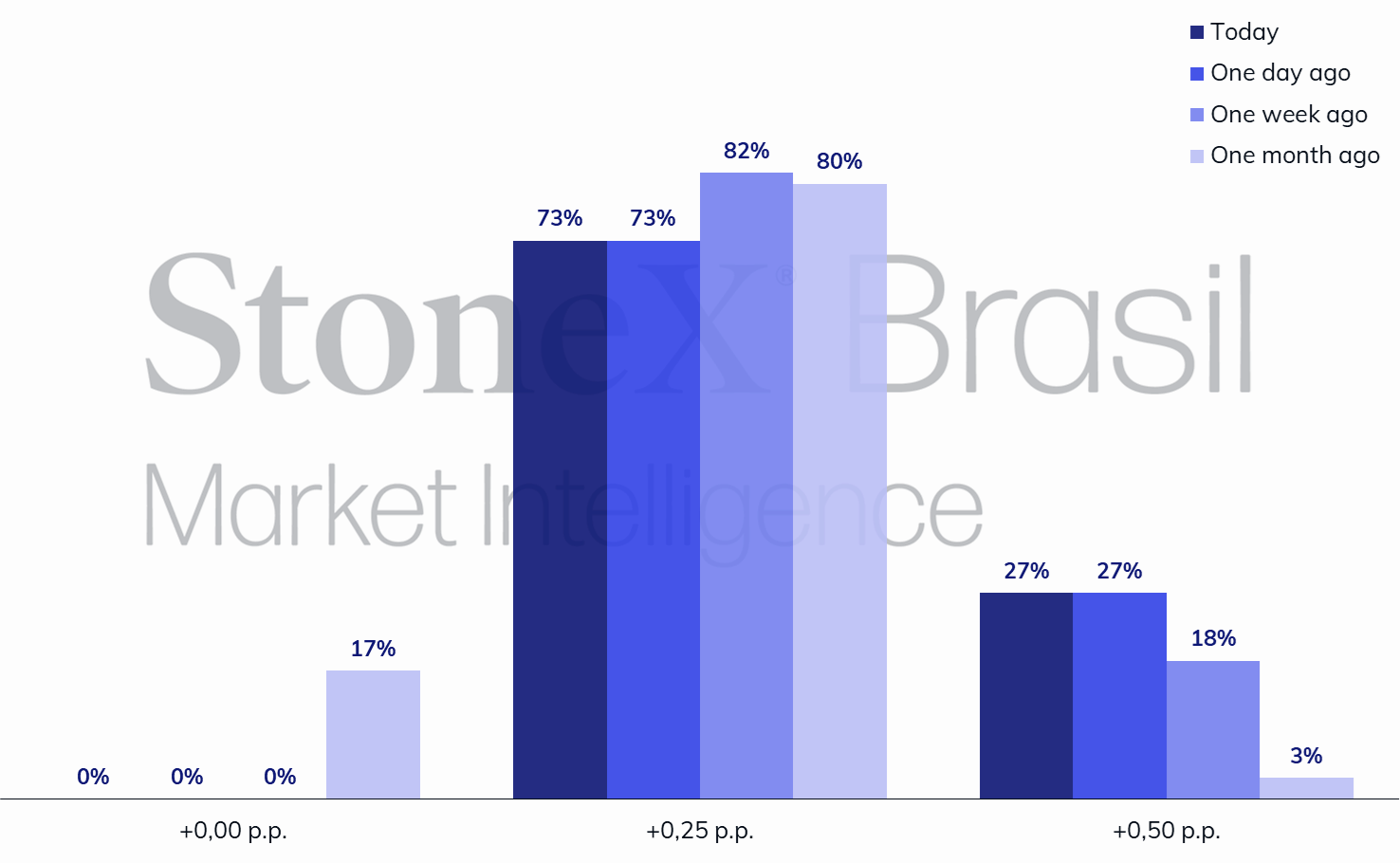
Last week, the publication of the minutes of the Federal Open Market Committee's (FOMC) monetary policy decision caught investors' attention, especially because of what the document did not say. Immediately after the Committee decided to reduce the pace of interest rate hikes on February 1 from a 0.50 p.p. adjustment in December to 0.25 p.p., Fed Chairman Jerome Powell justified the measure by mentioning "disinflation" or "disinflationary process" 15 times in his press conference. The minutes of the same decision, released on Wednesday (22), did not mention any of the terms even once. After the sequence of higher-than-expected economic indicators for January, some analysts question the decision taken by the FOMC as premature, suggesting that the Committee should have kept the interest rate hike at 50 basis points in the February decision and, they argue on raising the adjustment to 0.50 p.p. in March possibly. In this sense, it will be important to observe the comments of the authorities that make up the Federal Reserve and their perceptions about the situation in the country and the most appropriate strategy for American interest rates. Fed Board of Governors member Philip Jefferson, Fed Board of Governors member Christopher Waller, Atlanta Fed President Raphael Bostic, Fed Board of Governors member Michelle Bowman, and Richmond Fed President Tom Barkin are scheduled to speak this week.
Economic data in the United States
Impact on USDBRL: bullish
US economic indicators for January brought several surprises for investors, generally beating expert estimates: job creation, services Purchasing Managers' Index (PMI), retail sales, and inflationary metrics such as the Consumer Price Index (CPI), Producer Price Index (PPI), and Personal Consumption Expenditures (PCE). This outlook has renewed fears that the country's price acceleration will remain widespread and persistent for longer than anticipated, which would require tighter and more prolonged monetary tightening by the Federal Reserve. The risks are more tilted to the inflationary upside at the moment.
Bets on the Federal Reserve's March 22 interest rate decision
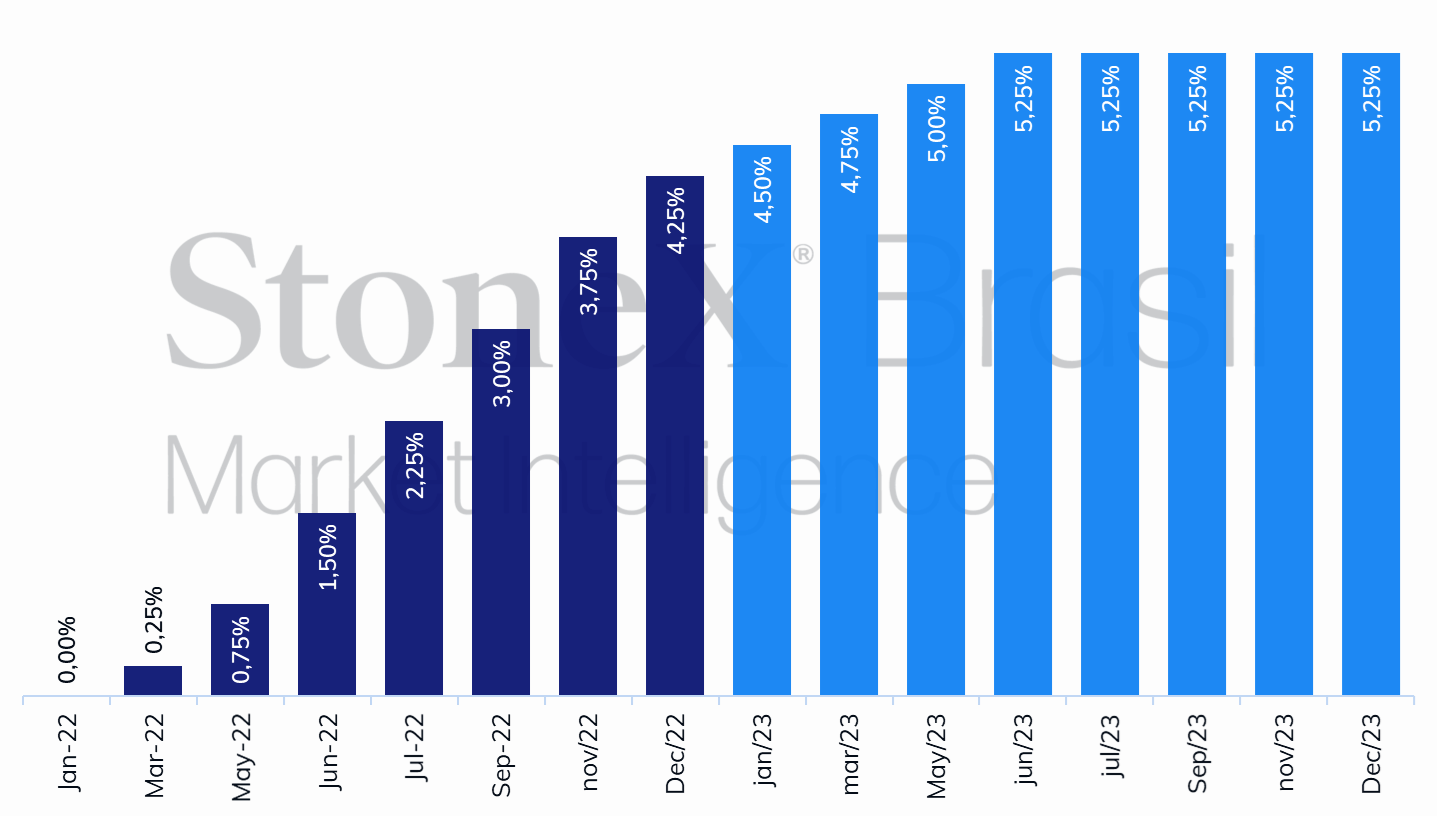
US interest rate history and higher probability bets on the futures market
Source: CME FedWatch Tool. Design: StoneX. Probabilities in the future interest market regarding February 24, 2023
In this context, analysts will watch the release of the ISM manufacturing and service sector PMI closely to understand if the US economy is reaccelerating or if January was just a point outside the curve. It is expected that manufacturing activity data should remain in decline, as it has for the past five months, but that the level of service activity will continue to expand significantly after surprising with a strong rebound in January. Additionally, January's durable goods orders will be released this week, signaling the investment potential of companies and, by extension, their confidence in future sales.
Economic data in Brazil
Impact on USDBRL: bearish
This week, the Brazilian Institute of Geography and Statistics (IBGE) publishes the 2022 Gross Domestic Product result. The average estimates indicate a 2.9% expansion in four accumulated quarters but a 0.2% retraction in the quarterly comparison. Estimates for 2023 also indicate a slowdown in growth, totaling only 0.8% year-to-date. In addition, data for the labor market in December will be released as public finance indicators for January.
Positive exchange flow at the beginning of the year
Impact on USDBRL: bearish
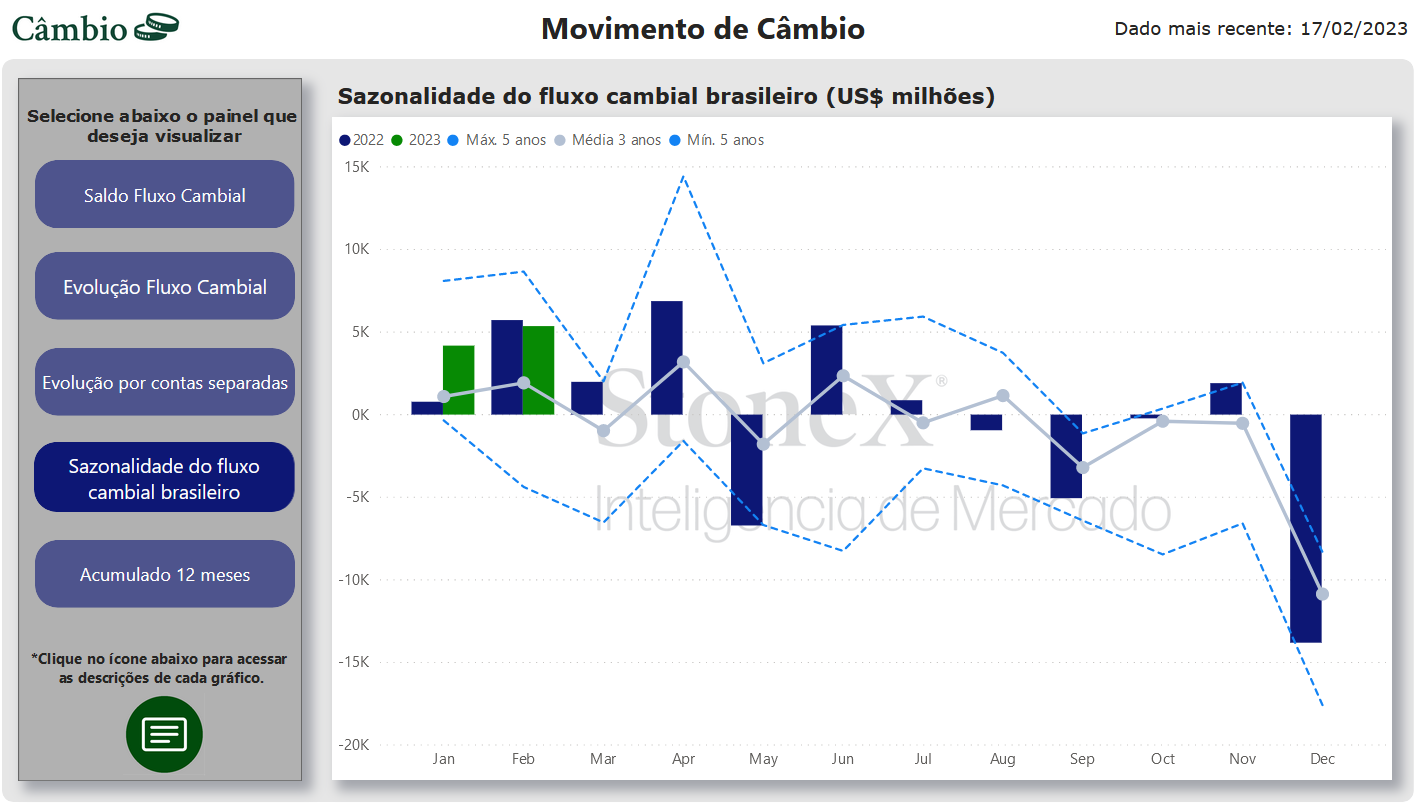
Several analysts note that the exchange rate movement recorded by the Central Bank began the year with high positive balances, both in the commercial and financial accounts. The accumulated trade surplus from January to February 17, 2023 (13 working days in February) is USD 4.929 billion, against USD 0.081 billion in the same period last year (using the first 13 working days of February for comparison). The financial surplus in 2023 is USD 4.604 billion, compared to a deficit of USD 0.361 billion in the same period in 2022. The high foreign appetite for Brazilian assets has contributed to containing the weakening of the real at a time of greater perception of fiscal and political risks reported by domestic investors that favor volatility in asset prices.
Foreign exchange flow balance as of February 17 (USD million)
Fonte: Banco Central. Elaboração: StoneX.
Access the interactive dashboard with detailed information on the exchange rate flow since 1982 at https://stonex.digital/interativos/041f5f1f-f13f-4b92-916f-11bed5761ad5