Spread of corn leafhopper reduces the potential of the 2023/24 crop in Argentina
The Buenos Aires Grain Exchange estimates a potential 12% crop failure, with the possibility of further losses
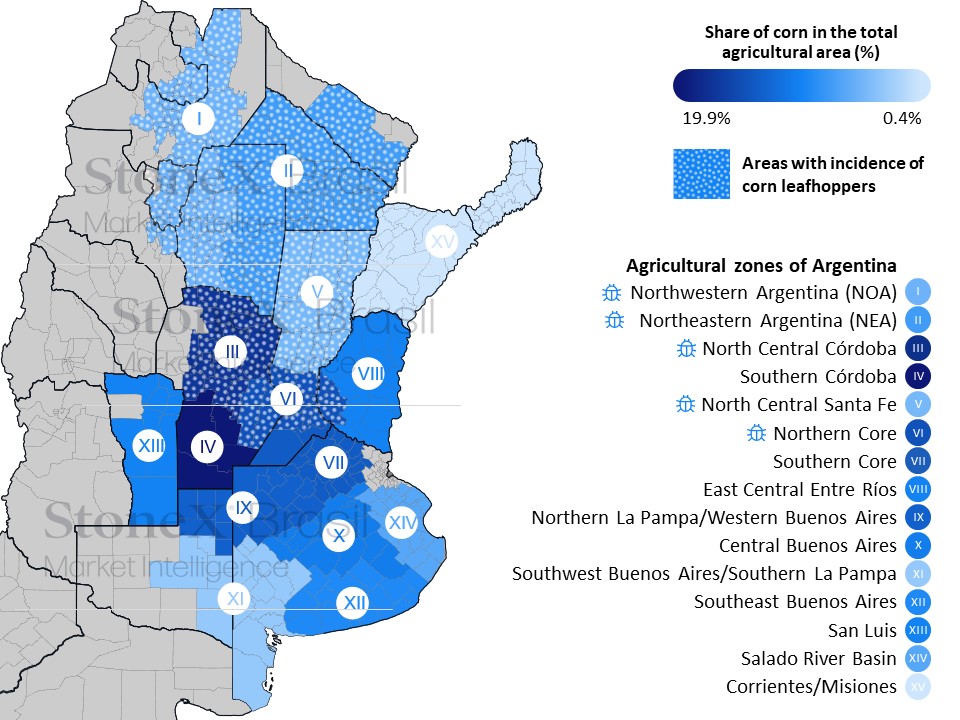
The Buenos Aires Grain Exchange (BCBA) estimates that 7.2 million hectares were planted with corn in Argentina in the 2023/24 season, a similar area to Mato Grosso. As usual, corn planting began in September in the agricultural zones of Southern Core, Northern Core, and West-Center of Entre Ríos (check the map at the end of the report). In the other 12 zones, most crops were only planted between December and January, called late planting crops. In the current cycle, it is estimated that between 65% and 75% of the agricultural area of corn is late planting.
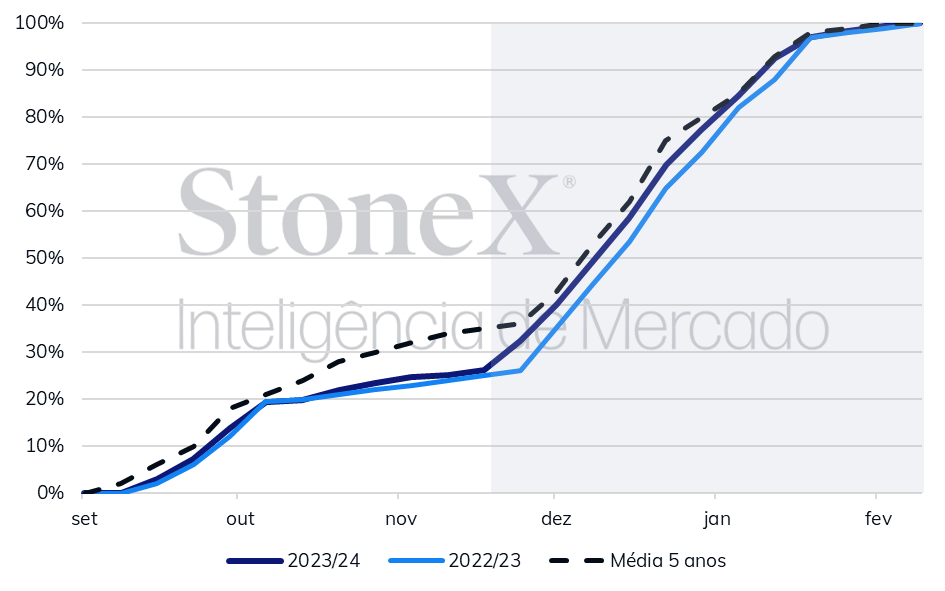
Source: Buenos Aires Grain Exchange (BCBA). Design: StoneX. *late planting is highlighted in gray
The development of the crops was quite satisfactory until the beginning of March. Although most of the country suffered from a heatwave from January to February, this did not significantly affect the growing conditions, with the BCBA classifying 87% of the crops as normal, good, or excellent.
In this scenario, the initial estimates were of a robust crop in Argentina. Once again, resorting to BCBA, the initial estimate was for a 56.5 million tonnes production, which would be the largest volume in history and represent an increase of 22.5 million tonnes compared to the 2022/23 crop, which was greatly affected by La Niña.
Starting in March, however, the pest, popularly known as corn leafhopper, began to spread through the crops. This insect is very harmful to crops due to two factors. Firstly, because the leafhopper transmits bacteria from the mollicutes class, it causes corn stunting, resulting in smaller cobs with fewer grains. Secondly, the leafhopper can also transmit the Maize Rayado Fino virus (MRVF), which reduces plant growth. Because they reproduce quickly and have a great migration capacity, the population of these insects can grow and spread rapidly.
For years, leafhoppers have been observed in the agricultural areas of Argentina's Northwest and Northeast. However, the impact on crop productivity is normally around 5%, while in the current cycle, losses exceed 50% in some areas.
Perhaps even more damaging to the Argentines is that this pest has spread to regions where it is not normally observed. In particular, the high incidence in the agricultural areas of Central-North Córdoba, Central-North Santa Fé, and Northern Core stands out.
In total, five agricultural zones in Argentina, which account for 45% of the corn area, are experiencing an infestation of leafhoppers. Only the one in the North Core has an advanced harvest and, therefore, is less susceptible to new crop damage. As mentioned, the North Core is one of Argentina's few early-planting agricultural zones.
In its latest release, regarding April 24, BCBA estimated Argentina's crops in normal, good, or excellent conditions at 60%, a 27-percentage point reduction compared to the beginning of March. Now, the growing conditions are below the 82% average recorded between the crops of 2018/19 and 2021/22.
Argentina | Normal, good or excellent growing condition - Corn
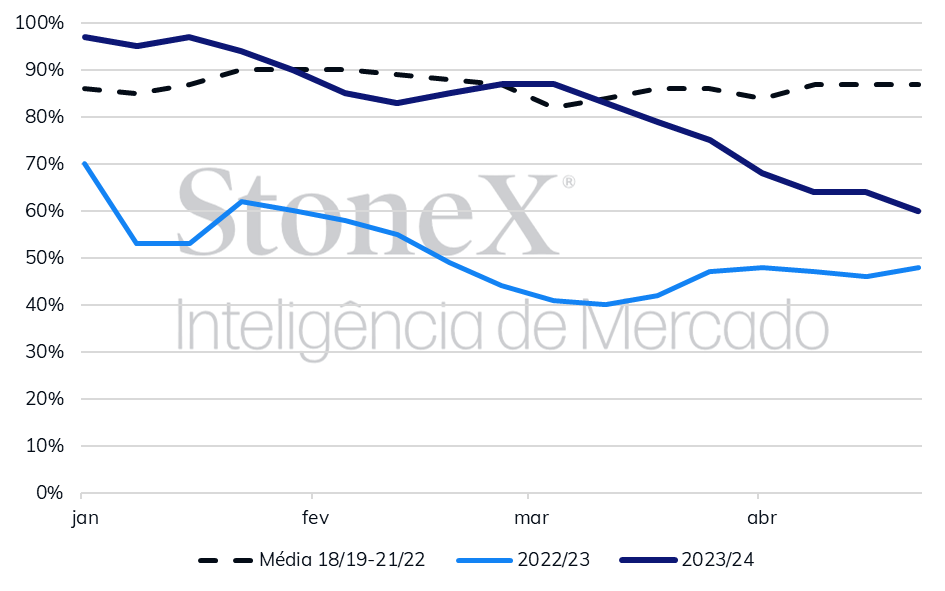
Source: Buenos Aires Grain Exchange (BCBA). Design: StoneX.
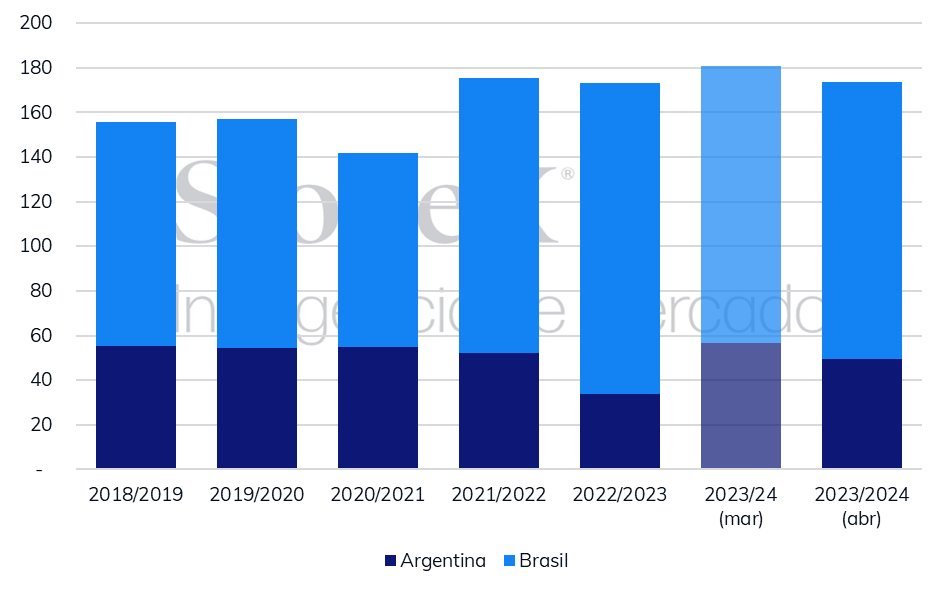
With this reduction in the quality of the crops, there were also adjustments in the crop estimates. In April, BCBA started estimating the production of 49.5 million tonnes of corn, a 12% reduction compared to the initial estimate. Consequently, the outlook ceased to be that of a record crop in Argentina and became the second smallest crop in the last six cycles, surpassing only the 2022/23 crop, which La Niña severely impacted.
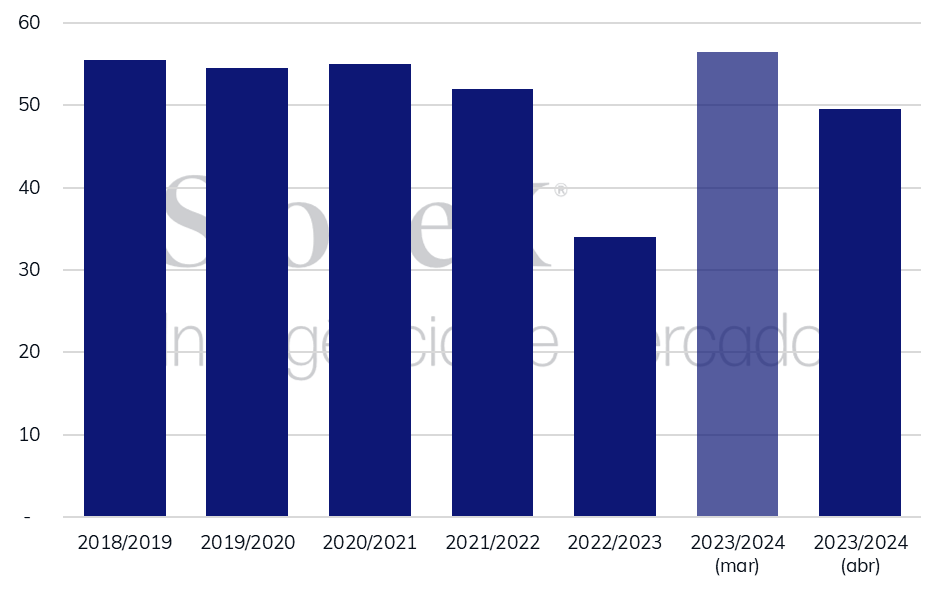
Source: Buenos Aires Grain Exchange (BCBA). Design: StoneX.
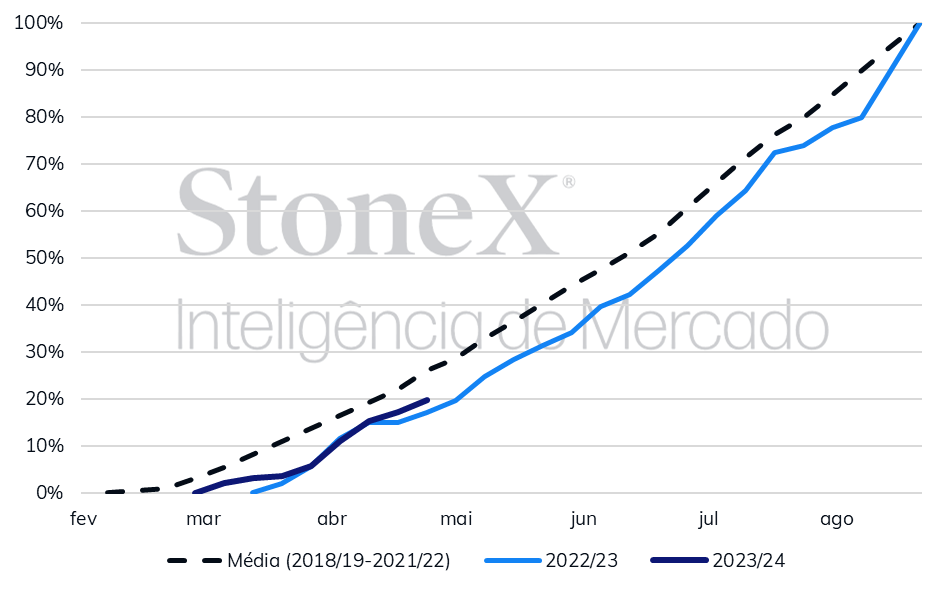
It is worth noting that new corrections to these estimates have not been ruled out. So far, only 19.8% of the crops have been harvested, which means that most of the crop is still subject to the spread of the leafhopper. Moreover, the perspective is that this percentage will not increase so rapidly. As mentioned, between 65% and 75% of Argentine corn crops in 2023/24 are late planting, so most of the harvest is scheduled to occur only from June onwards.
Source: Buenos Aires Grain Exchange (BCBA). Design: StoneX.
The main point of attention is the southern region of Córdoba, an area still untouched by the pest but surrounded by areas where the pest is already well spread. In this region, 19.9% of the hectares planted with corn in the 2023/24 cycle are located, the highest percentage among the 15 zones analyzed by BCBA. As of April 24, only 8.3% of the crops in this area had been harvested, so a large part of the crop in southern Córdoba is still subject to deterioration.
On a continental scale, the impacts of the leafhopper have already caused moderate changes in the supply outlook. Throughout the first quarter, the price of corn on the Chicago exchange fell because the market estimated that the annual decrease in the Brazilian crop 2023/24 would be more than offset by the annual growth of 22.5 million tonnes of the Argentine crop. The statement remains valid, but the power balance between Brazil and Argentina has become evener. This is due to the latest estimate from BCBA, which indicates a rise of 15.5 million tonnes for the Argentine crop. This increase is slightly higher than the reduction of 15.0 million tonnes predicted by StoneX for the Brazilian crop.
Source: Buenos Aires Grain Exchange (BCBA) and StoneX. Design: StoneX.
If there are new cuts in the estimate of either of the two countries, we will probably have a reduction in South American supply in 2023/24 compared to 2022/23.