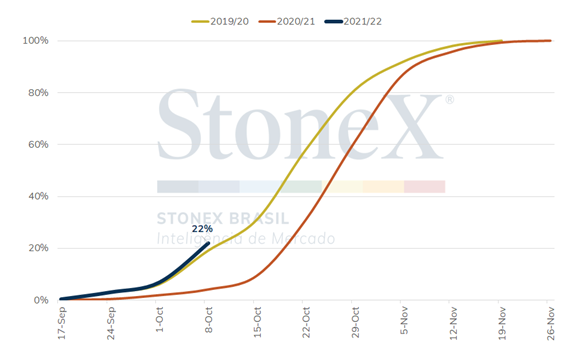
Brazil faces a dry period in the Center-South during the winter months, with rainfall returning from September onwards and allowing the start of the soybean crop in several states, including Mato Grosso. However, in 2020, there was a delay in rainfall normalization, which affected planting in the state and postponed the oilseed harvest.
Since corn and cotton second crops in Mato Grosso account for a large part of production (about 85% of cotton and almost 100% of corn) and they are planted in the same areas where soybean is harvested, the oilseed crop progress is fundamental for their cycles.
This delay in the soybean 2020/21 season directly impacted cotton second crop, whose ideal planting window is between December and January, with 68% of the planting taking place outside this optimal period. In addition, this unfavorable scenario forced farmers to rearrange their cultivation areas, ceasing to plant part of the cotton or changing to other crops, such as corn, which presented a considerably more attractive scenario than the lint at that time.
One of the issues that best illustrates the favorable moment experienced by the cereal was the sales pace. According to StoneX's follow-up, about 67% of the 2020/21 corn crop was sold by the end of 2020, while 57% of the 2019/20 crop was sold by the end of 2019. On the other hand, according to Imea data, cotton experienced the opposite situation. About 54% of the 2020/21 cotton crop was sold, while by the end of 2019, sales for the 2019/20 crop had reached 73%.
This difference in the pace of marketing indicated a greater buying appetite for corn, whose balance sheet was already tight due to heated demand, resulting in tight carryout for the 2019/20 crop. On the other hand, cotton consumption was intensely impacted in 2020 by the drop in textile activity in Brazil and major international hubs due to the crisis caused by the Covid-19 pandemic, which resulted in record stocks of Brazilian cotton at the end of the 2019/20 season.
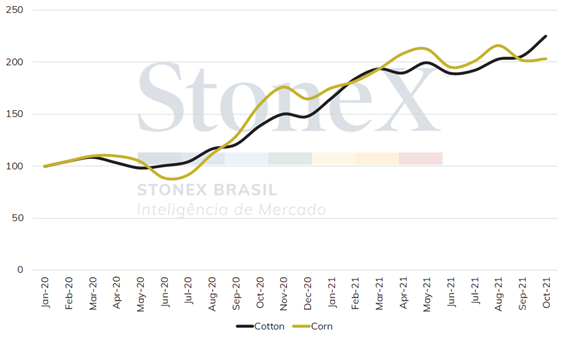
Another issue that helps illustrate the good momentum of the cereal against cotton was the issue of the prices. As much as cotton was quoted at BRL122.91/@, on average, in Mato Grosso in December 2020, showing an appreciation of 36% in the yearly comparison, the price of the cereal reached BRL 59.94/bag, 50% higher from that observed in December 2019, which increased the attractiveness of the grain over cotton.
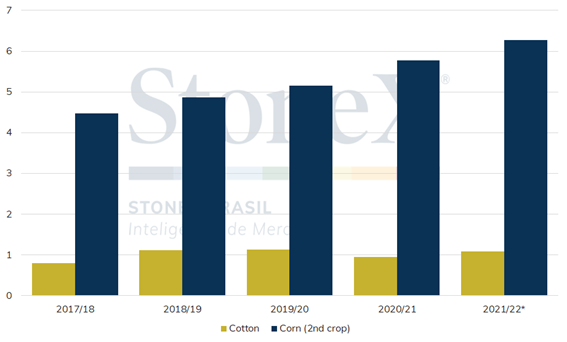
As a result, after a good 2019/20 crop for Mato Grosso cotton farmers, who planted more than one million hectares and produced 2.1 million tonnes of cotton, the planted area in the following season fell to 942,000 hectares, according to IMEA and Conab data. According to Conab, the productivity in the state went from 1,799 kg/hectare to 1682 kg/hectare in this period, resulting in a production 400 thousand tonnes lower.
As for corn, delays in planting, whose best period is between January and February, also contributed to the decline observed in the safrinha 2020/21, highlighting that the below-average rainfall impacted the crops planted later more strongly. As a result, according to StoneX's estimate, the average yield in Mato Grosso was 5.3 tons/ha, a 19% drop compared to the 2019/20 crop, which, even with the 12% increase in planted area, resulted in a production of 30.8 million tonnes, 9% lower compared to the previous crop.
In 2021, on the other hand, the promising start of soybeans planting in Mato Grosso should rule out the possibility of a scenario similar to last year, including forecasts of above-average rainfall in October and estimates of growth in soybeans, cotton and corn areas.