Besides supply, the market will also follow the demand side, which plays a key role in grain pricing. Although the outlook, in general, is for a heated demand, with the good Covid-19 vaccination progress in several countries and the measures adopted by governments around the world to stimulate the economy, China's behavior inspires attention.
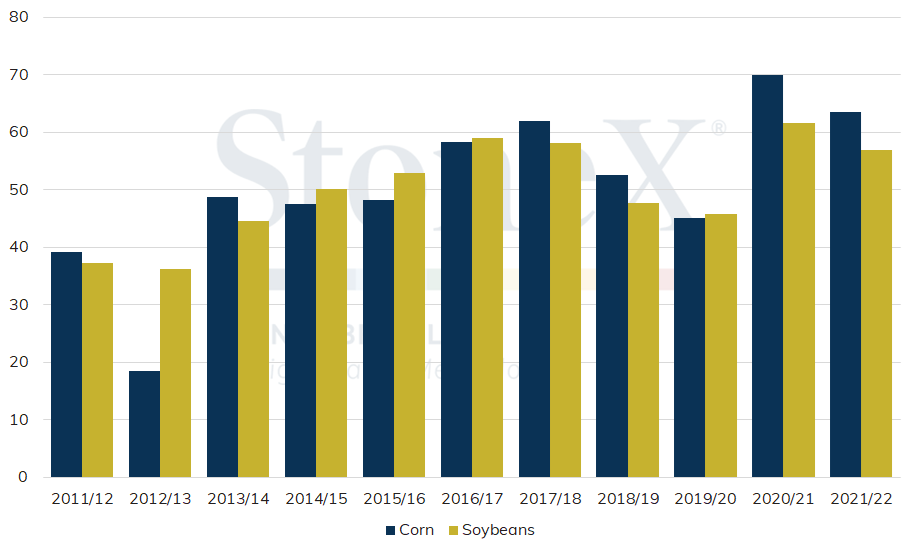
The pace of US soybean export sales for the 2021/22 crop is considerably slower than in the same period last year, with a gap that exceeded 16 million tonnes at the end of the first half of October. As a result, the USDA estimates that exports for the 2021/22 cycle will be slightly weaker, with a considerably smaller gap of 4.78 million tonnes.
China is the main responsible for this weaker pace of North American soybeans sales, and what happens in the Asian country is closely monitored. After the serious outbreaks of African swine fever, which decimated a considerable part of the Chinese herd, there were massive investments in the recovery, including a greater improvement of the meat industries. However, with the herd practically recovered, pork prices are low, which raises concerns about feed consumption. In addition, China is facing an energy crisis, with the shutdown of soybean crushers in some regions.
For now, estimates of Chinese imports stand over 100 million tonnes in 2021/22, a volume that also depends on purchases of US soybeans since the supply of oilseeds is very concentrated.
The Department estimates US exports at 63.5 million tonnes for corn, 6.42 million down from last season.
However, the USDA expects corn imports from China to total 26 million tonnes, the same volume estimated for the 2020/21 crop, leading to the conclusion that US corn is expected to lose market share in the Asian giant, especially to Ukraine, which is in the process of harvesting its 2021/22 crop and heading for record production.
US soybean and corn exports (million tonnes)
Source: USDA. Design StoneX.
Given this scenario, and even though the crop year only ends in August 2022, US sales and shipments need to gain strength in the coming weeks, especially soybeans, since the best window for US exports is the fourth quarter of the year. In the first months of 2022, Brazilian soybeans should already resume the leading role in exports, even more with the great possibility of new record production. Thus, a recovery in US sales is still possible. Still, this movement must occur soon, noting that in the same period in 2020, the country's weekly export sales exceeded 2 million tonnes, while today the volumes are around 1 million tonnes.