On Friday (10), the USDA released its monthly supply and demand report (WASDE), which is always highly anticipated by the market. As expected, the report didn't bring any big surprises, with the US acreage number for the 2022/23 crop to be released on June 30 and only being incorporated in the July WASDE report.
The conflict in Ukraine continues to bring uncertainties to the wheat and corn markets.
Soybean
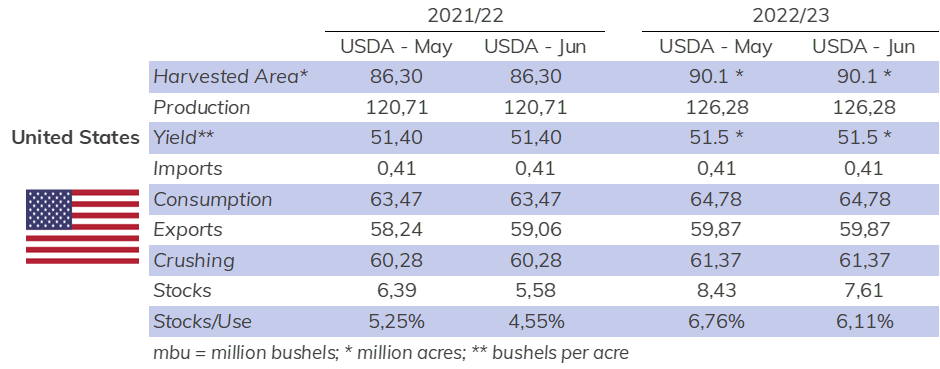
For the US 2022/23, since there were no changes in acreage and yield should be revised only in August, production remained unchanged at 126.3 million tonnes, which would be a record volume for the country.
Demand variables were not adjusted. Even so, ending stocks retreated from 8.43 million to 7.61 million tonnes, reflecting the lower carryin.
This lower carryin resulted from another increase in the country's 2021/22 exports to 59 million tonnes, amid heated sales, mainly to nonChina destinations, which impacted the carryout of the current cycle, which fell to 5.6 million tonnes.
For South America, it is worth noting that the Department increased the Brazilian 2021/22 production from 125 million to 126 million tonnes and the Argentine production from 42 million to 43.4 million tonnes.
Unlike the previous reports, there were no new adjustments in the estimates of China's imports, with its supply and demand balance remaining unchanged for both crops, 2021/22 and 2022/23.
Soybean S&D balance - US (MMT)
Source: USDA. Design: StoneX.
Corn
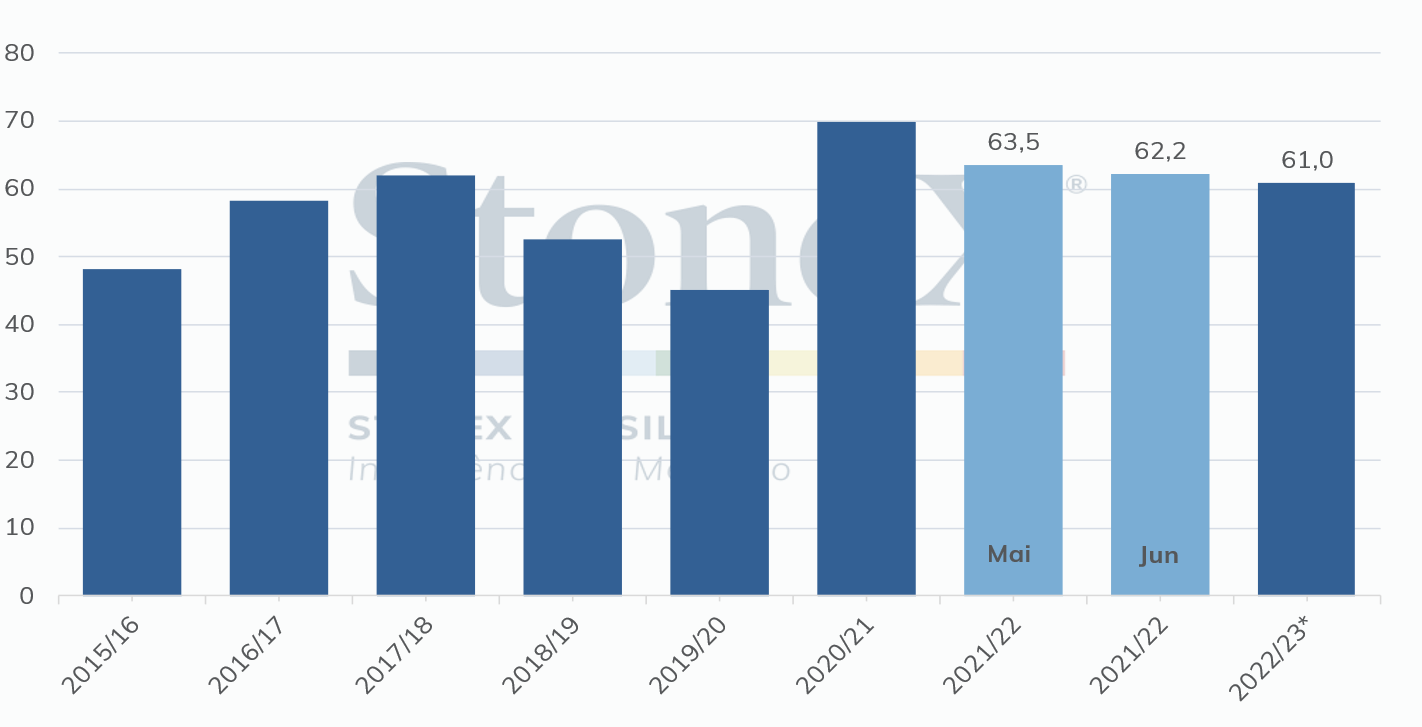
Regarding corn, the main highlight in the North American balance was the reduction in exports related to the US 2021/22 crop, from 63.5 million to 62.2 million tonnes. On the other hand, the Department partially offset the reduction in foreign demand with a slight increase of 127 thousand tonnes in domestic consumption for food, seeds and industrial use to 173.1 million tonnes. With this, ending stocks for the 2021/22 season were raised by 1.1 million tonnes to 37.7 million, resulting in a stock-to-use ratio of 10%, compared to 9.6% in the May report.
As already mentioned, there was no change in the US production for 2022/23, with corn unchanged at 367.3 million tonnes, since the Department is waiting for the acreage report to make further changes in the country's grain supply. For consumption, the estimate for the next cycle exports also remained unchanged at 61 million tonnes, while it brought a marginal increase in domestic consumption for food, seeds and industrial use, going from 173.1 to 173.2 million tons. Thus, ending stocks for the 2022/23 season advanced from 34.5 million to 35.6 million tonnes, with a stock-use ratio of 6.9%, 0.3 p.p. above the last report, which still sets a scenario of tight stocks in the US.
Regarding the main players in the corn market, the USDA brought no changes in its balances for Brazil, Argentina and China but changed the numbers for the Ukrainian 2022/23 crop. The country's production rose from 5.5 million tonnes to 25 million tonnes. According to the Department, this revision was motivated by more optimistic data regarding acreage, which the Ukrainian government reported.
Corn exports trend | US (MMT)
Source: USDA. Design: StoneX.
Wheat
Wheat has again received the attention of the grain market after changes in the estimates for global supply and demand released by the USDA. The Black Sea conflict continues as the protagonist of the effects on the global balance, followed by the weather market.
In the US domestic market, the 2022/23 crop perspective is of increased supply, steady domestic use, unchanged exports, and higher stocks. Supply was revised down by approximately 200,000 tonnes, and wheat yields will trend at 46.9 bushels per acre, an increase of 0.3 bushels from last month's estimate. Wheat projections broken down by classification for the 2022/23 crop will begin to be published from the next report on July 12.
Regarding the global market, the changes were more contrasting and have moved the market since the data release. The outlook indicates pressure on wheat supply for 2022/23, even with lower consumption, resulting in a slight decrease in ending stocks. World production was reduced by 1.4 million tonnes, from 774.83 to 773.43 million tonnes.
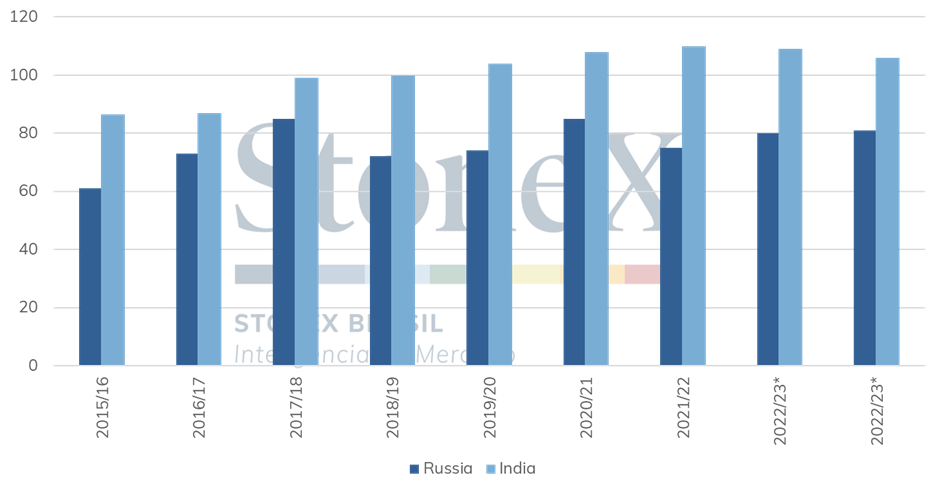
The figures for India and Russia for the 2022/23 crop stand out, while there were no changes for Ukraine. India's production was reduced by 2.5 million tonnes, from 108.5 million to 106.0 million, due to severe weather conditions in March and April. On the other hand, Russia's production increased by 1.0 million tonnes to 81.0 million for winter wheat that is under favorable weather conditions.
Projected global trade for 2022/23 is likely to decline by 0.3 million tonnes to 204.6 million as lower exports from India are not fully offset by higher exports from Russia.
The reconfiguration of wheat trade flows will likely keep prices high, especially as the Russians try to circumvent sanctions and Ukrainian supplies remain trapped in the country.
Wheat Production - Russia and Ukraine (million tonnes)
Source: USDA. Design: StoneX.
The June WASDE report did not bring major changes for cotton, especially for the 2022/23 crop, not generating much volatility in the market, as expected. The biggest revisions were concentrated in the 2021/22 cycle, impacting the Brazilian and Indian productions. Furthermore, the USDA did not change the projections for the North American crop; thus, the country's exports are still estimated at 3.2 million tonnes and ending stocks at 740,000 tonnes.
Regarding the 2021/22 crop, India suffered the most revisions, especially regarding production, which went from 5.55 to 5.33 million tonnes (-3.9%). The Indian crop failure has forced changes in the WASDE projections in recent months, and in the June report, it again impacted exports (-8.5% compared to May) and domestic consumption. Brazil also underwent some revisions due to the 3.8% reduction in domestic production due to unfavorable weather in the main cotton-producing states. With this, its supply went from 2.87 million to 2.77 million tonnes. Nevertheless, despite the fall, the result remains better than the previous cycle, 18% higher than in 2020/21.
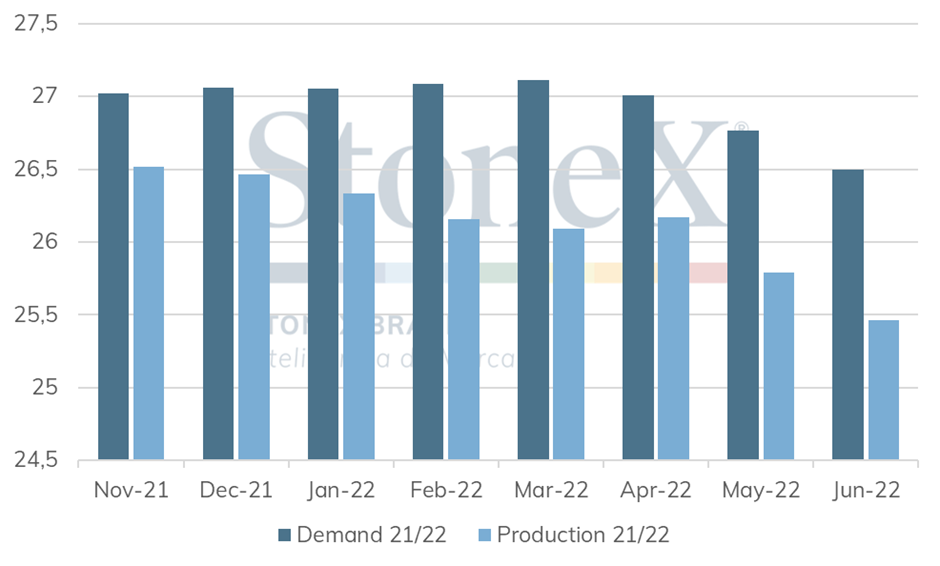
Despite the minor impact on the market, it is possible to state that the recent report has a downward trend since all global demand indicators for the 2022/23 crop were revised downwards, while production suffered a marginal increase, estimated at 26.4 million tonnes. Due to the drop in global production in 2021/22, it is estimated that carryin will decrease in the 2022/23 cycle. The decrease in the 2022/23 carryin was accompanied by a slight reduction in global domestic consumption from 25.6 million to 25.5 million tonnes, keeping ending stocks in 2022/23 almost steady at 18 million tonnes.
However, it is worth noting that even with a drop in demand in 2022/23, demand is still higher than the total supply by 100,000 tonnes. Still, the expectation of a slowdown in the world economy and advancing inflation may provide a margin for a further decline in consumption next season. In addition, despite recent rains in Texas, numerous uncertainties remain regarding the North American result, which may force revisions in WASDE's projections on global production.
Evolution of global consumption and production estimates for 2021/22 (MMT)
Source: USDA. Design: StoneX.