April 19 - Stocks are mixed at midday, while traders digest elevated geopolitical risks along with a fresh recognition that we will likely see the Federal Reserve keep interest rates "higher for longer." The VIX is trading near 19, while the dollar index is trading near 106.1. Yields on 10-year Treasuries are trading near 4.62%, while yields on 2-year Treasuries are trading near 4.97%. Crude oil prices are roughly 1% higher, while the grain and oilseed markets are mostly higher as well, with short traders uneasy amid the heightened geopolitical risks.
The U.S. Environmental Protection Agency confirmed this morning that it will waive requirements that prohibited the sale of gasoline with a 15% ethanol blend between June 1 and September 15. E-15 gasoline is allowed to be sold in other months, but EPA guidelines normally prohibit its sale in the hotter summer months. But for the third year in a row, the EPA will waive those restrictions, and allow for its sale. The amount of E-15 that is sold in America is very small, so waiving the restriction is not going to cause a big increase in ethanol demand. Rather, it will avoid a seasonal dip in demand. It's market impact is more psychological than it is fundamental. Obviously, a wholesale move from E-10 to E-15 across America would have a huge impact - increasing demand for ethanol by nearly 50%. But that's not what we're talking about. A waiver is better than no waiver for the industry, but the market impact is rather small. Nonetheless, today's announcement did help provide a psychological boost to the corn market at a time when it needed it. I reported yesterday that marketing year to date corn use for ethanol exceeds the seasonal pace needed to hit USDA's target by 95 million bushels. The above helps keep that pace going, while the market focuses increasingly on the size of the upcoming harvests in Argentina, followed by Brazil, followed by the U.S. Midwest.
Argentina's corn crop looked to be a big one, following three years of La Nina related drought conditions. But now it looks to be smaller than first anticipated due to a disease in the crop being spread by leaf hopper insects. It's still unclear what the final impact will be on corn yields. Some sources suggest that it may be pretty significant, while others downplay it. This is a relatively new problem, so there's still much to be learned. Further north in Brazil, the winter (safrinha) corn crop is progressing through early pollination. Late March rains helped save the day, and they lingered deeper into April than anticipated. About a quarter of the crop was under stress until weekend rains provided another round of timely relief. Now the pattern is shifting notably drier going forward. We anticipate that production estimates will start eroding lower, although it is still unclear on the extent of losses that we'll see. Daytime highs are generally in the 80s F, with relatively high humidity. The market would care more about the above if not for the 2+ billion bushel surplus carryout in the United States, although that's still not enough to make us immune to weather problems.
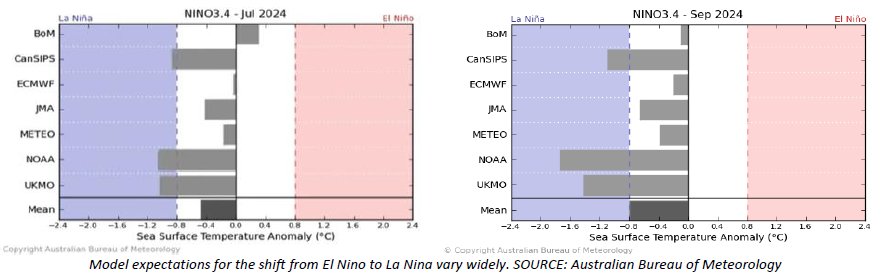
That brings us to the Midwest as we transition out of El Nino to La Nina in the months ahead. The models differ wildly on the anticipated speed of that transition, as illustrated in the graphics below, and they're overall a bit less aggressive now than they were a month ago. The graphic on the left below shows their predictions for the ENSO cycle in July, with the graphic on the right showing it for September. Purple coloring on the left is a weak to stronger La Nina, while the red coloring on the right is a weak or stronger El Nino. We're currently in a weak El Nino that is dissipating. NOAA is among the more aggressive in calling for a borderline moderate La Nina by July, with a strong La Nina going by September. Other models are less aggressive. Which one is correct will have a big impact on our growing season.