April 2 - Stocks are firmly lower at mid-day as hopes for a dovish Fed continue to dissipate following a fresh round of stronger than expected U.S. economic data after more of the same yesterday. The VIX is up somewhat sharply, pushing up to a roughly three-week high earlier in the session and hanging around the 15.1 level. The dollar is down after yesterday's sharp jump, trading around 104.5 at the time of writing. Treasuries are mixed, with 10-year yields up slightly around 4.36% while 2-year yields are down slightly around 4.69%. Crude oil continues to find strength with geopolitical risks rising as Iran vows retaliation for yesterday's Israeli strike that killed several high ranking Iranian military officials in Syria and Ukraine's drone strike on another Russian refinery hundreds of miles from the frontlines raises fears of further escalation. The ags are mixed, with soybeans trying to cling to small gains while the wheat complex sells off following yesterday's USDA Crop Progress report, and the cattle sector bounces back from yesterday's selloff.
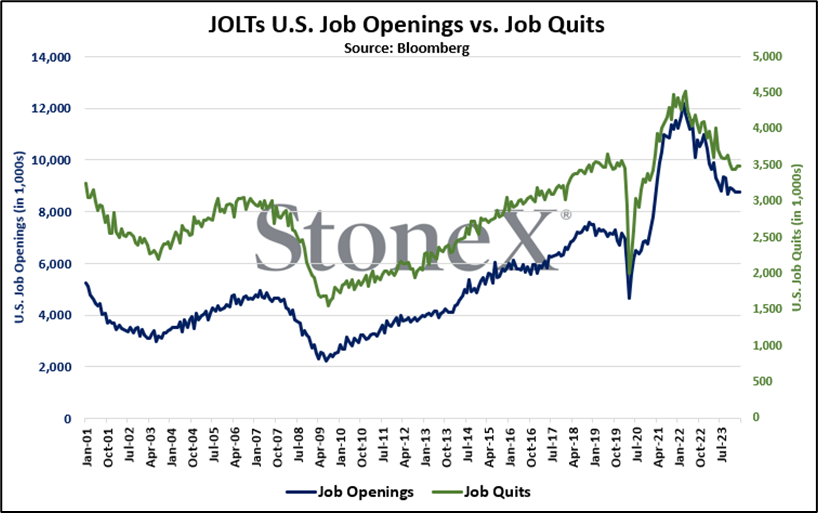
U.S. job openings rose to 8.756M in February, up from the downwardly-revised 8.748M in the month prior but roughly in line with analyst estimates of a rise to 8.76M. By sector, the biggest job gains were in finance & insurance (+126K), followed by state & local government (+91K), and arts, entertainment, and recreation (+51K). Decreases were seen in the information sector (-85K), and the federal government (-21K). Regionally speaking, the only area to see gains were in the West (+81K), while job openings fell in the South (-62K), Midwest (-9K), and Northeast (-2K). Job quits also rose from January's revised 3.446M to reach 3.484M, marking the highest level seen since November but still 22.8% below the record high hit back in April 2022. The quits rate held steady at 2.2% in February, matching the same level seen in the three months prior. The tightness of the U.S. labor market has eased considerably from its peak but, as can be seen in the graphic below, remains relatively high compared to pre-pandemic historical levels. The tight labor market has been a major focus of the battle with inflation, but today's data does little to change the debate. The market will now turn its attention to Friday's upcoming jobs report, with hopes of gaining more insight into the strength of the labor market as well as potential lingering inflationary pressures from wage growth.
U.S. factory orders rose 1.4% in February, much hotter than expectations of a 1.0% rise and a sharp uptick from January's upwardly-revised 3.8% drop (was initially a 4.0% drop). Durable goods orders rose by 1.3%, slightly below the advance estimate of 1.4%, while non-durable goods were up 1.6%. This follows yesterday's surprise hotter than expected manufacturing data that sparked an equity selloff as traders' dovish hopes were dashed. The U.S. manufacturing sector has been one of the hardest hit sectors in the last couple years and its surprising rebound underpins the broader economic strength that has the Fed feeling comfortable with holding rates higher for longer.
Traders will hear plenty from the Fed this week, with multiple members making scheduled remarks today and tomorrow, with the most important being Fed Chair Jerome Powell's speech at Stanford tomorrow. Powell's last public comments on Friday reiterated the importance of the Fed being careful in not pivoting too soon and emphasized that the current strength in the U.S. economy means that the Fed doesn't need to be in a hurry to cut. Expectations are to hear similarly cautious, hawkish comments from Fed members today and tomorrow, with more data to support their approach. Fed fund futures have showed traders gradually walk back their rate cut expectations, with the first cut still expected in June, but the market now pricing in less than 70 basis points of cuts by the end of 2024, meaning their former certainty of seeing three cuts this year is fading.