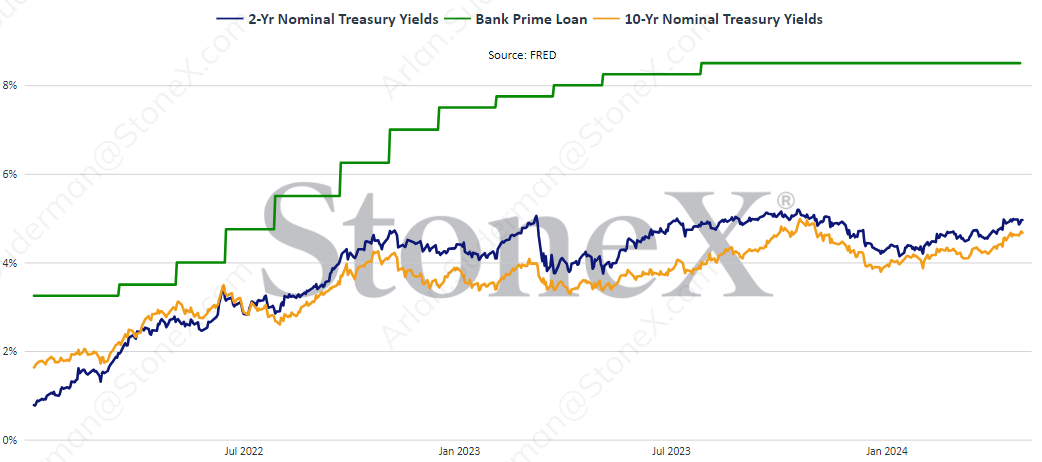
April 30 - Stocks turned lower with this morning's employment cost data, and never looked back as the dollar followed Treasury yields higher. The VIX Is trading near 15 at midday, while the dollar index is trading near 106.1. Yields on 10-year Treasuries are trading near 4.66%, while yields on 2-year Treasuries are trading near 5.01%. The risk-off sentiment carried into the commodities as well, with the energies and grains all under selling pressure today. Corn prices are holding up the best, while active selling produced double-digit losses for soybeans and for wheat. The cattle market continues under pressure amid the bird flu uncertainty surrounding the industry.
Argentine lawmakers began debate Monday on two sweeping economic reform bills supported by President Javier Milei that call for privatizations and for tighter fiscal policy, while also taxing higher level salaries and reforming labor laws. The labor union responsible for the strike stated that the work stoppage will continue as long as the congressional session lasts, with estimates currently focused on one week. At that point they will reassess their best strategy to go forward. The legislation being debated would lower the salary levels subject to income tax, among other things. Demand for U.S. soymeal increased on Monday as word of the strike hit the market, although that strength has not carried into today's session, allowing soybean prices to fall sharply once again.
The Federal Housing Finance Agency house price index rose 1.2% month-on-month in February, representing a sharp turn around from the -0.1% posted in January. Furthermore, the sharp increase surprised analysts, who were anticipating just 0.1% gains. The house price index rose 7.0% year-on-year in February, up from an upwardly revised 6.5% the previous month. Shelter is a major component driving inflation in the services sector, largely due to the lingering shortage of housing that reignites demand whenever consumer sentiment improves and interest rates pull back. We saw a sharp decline in interest rates in early February, which combined with a sharp rise in consumer confidence in January after indications of a Fed pivot in December. That helped fuel the reinflation pressures that we saw in the first quarter of this year.
But the Conference Board's Consumer Confidence Index fell to 97.0 in April, down from a downwardly revised 103.1 in March, and below analyst expectations of 104.0. In fact, the index came in below the lowest of pre-report estimates. Even so, that keeps the index within a relatively narrow band that has largely contained it over the past couple of years. The present situations index dropped to 142.9 in April, down from a downwardly revised 146.8 in March. The expectations index reflecting the consumer's short-term outlook for income, business, and labor conditions, fell to 66.4, down from 74.0 the previous month as Treasury yields rallied again. Six-month buying plans for homes and big-ticket appliances declined, as did vacation plans, as Treasury yields rallied again. An expectations index below 80 often signals an approaching recession. Contrary to the house price index and employment index data released today, the consumer expectations index would argue for a more dovish approach by the Federal Reserve. It was interesting to see that consumer confidence among those bringing in an income of $25,000 to $49,999 was relatively stable, while falling notably among those making less than or more than that range, although consumers under 35 years of age maintained a higher degree of confidence than those over 35 years of age. Longer-term, we're seeing the greatest trend toward an erosion of confidence among those earning more than $50,000.