August 10 - Stocks rallied this morning on an upbeat inflation report that elevated hopes of a quicker rate pivot by the Federal Reserve. The VIX is trading near six-day lows near 15 as stocks rally. Yields on 10-year Treasuries are trading near 4.02% after slipping to eight-day lows earlier in the session, while yields on 2-year Treasuries are trading near 4.78%. Crude oil prices are modestly lower after setting fresh nine-month highs earlier in the session, while the grain and oilseed markets are mixed to firmer at midday. New-crop soybean prices are the strongest in the grain complex as traders position for the possibility that USDA will cut its yield forecast tomorrow, further tightening the new-crop balance sheet. Corn and wheat prices are consolidating just above recent lows, but with a firmer tone to them ahead of tomorrow's report. USDA is expected to make additional cuts to its wheat harvested acreage estimate in tomorrow's report, but possibly with higher yields.
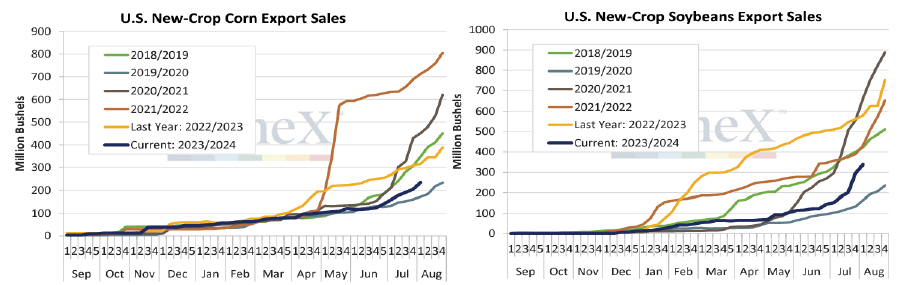
The primary focus of tomorrow's USDA WASDE crop report will be the U.S. corn and soybean yield estimates, although we'll also likely see a bump in Brazil's corn estimate that will have negative implications for some time to come on U.S. exports. The recent surge in Brazilian corn and soybean production is having an impact on U.S. exports of the two commodities, combined with sluggish Chinese demand. The two graphics below show new-crop corn and soybean export sales on the books for the '23/24 marketing year that begins on September 1, relative to other recent years. It's not the slowest start on record, but it is slow relative to most other recent years. New-crop corn export sales to all destinations on the books currently total 235 million bushels, with just 10.7 million bushels of that total destined for China. That could change if China sees a big drop in this year's production due to adverse weather, but that's not currently expected. Rather, demand remains soft due to a large amount of lower quality wheat and rice flooding the feed market due to persistent rains just prior to and during harvest for those two crops. New-crop soybean export sales on the books are a bit better at 338 million bushels, but as you can see from the graphic below, that's still down notably from previous years, with China accounting for just 138 million bushels or 41% of that total. China normally accounts for more than 60% of exports. China has stepped up purchases in recent weeks, but it is still far below its normal pace, while non-China buying is performing better. The above provides further evidence that USDA is likely over-stating new-crop corn and soybean exports, although with soybeans, USDA is likely understating domestic demand to at least partially offset the difference, whereas with corn it's likely overstating U.S. feed usage as well.
A drought in central America may contribute to problems with U.S. exports to China in the year ahead. The Panama Canal is dependent on rainwater to feed its lock system that allows ships to pass through the Canal. The lake that feeds the lock system is at a four-year low due to drought conditions, enhanced by the current El Nino weather pattern. As such, lock operators are reducing the draft for ships moving through the Canal, while also reducing the number of ships that pass each day. There are currently 154 commercial vessels waiting to pass through the Canal with an average wait time of 21 days. The Canal typically moves 23 ships per day through the lock system, but they have currently reduced that to 14, leading to the backlog. The increased waiting time adds to cost, as does choosing an alternate route around South America. The current problem is expected to get worse before it gets better, with shipping slowed through much of the coming year. The added cost may incentivize China to utilize some of the cheaper Brazilian soybeans it's been locking away in reserve rather than pay the higher costs for U.S. soybeans over the next six months, reducing U.S. exports.