August 13 – Optimism abounds on Wall Street at mid-day following this morning’s cooler-than-expected PPI reading, as stocks continue their push higher while the VIX falls below the 19.5 level. Today’s PPI kicks off a big week of economic data, with CPI due up tomorrow, U.S. retail sales on Thursday, and consumer sentiment due on Friday. The dollar reversed course following this morning’s PPI release to now trade in the red on the day, hanging near the 102.7 level at the time of writing. Treasuries have done the same, with 10-year yields now down to 3.86% while 2-year yields trade just above 3.96%. Crude oil is taking a break following its recent rally, with the nearby WTI contract down nearly 2% on the day as it trades near $78.60/barrel, while the ags are in the red across the board following yesterday’s ugly USDA report.
This morning’s PPI data showed a welcomed break in inflation at the wholesale level, helping keep the Fed on the path towards cutting rates starting in September. While the muted headline and core readings were both seen as positives, perhaps one of the most noteworthy takeaways was the decline in services. Service costs have been a sticky portion of the broader battle with inflation over the last few years, accounting for a large share of the initial rises seen as well as the resurgence seen earlier in 2024. However, July marked the first monthly decline in services thus far in 2024, helping offset the jump in energy costs. If this were to be the start of a trend going forward, inflation could have an easier path to continue lower. We’ll get more insight from the Fed later today, with Atlanta Fed President Raphael Bostic on tap to give comments this afternoon.
China’s new bank loans cratered to 260 billion Yuan in July, the lowest level seen since October 2009 as credit demand in the country remains weak amid their prolonged property market slump and broader economic uncertainty. While there is a seasonal element at play here, with July typically being a weak month, this marks a 24.8% drop from last July and a 61.7% drop from July 2022, making it harder to call this a fluke. China’s total social financing, a broad measure of credit and liquidity in the economy that includes off-balance sheet items such as IPO’s, bond sales, etc., also took a dip in July, falling to the second-lowest monthly reading of the year at 770 billion Yuan, though that at least marked an improvement from the same month in the year prior. These readings highlight an ongoing cloud over market sentiment in China, with trading volume in Chinese stocks falling to levels not seen since the pandemic lows of May 2020.
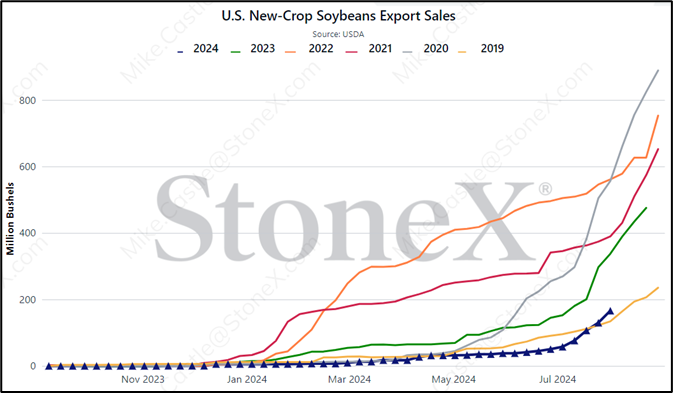
Chinese economic concerns are negative for soybeans, adding additional downside pressure following yesterday’s heavily bearish report from the USDA. Soybeans are seeing double-digit losses again today, trading at nearly four-year lows. While the supply side is ugly, with the would be record national yield of 53.2 bpa and an additional million acres leading to record production and the highest carryout seen since 2018, it’s important to look at the demand side as well. USDA also raised 2024/25 soybean exports by 25 million bushels, now pegged at 1.85 billion. This would mark a sizable 150-million-bushel year-on-year increase. As of last week’s export sales report, 2024/25 soybean sales lag last year’s pace by 50.8%, meaning we need to see a very large ramp-up in demand for U.S. soybeans to meet this estimate. China is by far the top buyer of U.S. soybeans, but 2024/25 sales to China lag last year’s pace by 85% and sales to unknown destinations, typically assumed to be China, lag last year’s pace by 23%. While we’ve seen an uptick in Chinese soybean purchases recently, the majority of that has favored South American origins, as was the case this year as well. With the USDA calling for back-to-back record South American soybean crops, China coming off record imports in the 2023/24 season, and ongoing concerns regarding the Chinese economy, it’s not out of the question to see their imports take a bigger-than-expected step back in the year ahead, potentially causing U.S. supplies to become even heavier than anticipated.