August 15 - Stocks increased their losses this morning as Wall Street traders fretted that this morning's strong retail sales data for July may push the Federal Reserve to increase its benchmark interest rate again. The VIX Is trading back above 16 at this hour, while the dollar index is trading near 103.0. Yields on 10-year Treasuries are trading near 4.18%, while yields on 2-year Treasuries are trading near 4.92% as investors seek the safe-haven securities. Broad-based selling in the commodity space weighed on both the energy and the Ag sector this morning. Crude oil prices are more than 2% lower, while wheat leads the grain and oilseed sector lower with more than 2% losses as well. December corn is poised for a possible test of the July low, while Chicago wheat fell to its lowest level since May 31st. Additional pressure comes from larger-than-expected increases in the corn and soybean crop ratings released by USDA on Monday afternoon, suggesting a recovery in those crops from late-July heat and dryness stress.
The United States has a demand problem. Export demand for U.S. corn, soybeans and wheat is very poor. USDA cut its old-crop corn export target again on Friday to 1.625 billion bushels, which is down 775 million bushels from where its target started a year ago. It lowered its current-year wheat export target to 700 million bushels, which if verified would become our lowest export total in 52 years. There's been a lot of focus this summer on strong Chinese soybean demand, with people wrongfully interpreting that as strong domestic demand in China. It's true that cheaper prices have stimulated a return to higher soymeal inclusion levels in rations, but that doesn't explain the bulk of the higher-than-expected demand. The primary driver has been China's desire to take advantage of Brazil's cheap currency and its bumper soybean crop. It continues to import roughly 2 million metric tons per month more than it crushes, sticking the surplus soybeans away in its reserves. Keep in mind that last year it reduced its U.S. soybean purchases by offering soybeans from its reserves, drawing them down. It's now rebuilding those reserves, plus adding more.
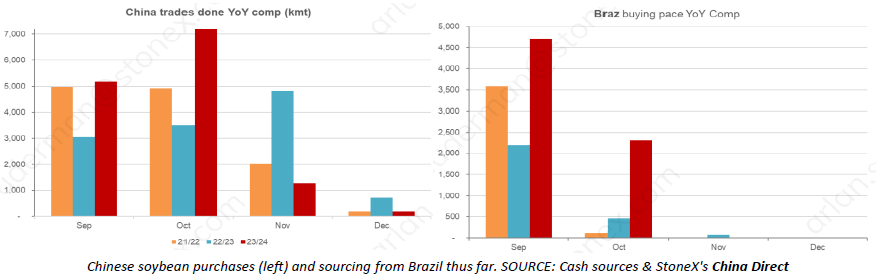
The question is, will they again use those reserves to reduce U.S. purchases - possibly by a much larger amount? We don't know the answer to that question. If so, they could dramatically reduce demand for U.S. soybeans during our peak export season. The answer to that question may hinge on the prospect for another big Brazilian crop in six months. Planting will start in Mato Grosso a month from today, although El Nino often times brings a late start to the rainy season that allows planting to start. China may want to see how the growing season starts before deciding to pull from its reserves again. However, we do know that the massive size of Brazil's past crop is already having a negative impact on U.S. exports, regardless of whether China pulls substantially from its reserves. That's because China is actively buying Brazilian soybeans for shipment during the normal U.S. export season. The graphic on the left comes from China Direct, which is published daily from our Shanghai office. It shows Chinese purchases for loading over the next four months, relative to the pace of purchases the previous two years. The graphic on the right shows purchases from Brazil for loading over the next four months, relative to the past couple of years. The graphics show that China has already covered more than 7 mmt of its October shipment needs, or roughly 70% of its estimated demand for the month. That's roughly 3 mmt ahead of the pace seen last year at this time. Its October shipment bookings from Brazil are roughly 2 mmt above the previous year's pace, reducing the need for U.S. soybeans in its peak shipment period. My '23/24 soybean export target has been 1.775 billion bushels for some time, but I may be too high, depending on how the above plays out over the next 60 days.