August 30 - Stocks firmed this morning on the belief that today's weak economic data will open the door for a pause in interest rate hikes by the Federal Reserve, although a couple of key data reports are still scheduled for later this week. Even so, the VIX slipped to a four-week low near 14 today, while the dollar index is trading at a two-week low near 103.1. Yields on 10-year Treasuries are trading near 4.10%, while yields on 2-year Treasuries are trading near 4.87%. Crude oil prices are modestly higher as we approach midday, while the grain and oilseed markets are mostly lower. Profit taking and spread unwinding supported Chicago wheat following recent sharp losses, but the rest of the primary grain and oilseed markets were under modest pressure today that seemed to be caught up in a pre-holiday weekend malaise. Traders continue to hear anecdotal reports of crop deterioration from the current Midwest weather pattern, but they lack data to suggest that the deterioration is worse than what has already been priced into the market. The next USDA crop ratings won't be released until Tuesday, with the agency closed on Monday for Labor Day.
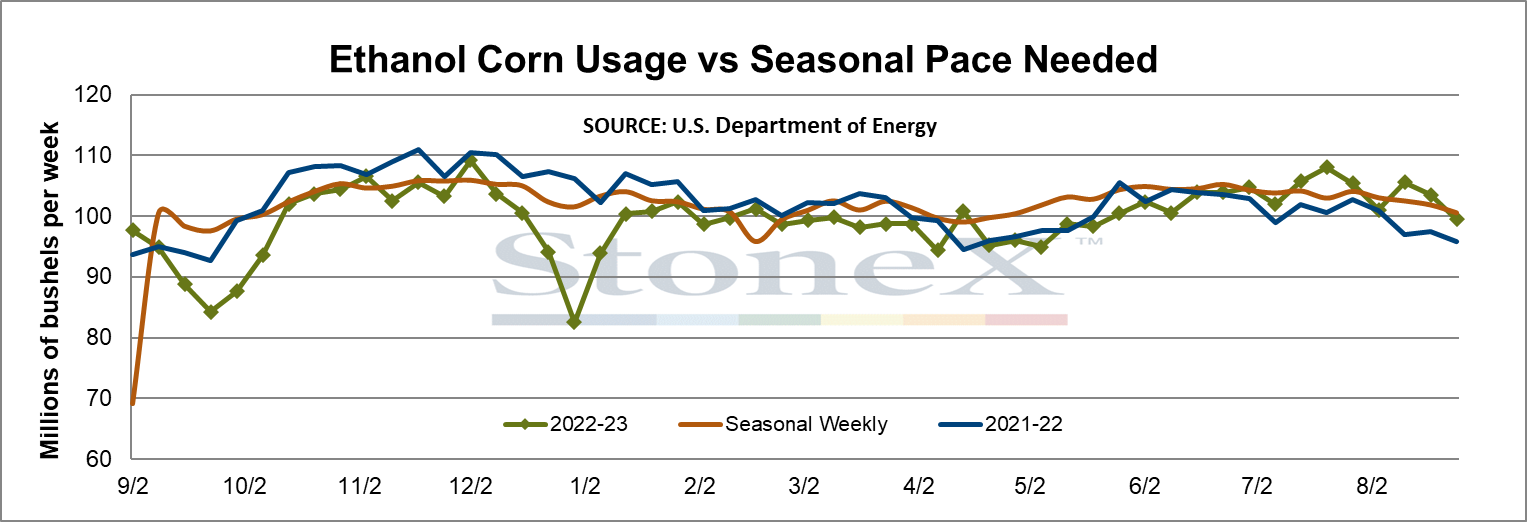
Commercial crude oil inventories fell by another 10.6 million barrels in the week ending August 25, continuing the trend of rapid depletion of supplies that we've seen this month. Total stocks, minus the Strategic Petroleum Reserve, are now at 422.9 million barrels, down 3% from the five-year average for late August. It's interesting to note that crude oil imports are increasing, with the four-week average at 6.8 million barrels per day, up by more than 12% from the previous year's pace. Gasoline stocks fell by 0.2 million barrels, putting them 5% below seasonal levels. Distillate stocks rose by 1.2 million barrels last week, but they remain 15% below levels typically seen at this time of year. Ethanol stocks fell to a 19-month low of 21.6 million barrels in the week ending August 25, down from 22.8 million the previous week and down from 23.5 million barrels in the same week last year. Ethanol production slipped to 1,007K barrels per day during the week, down from 1,048K bpd the previous week, but up from 970K bpd in the same week last year. The graphic below shows estimated weekly corn use for the production of ethanol. Estimated corn use for ethanol for the marketing year to date totals 5.111 billion bushels, with six days left in the year. That suggests that we could see the final numbers come in 20ish million bushels below USDA's target, depending on final conversion data for July and August.
The State Street Investor confidence index surged 11.4 points in August to 107.7, posting its largest monthly increase in 18 months. The index increased in all three global regions. The North American index rose by 12.9 points to 103.8, while the Asian index rose 4.8 points to 102.2 and the European index rose 4.3 points to 103.7. The index measures investor confidence by monitoring the flow of money both in and out of the equity markets. Other data released today revealed that the pending home sales index rose 0.9% in July to 77.6, when analysts expected it to slide 0.4% following 0.4% gains in June. Contract signings rose in both the South and in the West, while declining in the Northeast and in the Midwest. While sales rose in July, pending home sales remain down 14% year-on-year. The trade is now focused on tomorrow's personal income and outlays data that will include the PCE inflation data - the Federal Reserve's preferred gauge of inflation. Analysts expect it to show headline inflation at 3.3% in July, with core inflation at 4.2% - not that much different than the consumer price data. That will be followed by the big monthly jobs report on Friday, which is expected to show that the economy created 170K jobs in August, while leaving the unemployment rate quite tight at 3.5%. Average hourly earnings are expected to be up 4.4% year-on-year.