December 17 – Stocks are in the red at mid-day, with the market continuing to focus on expectations of a more hawkish Fed in 2025 than previously thought, with only two more 25 basis point rate cuts (after this week’s expected 25-point cut) now priced in by the end of 2025. The probability for a 25-point cut tomorrow remains almost certain at 95.2%, though it is worth pointing out that’s down from 98.2% yesterday following this morning’s hotter than expected retail sales. The VIX pushed to a nearly one-month high earlier this morning but has since come back down to hover below the 15.3 level at the time of writing. The dollar is back in the green with weakness elsewhere around the globe, trading just above the 106.6 level. Treasuries are off slightly at mid-day, with 10-year yields just below 4.39% and 2-year yields below 4.25%. Crude oil remains in the red, with the nearby WTI contract trading around $69.50, while the ags are largely in the red, save for the cattle complex.
U.S. homebuilder sentiment held steady in December, with NAHB’s Housing Market Index remaining unchanged from November at 46 versus forecasts of a minor improvement up to 47. Breaking down the data, current sales conditions held steady at 48, while optimism for the future continued to show improvement, with six-month sales expectations rising another 3 points up to a reading of 66, the highest level seen since April 2022. However, traffic of prospective buyers offset some of this positivity, falling one point back down to 31. When looking at things regionally, the Northeast continues to show the most optimism, rising to a six-month high of 62, while the Midwest held steady at 48, the South improved from November’s 42 up to 48, but the West fell one point down to 38, the lowest level seen since August. Today’s data is just a preliminary reading, so we will get another update at the end of the month, but the overall outlook for the housing market from the perspective of builders has improved solidly through the fall since bottoming out this summer.
November manufacturing production in the U.S. disappointed on this morning’s report, showing 0.2% month-on-month growth versus market estimates of a 0.5% increase, while October was revised further downward from -0.5% down to -0.7%. In year-on-year terms, U.S. manufacturing production was down by 1%, the sharpest decline seen since April and marking the fifth consecutive monthly decline. Overall industrial production fell 0.1% month-on-month, sharply missing forecasts of 0.3% month-on-month growth, though still improving from October’s downwardly revised -0.4%. While the manufacturing side was below expectations, the real drag came from ugly drops in mining output and utility output and distribution of -0.9% and -1.3% month-on-month, respectively. In year-on-year terms, overall U.S. industrial production was down by 0.9%, the largest decline seen since January. Total capacity utilization fell to its lowest level since April 2021 at only 76.8%, well below forecasts of an improvement to 77.3%. By sector, manufacturing capacity utilization actually showed a slight 0.1% improvement to 76.0%, while mining fell by 0.7% to 88.8%, and utilities operating rates fell a sharp 1.2% to only 70.0%. While the downward revisions and overall poor performance in October may be explained in part by the impact of Hurricane Milton and maybe to some extent rebounding from Hurricanes Francine and Helene in the month prior, the lack of improvement in November is certainly a disappointment.
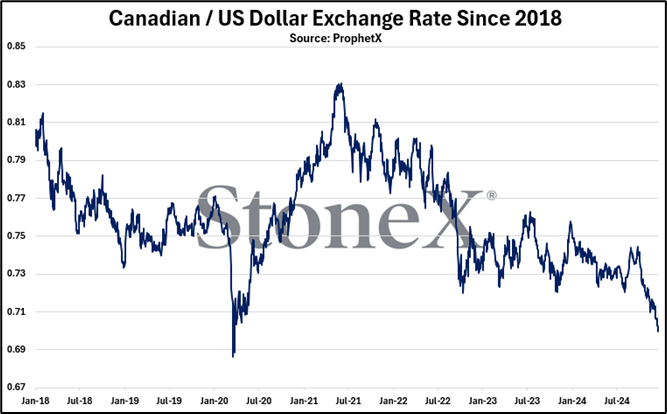
Political strife within a growing handful of the world’s largest economies is adding uncertainty to the broader markets, with Canada joining the list following the abrupt resignation of their Finance Minister yesterday. The timing couldn’t be much worse for the Canadian government, with now-former Finance Minister Chrystia Freeland also being the head of a special cabinet committee on Canada/U.S. relations and the Trump administration set to take office next month calling for tariffs on Canada. Multiple Canadian politicians have referred to the country’s current situation as “chaos,” and they are not alone, as this follows breakdowns in government in France, Germany, and South Korea. This means four of the world’s thirteen largest economies are all facing considerable difficulty in governing, providing more uncertainty to the global economic picture. The ongoing situation in Canada has pushed the Canadian dollar to its lowest level versus the U.S. dollar since the pandemic dip in the spring of 2020.