February 5 – The tech heavy Nasdaq is leading the way lower at mid-day due to disappointing earnings from Google parent Alphabet and Advanced Micro Devices (AMD), while the Dow Jones and S&P 500 are pushing back narrowly into the green after trading lower earlier in the session. The VIX has calmed through the day, hovering near 16.7 at the time of writing after pushing to 17.3 earlier this morning. The U.S. Dollar continues to break sharply lower this week, pushing down to 107.3 at mid-day after spiking as high as 109.75 on Monday. Treasuries are under pressure as well, with 10-year yields falling to their lowest level since mid-December around 4.42% while 2-year yields are doing the same as they hover near 4.17%. Crude oil is weaker on the day, with the nearby WTI contract trading down to $71 following an unexpectedly large build in U.S. crude and gasoline stocks on this morning’s DOE report. The ags are mixed with soybeans leading the way down while the wheat complex attempts to cling to small gains and the cattle complex rebounds relatively sharply from early week losses.
The U.S. service sector took a step back to start 2025, with this morning’s January Services PMI readings from both ISM and S&P Global showing notable declines from the month prior. ISM’s reading fell to 52.8 in January while December was also revised downward slightly to a 54.0 reading. This missed expectations of a slight rise to 54.3, with business activity and new orders both taking noteworthy steps back. S&P Global’s January Services PMI came in at 52.9, down sharply from the 56.5 seen in December and marking the lowest level seen since April 2024. On a more positive note, the employment portions of both indexes showed strength, adding further signs of health in the U.S. labor market after the stronger than expected ADP report this morning.
Nitrogen fertilizer prices are rallying sharply both globally and domestically ahead of the upcoming U.S. spring application season. On the global side, ongoing Chinese urea export restrictions combined with the loss of Iranian production and subsequently exports due to gas availability issues have restricted front-end supply, while strong demand from Brazil and India have soaked up much of the available length. India recently wrapped up a tender in which their purchase goal was 1.5 million metric tons (MMT) but were only able to secure ~559K. Due to this shortfall, expectations are to see them step forward with another tender in the near future. Unfortunately for the U.S., the timing of this tender could force domestic buyers to compete directly with India for these relatively limited tons during the most important season of U.S. nitrogen imports, early spring.
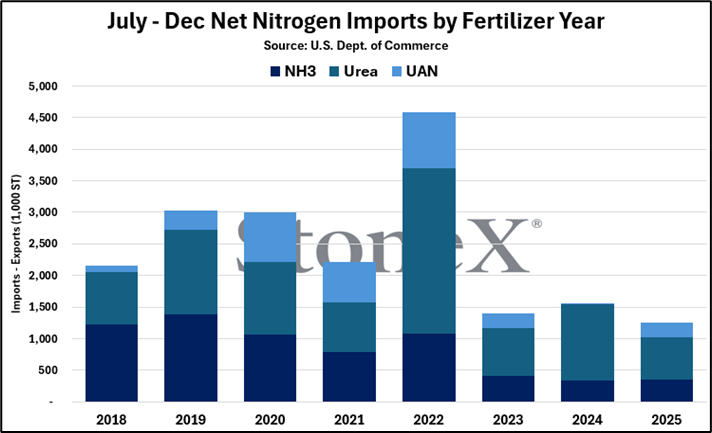
December U.S. trade data was released this morning, showing domestic nitrogen supply continuing to look quite snug heading into the offseason, meaning there is considerable ground to be made up prior to spring. Through the first half of fertilizer year 2025 (for those not familiar, the U.S. fertilizer year runs July – June), the U.S. has seen the smallest net imports (imports minus exports) of the big three nitrogen products in the last decade-plus. Across the board on nitrogen, U.S. imports have been behind schedule while exports have been ahead of schedule due in large part to the global tightness alluded to above and the larger role on the export market that the U.S. has moved into since Russia’s invasion of Ukraine nearly three years ago. While it’s not too late to ramp-up imports ahead of the spring season, we know U.S. Gulf (i.e. NOLA) values will have work to do relative to firming global values in order to draw in said imports. We’ve seen this work being done, with nitrogen prices rallying throughout the start of 2025 and NOLA urea and UAN values climbing $15 - $25/ton this week alone, but with other northern hemisphere buyers stepping forward and India potentially announcing another tender soon, we may continue to see that global tightness play out in the weeks/months ahead.