January 10 - Stocks traded modestly higher midday as traders anticipate key inflation data over the next two days. The VIX is trading below 13 again, while the dollar index is trading near 102.4. Yields on 10-year Treasuries are trading near 4.03%, while yields on 2-year Treasuries are trading near 4.37%. The broader commodity sector is mixed, with crude oil prices near unchanged at midday, while grain and oilseed prices consolidate ahead of Friday's big set of USDA crop reports. The agency will be releasing the results of its winter wheat seedings survey, quarterly grain stocks survey, final 2023 U.S. production estimates, while also revising its domestic and global balance sheets. It's the largest data dump of the year, opening the door for a higher risk of surprises in either direction. Meanwhile, the protein sector continues to deal with weather disruptions. Lean hog futures are consolidating from recent strong gains, but both the cattle and hog complex continue to be impacted by the current weather pattern. Feed yards in the western feedlot region are finally getting back into all areas to feed cattle, while a packing plant in Dodge City is still shut down. Performance of both cattle and hogs are being negatively impacted by the snow and the cold.
China reviewed its grain reserve acquisitions over the past year in a national work conference on Monday and Tuesday. It purchased more than 400 million metric tons of grain in 2023 for the reserve, which is 57.5% of the country’s total output for the year of 695 million tons. China utilized strategic measures to ensure national food security through policy-based purchases and/or sales to help stabilize domestic prices against the impact of fluctuating international grain prices. Policy-based transactions dominate China’s corn, wheat, and rice. Authorities set price floors for wheat and rice in major producing provinces to protect farmers' interests. China has built a storage capacity of standard warehouses for grains to contain as much as 700 million tons in its reserves, which exceeds its annual production. It believes that this lays a solid foundation for China to maintain abundant grain inventories, with the stock-to-use ratio above the international grain security threshold of 17-18%. China believes this keeps prices stable for its producers, but as we learned in the 1980s, it also disincentivizes production. That's one of the reasons why its trend corn yield is still just above 100 bushels per acre. However, it also means that China believes that is less vulnerable to famine that could cause its citizens to stage a revolt against the government.
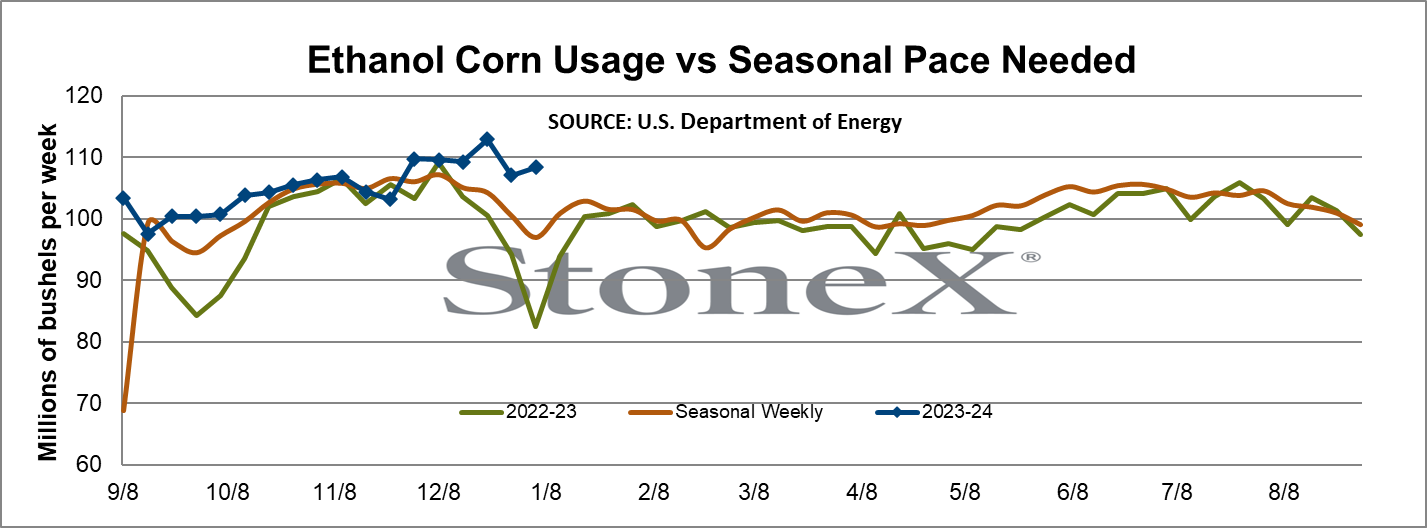
U.S. commercial crude oil stocks (excluding the Strategic Petroleum Reserve) rose 1.3 million to 432.4 million barrels in the week ending January 5, leaving it still about 2% below levels typically seen in early January. Gasoline stocks increased by 8.0 million barrels, putting them 1% above seasonal levels. Distillate stocks jumped 6.5 million barrels, putting them still roughly 4% below the five-year average for this week of the year. Ethanol stocks rose to an eight-month high 24.4 million barrels in the week ending January 5, up from 23.6 million the previous week, and up from 23.8 million barrels in the same week last year. Ethanol production rose to 1,062K barrels per day on favorable grind margins during the week, up from 1,049K bpd the previous week, and up from 943K bpd in the same week last year. The production of ethanol utilized an estimated 108.4 million bushels of corn in the week ending January 5, as shown below, up from 107.0 million the previous week, and up from 93.9 million bushels the previous year. Estimated year to date corn use for ethanol totals 1.908 billion bushels, up 119 million or 6.7% from the previous year's pace, arguing for USDA to bump its corn use for ethanol target by another 30 - 50 million bushels on Friday.