January 7 – Stocks are under pressure today as concerns of a more hawkish Fed rise following this morning’s stronger than expected U.S. economic data, while the VIX rises above 17. With the labor market and service sector both looking much hotter than previously feared, traders are now pricing in an over 95% chance of rates being left alone at the FOMC’s next meeting later this month, with the next cut not expected until June and only one cut priced in by the end of 2025. This is also bolstering the U.S. dollar, which has reversed course through the morning to now trade higher, just below 108.3 at the time of writing. Treasuries are pushing higher as well, with 10-year yields trading above 4.69% while 2-year yields trade near 4.31%. Crude oil is recovering some of yesterday’s losses, with the nearby WTI contract back up to $74.20 this morning after snapping a five-day winning streak the day prior. The ags are mixed, with the wheat complex clinging to small gains while corn and soybeans hang narrowly in the red.
Today’s JOLTs report showed a sharp increase in job openings in the U.S. to 8.098M in November, much larger than market expectations of 7.70M, while October was revised higher up to 7.839M as well (from 7.744M previously). This marks the highest level of job openings seen since May, pointing to renewed strength in the U.S. labor market and dampening the need for rate cuts. Professional and business services led the way higher (+273k), followed by finance and insurance (+105k), and private educational services (+38k), while losses were seen in the information sector (-89k). Regionally speaking, the biggest increase was seen in the South (+194k), followed by the Northeast (+49k), and the West (+32k), with the Midwest being the only region to report a loss (-16k). It’s worth noting that this big increase in the South may be influenced in part by post-hurricane recovery in November, so perhaps take some portion of this strength with a grain of salt. Another highlight from this morning’s report was job quits falling to only 3.065M in November, the lowest level seen since August 2020, with the quits rate (voluntary job leavers as a proportion of total employment) falling to only 1.9%.
The U.S. service sector showed strength to close out 2024, with this morning’s ISM Services PMI rising to 54.1 in December, up from 52.1 in November and above market expectations of a 53.3 reading. The Business Activity subindex saw an improvement to 58.2 in December from the 53.7 seen in November, while the New Orders subindex also improved to 54.2 from the 53.7 in the month prior. Elsewhere, the Employment portion did see a slight drop to 51.4 from the 51.5 in November, though this still capped off a three-month streak in expansionary territory for the first time since late 2023. While most of the above news was quite positive, one less rosy takeaway was the Prices subindex rising very sharply to 64.4, the highest level seen since February 2023. With concerns of re-inflation in 2025 simmering, this could be a bit of a warning sign of things to come, also supportive of a more hawkish Fed.
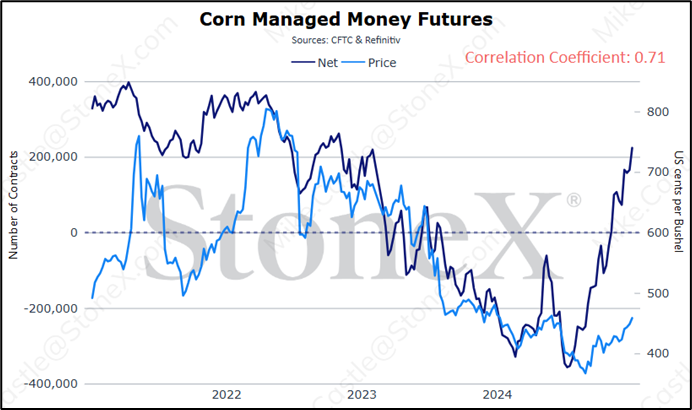
Yesterday’s holiday-delayed CFTC Report in general saw big net purchases by managed money, adding 67.9k net length in corn on the week ending 12/31 to hold their biggest net long since November 2022 as the fundamental situation in the U.S. tightens. Managed money also bought back a net 25.4k of soybeans, effectively cutting their net short in half but trade estimates see them rebuilding shorts into the end of last week and yesterday. Soymeal saw similar action, while soy oil net shorts built by just under 10k on the week. Managed money also covered small portions of their net shorts in Chicago and KC wheat but are estimated to remain quite net short across the board in the wheat complex. Fundamental information before Friday’s much anticipated data dump from the USDA remains fairly limited, but we’re likely to continue seeing a fair bit of back and forth in the days leading up as speculative traders position themselves accordingly.