July 1 - Stocks struggled to hang onto early morning strength, as traders begin to shift their focus to the monthly jobs report that will be released on Friday, the day after the market is closed for the July 4th Independence Day holiday. The VIX continues to trade below 13 at midday, while the dollar index is trading near 105.9, recovering from sharp overnight losses as Treasury yields surge higher. Yields on 10-year Treasuries are trading near 4.48%, after posting fresh four-week highs, while yields on 2-year Treasuries are trading near 4.78%, after posting three-week highs. Crude oil prices probed above $83 late-morning to post fresh two-month highs on improving demand prospects, while the grain and oilseed sector is mixed to firmer in today's trade.
Corn prices are again under pressure today following USDA's bearish stocks and bearish acreage reports for the feed grain, although the lead September and December contracts have both held above Friday's lows thus far. Nonetheless, today's weakness wipes away any encouragement that chart technicians may have had from a relatively good finish to Friday's trading session, with added weakness coming as corn gets the short end of spread trading. Technically, end users will be watching to see if we hold Friday's low in this week's holiday-shortened trade. Strength in the markets is seen primarily in the soyoil and wheat markets. Frankly, both had fallen to levels that were seen as attractive by end users for extending coverage, creating some demand. Both markets had fallen to levels on the charts that had previously uncovered support.
There's a lot of farmer wheat and corn to be sold on rallies, and still quite a bit of soybeans as well - especially in Brazil. As such, rallies will be difficult to sustain until / unless a bullish story develops. Demand for soyoil as a feedstock for biofuel is expected to improve significantly in 2025, but that's still six months away, with plenty of time to trade weather in both the U.S. Midwest and the next Brazilian growing season between now and then. Related to that, StoneX Brazil maintained its old-crop soybean production estimate at 149 mmt today, based on its latest customer survey, while it cut its all-corn production estimate slightly to 121.18 mmt due to a modest reduction in its planted area estimate. USDA will be weighing in with its revised estimates when it releases its July WASDE crop report at the end of next week.
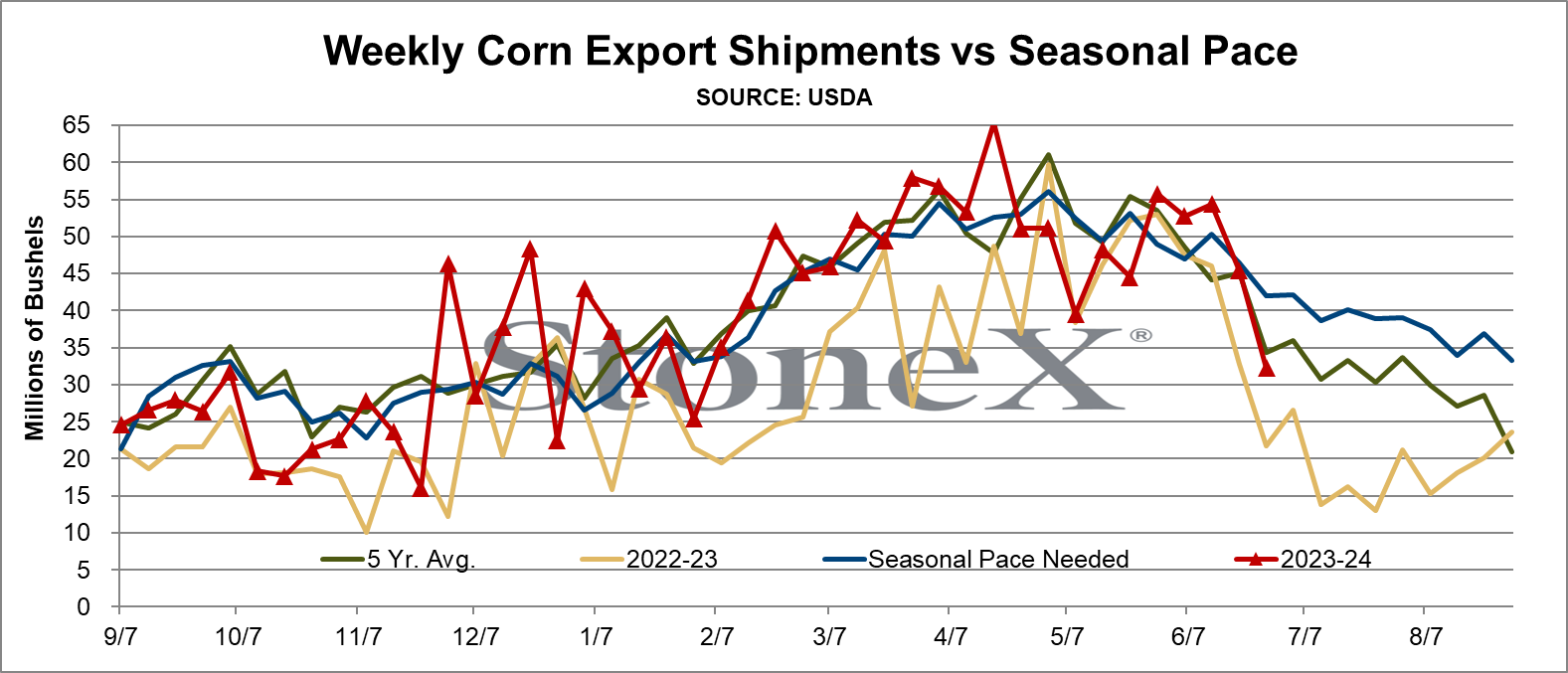
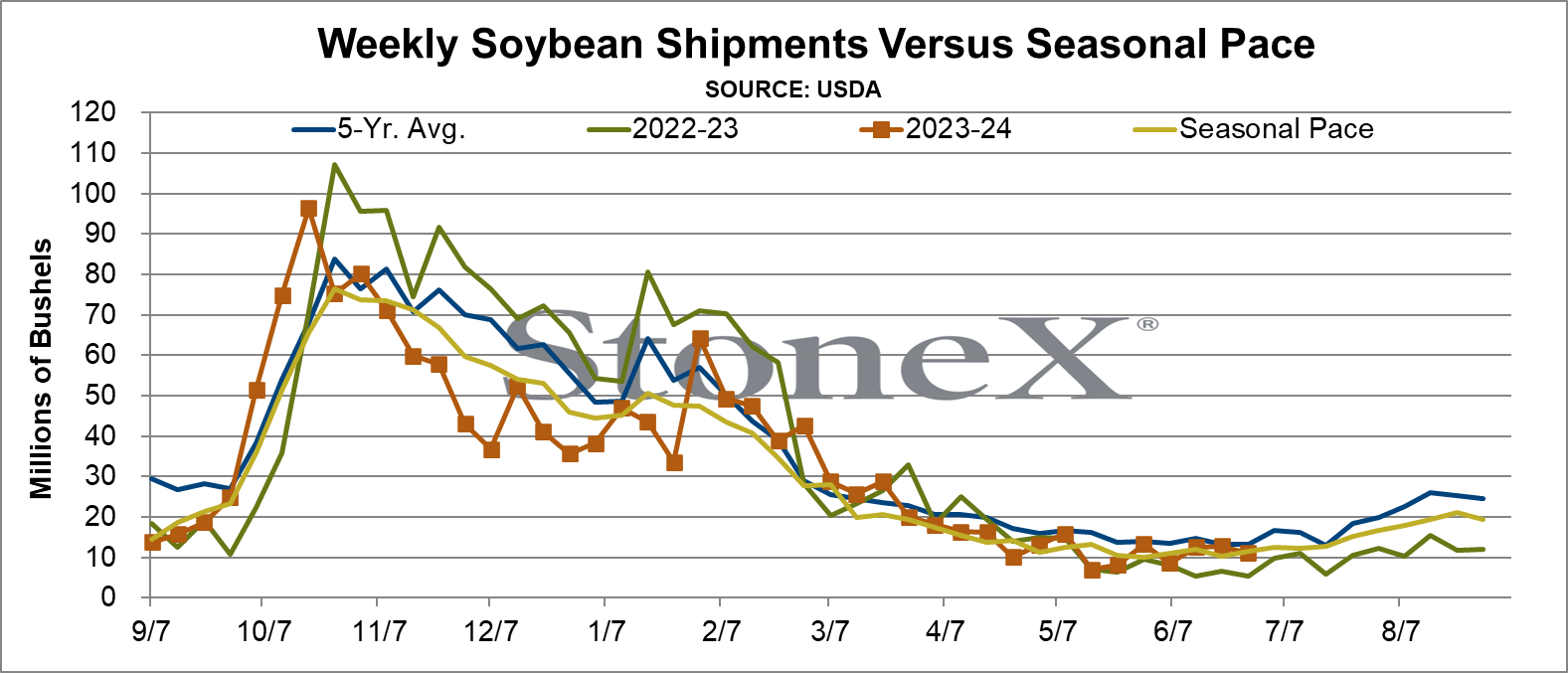
USDA inspected 32.3 million bushels of corn for export shipment in the week ending June 27, as shown in the graphic below, along with 11.1 million bushels of soybeans, 11.4 million bushels of wheat and 2.2 million bushels of grain sorghum. The portion of the above that was inspected for shipment to China included 2.1 million bushels of grain sorghum, but just miniscule amounts of corn, soybeans and wheat. Marketing year to date corn export inspections total 1.672 billion bushels, up 367 million bushels or 28% from the previous year's pace and 19 million bushels above the seasonal pace needed to hit USDA's target. However, the inspection pace dropped dramatically over the past couple of weeks as new-crop Argentine and Brazilian corn began to flow freely onto the world markets, raising concerns about where we could end the marketing year in two months. Marketing year to date soybean export inspections total 1.526 billion bushels, down 290 million bushels or 16% from the previous year's pace, but still 30 million bushels above the seasonal pace needed to hit USDA's target for the year. The problem is that sales commitments for the marketing year to date fall notably below the pace needed to hit USDA's target, raising concerns about whether we can maintain a sufficient shipment pace.