Today's Perspective Video: Are We on the Cusp of a Commodity Trade Deal with China?
July 16 - Stocks came under pressure this morning on a wire service report that President Trump is considering firing Federal Reserve Chair Jerome Powell. The White House spoke of that possibility earlier this year, but then pulled back from that position when the markets reacted negatively to it, worrying about the risk of political interference in monetary policy. Trump has remained critical of Powell, urging him to resign, but Powell has remained resolute. Criticism increased last week when the White House's Office of Management and Budget reportedly sent Powell a letter stating that it was "extremely troubled" by cost overruns in the Fed's $2.5 billion renovation of its headquarters in Washington. I've been critical of Powell and of the Federal Reserve, but it's never good to have political influence over the Fed. The markets recovered after President Trump told reporters that he's "very concerned" about Powell, but that he's "not planning on doing anything." In reality, Trump may be testing the market response with these leaks.
Stocks are under pressure despite data released this morning showing better than expected industrial output in June. Industrial production rose 0.3% month-on-month in June, up from analyst expectations of a 0.1% rise. The May data was also revised to flat, up from the -0.2% originally reported. Manufacturing output posted 1% growth in June, matching analyst expectations, while the May numbers were revised to 0.3% growth, up from the 0.1% growth originally reported. Capacity utilization rose to 77.6% in June, up from an upwardly revised 77.5% the previous month.
The VIX rose as stocks fell, with Wall Street's "fear indicator" currently trading near 18 after rising to a three-week high on the Trump - Powell rumors. However, all of the markets recovered somewhat as Trump dialed back the threats, and as Trump spoke of a possible trade deal with India. The dollar index is trading near 98.4 after falling notably earlier in the session. Yields on 10-year Treasuries though remain strong near 4.49%, while yields on 2-year Treasuries dropped to trade near 3.90%. This reflects the fact that the Fed is largely losing control of the longer-end of the yield curve, while it still maintains the ability to influence the short end. Crude oil prices are modestly lower, while the grain and oilseed markets are mostly higher in value buying at current cheap price levels.
The soybean market led the grain and oilseed sector higher this morning, capturing the attention of many in the industry. November soybeans successfully tested support at the psychological $10 level this week. The August weather models continue to suggest risk for the Midwest - the critical month for soybeans. "Unknown Destinations" bought a couple of cargoes of U.S. soybeans, which always triggers rumors of China buying, even though I remain skeptical. For the most part, we're seeing chart-driven value buying support the grain and oilseed markets this week.
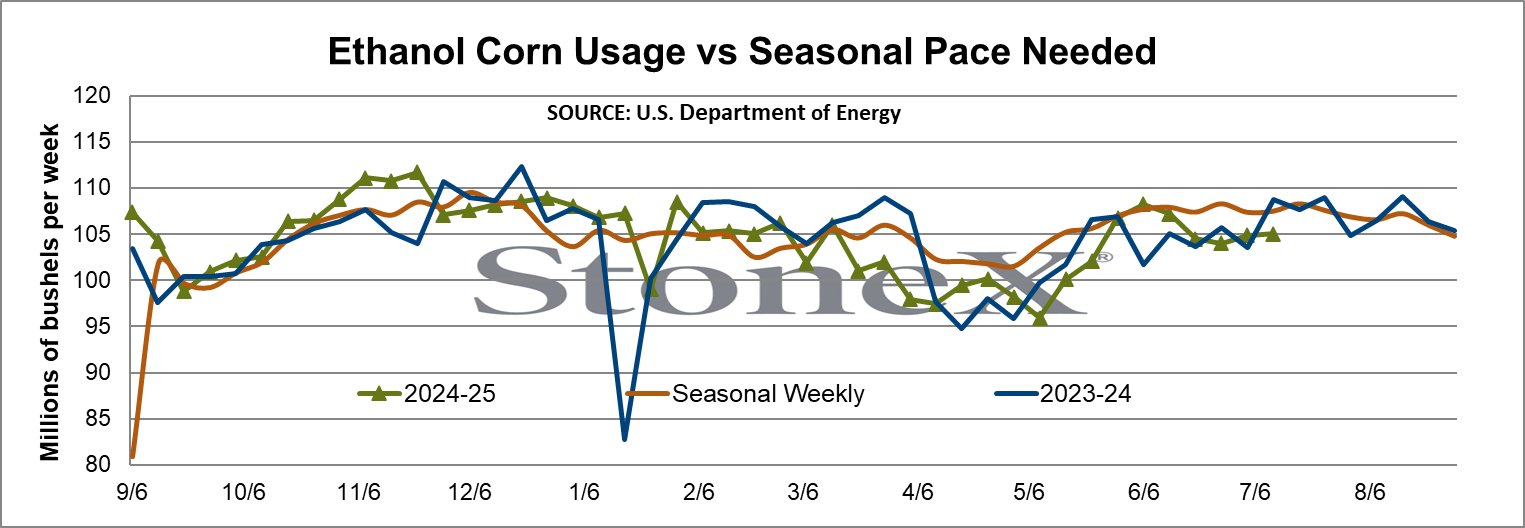
U.S. commercial crude oil stocks (excluding the Strategic Petroleum Reserve) fell by 3.9 million to 422.2 million barrels in the week ending July 11, putting them about 8% below levels typically seen in mid-July. Gasoline stocks increased by 3.4 million barrels, yet they remained slightly above seasonal levels. Distillate stocks rose by 4.2 million barrels to put them 21% below the five-year average for the week. Ethanol stocks slipped to 23.6 million barrels in the week ending July 11, down from 24.0 million barrels the previous week, but up from 23.2 million barrels in the same week last year. Ethanol production rose to 1,087K barrels per day last week, up slightly from 1,085K bpd the previous week, but down from 1,106K bpd in the same week last year. The production of fuel ethanol utilized an estimated 105.1 million bushels of corn last week, up from 104.9 million the previous week, but down from 108.7 million bushels in the same week last year. Estimated marketing year to date corn use for ethanol totals 4.691 billion bushels, down 6 million bushels from the previous year's pace, and nearly 15 million bushels below the seasonal pace needed to hit USDA's target for the year.