July 21 – The S&P 500 and Nasdaq are both at record highs at mid-day as the stock market starts the week off on a strong note, while the VIX cools slightly to hover around the 16.4 mark. The dollar is starting the week off in the red after falling on Friday, trading back below the 98 level to sit near 97.8 at the time of writing. Treasuries are slightly weaker as well, with 10-year yields trading just below 4.36% and 2-year yields trading just above 3.84%. Crude oil prices are also in the red to start the week, with nearby WTI down roughly 1% on the day as it trades near $65.75/barrel. The ags are mostly lower, with the grains and oilseeds down across the board as more beneficial rains fall and Midwest forecasts turn less threatening, though the cattle complex is again pushing higher.
The Conference Board’s Leading Economic Index (LEI) for the U.S. fell by 0.3% in June to 98.8, slightly worse than analyst estimates of a 0.2% decline, though May was revised upward to unchanged versus the original -0.1% reading. Conference Board officials noted that the stock price rally supported the LEI in June, though it was not enough to offset the negative impact of weak new orders in the manufacturing sector, soft consumer expectations, and rising claims for unemployment insurance. They also noted that the Conference Board does not forecast a recession at this point, though they do anticipate U.S. economic growth to slow in 2025, forecasting a real GDP growth of 1.6%. While the outlook for the leading index was relatively pessimistic, the Coincident Economic Index (CEI) that instead provides a look at the current state of the economy rose by 0.3% in June to 115.1, an improvement from unchanged readings in both April and May. All four components of the CEI (payroll employment, personal income less transfer payments, manufacturing and trade sales, and industrial production) saw month-on-month gains in June.
USDA inspected 26.9 million bushels of wheat for export in the week ending July 17th, blowing past the top-end trade estimate of 18.4 million and marking the largest weekly U.S. wheat inspections since September 2022. By class, HRW led the way at 10.9 million bushels, SRW at 6.8 million, HRS at 6.7 million, white wheat at 2.0 million, and durum at 0.5 million. Nigeria was the top destination for U.S. wheat, followed by Mexico and Indonesia.
Meanwhile, corn inspections fell to their lowest since early January at only 38.7 million bushels, coming in below the low-end estimate, though cumulative inspections remain well ahead of schedule on the year. Mexico was the top destination here. Soybean inspections were solid at 13.4 million bushels, coming in toward the high-end of the estimated range, with Germany being the featured destination. For the first time since at least the turn of the century, no milo was inspected for export, continuing to highlight the difficult demand picture for the crop given the ongoing absence of our traditional top buyer, China.
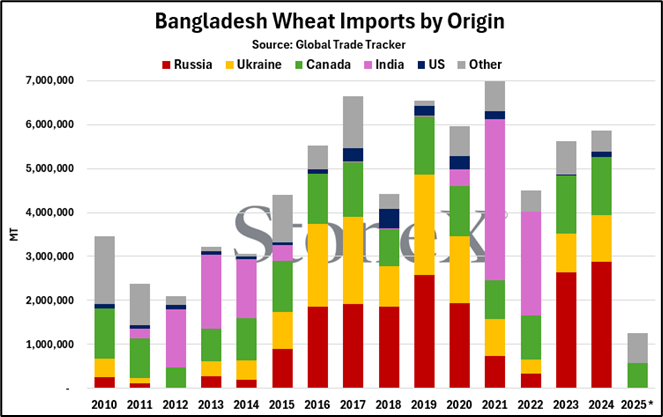
In other good news on the wheat side, the 700,000 MT per year wheat imports from the U.S. that Bangladesh committed to yesterday would represent a sizable uptick in the country's purchases of U.S. wheat. In fact, this volume would represent a new all-time record for U.S. wheat exports to Bangladesh by over 50%, with the previous record shipments being set in 2018 at 449,751 MT. As shown in the below graphic, Bangladesh typically gets the majority of their wheat from the Black Sea region, as well as Canada and at times India. The wheat complex traded higher in the overnights and early this morning on the news, but the downward momentum from the selloff in corn and soybeans, coupled with the still heavy global fundamentals, has taken the steam out as futures have dipped back into the red at mid-day. Regardless, the wheat market will take any amount of good news on the demand side it can get at this point.