July 22 – Stocks are mixed at mid-day, with the Dow Jones clinging to small gains while the S&P 500 and Nasdaq both hang in the red, with the latter leading the way down on weakness in chip stocks. The VIX traded up to 17.48 this morning, the highest since last Wednesday, but has since cooled to hover around 16.9 at the time of writing. The dollar is trading at a nearly two-week low as it slumps below the 97.5 level, adding to yesterday’s losses to start the week out on a soft note, providing some amount of tailwind for the commodity sector as U.S. exports look more affordable. Crude oil is down yet again as traders fret about a potential slowdown in demand given the upcoming August 1 tariff deadline as nearby WTI falls below the $65 mark for the first time since July 1. The ags are mixed, with corn and front-end soybeans in the red while deferred soybeans and the wheat complex push higher.
The Richmond Fed’s Manufacturing Index slumped to -20 in July, a notable decline from June’s downwardly revised -8 and marking the worst reading for the index since September 2024. All three of the headline index’s components deteriorated in July, with shipments falling to -18 in July from the -5 seen in June, new orders falling to -25 from -12 previously, and employment falling to -16 from -6 previously. For context, the Richmond Fed’s (Fifth District) survey includes firms in the District of Columbia, Maryland, North Carolina, South Carolina, Virginia, and most of West Virginia.
While the manufacturing data looked a bit ugly, the service sector in the Fifth District provided somewhat of a silver lining. The Richmond Fed’s Service Revenues Index broke back into expansionary territory in July with a reading of 2, up from the -1 seen in June and representing the first positive reading since February. Improvements were seen in the Demand, Local Business Conditions, and Equipment & Software Spending subindexes, while Capital Expenditures took a step back and Services Expenditures held steady. Similar to the manufacturing side, the employment portion deteriorated for the service sector as well. Today’s data also showed some positivity for the inflation picture, with input costs for both the manufacturing and service sectors taking a step back in July, while output prices also fell for manufacturers but rose for service providers.
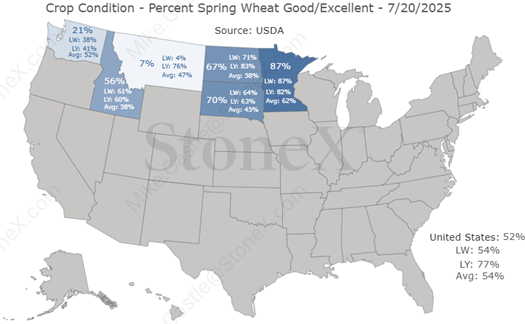
U.S. spring wheat ratings took an unexpected step back on yesterday afternoon’s USDA Crop Progress report, falling 2% week-over-week to now sit at 52% good/excellent versus market expectations of a 1% weekly improvement. The drop was largely a result of a sharp 17% decline in Washington, coupled with a 5% drop in Idaho, and a 4% drop in North Dakota. The hardest hit state this season, Montana, had been looking at their worst ratings on record earlier this month but saw a 3% week-on-week improvement to reach 7% good/excellent, now pulling ahead of where they sat at this point in 2021. On the opposite end of the spectrum, Minnesota’s spring wheat crop held steady at 87% good/excellent, the second-best on record for the week, trailing only the 88% seen at this time in 2010. Much of spring wheat country saw beneficial rains over the weekend and yesterday, with a system moving across the Dakotas and northern Minnesota today. On the other side of the border, there’s also a system currently bringing rain to southern Alberta’s spring wheat crop; it will be interesting to watch how far north this system holds as it progresses eastward, as the northern stretches of Saskatchewan’s spring wheat belt could certainly use another drink.
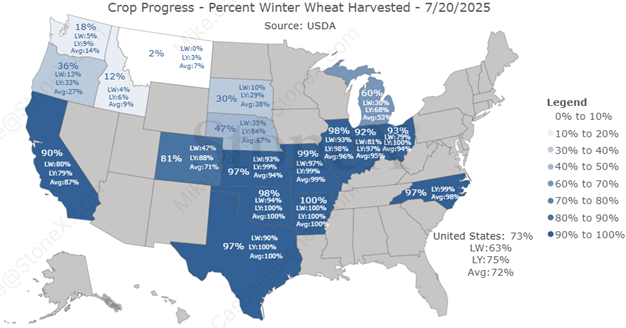
Winter wheat harvest advanced another 10% week-on-week to reach 73% complete, 1% behind market expectations but 1% ahead of the previous 5-year average for the week after initially getting off to a slow start. Nebraska and South Dakota are the furthest behind schedule now, entering the week at 47% and 30% complete, respectively. Forecasts show off-and-on chances of rain throughout the next two weeks for both states, potentially delaying harvest further. It’s also worth keeping an eye on the potential for quality issues this could cause, especially given the ongoing reports of issues with the European wheat crop.