July 25 - Stocks are mixed to higher at midday as traders buy time ahead of tomorrow's highly-anticipated interest rate announcement from the Federal Reserve. The dollar is trading near 101.4 at midday, while yields on 10-year Treasuries are trading near 3.90%, and yields on 2-year Treasuries are trading near 4.89%. Crude oil prices are modestly higher at fresh three-month highs, while the grain and oilseed sector is mostly lower - albeit well off session lows. Market-moving headlines are primarily focused on the escalating war in Ukraine that could reignite commodity inflation once again. One of the factors that I'll be listening for tomorrow will be whether the Fed acknowledges commodity risk in its assessment of inflation. Much of the focus this week is on food prices, but we've already seen a major breakout higher for energy prices in recent days.
The grain and oilseed sector came under pressure overnight when Russia chose not to continue its nightly shelling of Ukraine's export infrastructure - at least for last night. The general expectation is that there will be more strikes, although only Russia knows to what extent. Grain prices didn't rally yesterday because of an immediate shortage of corn and wheat on the world market. Russia continues to dump cheap wheat on the market, while Brazil is harvesting a record corn crop. But this week's rally has largely been about fears for future shortages as Russia bombs Ukraine's infrastructure, that may discourage Ukraine farmers from planting in the year ahead. The European Union's Agriculture Commissioner tried to calm nerves today by stating that the EU is committed to facilitating export channels for Ukraine production, saying that it can bring Ukraine exports back upward to 4.5 million metric tons per month over time. That's easier said than done, but we can't rule out that possibility.
Grain prices came off their session lows, with Chicago wheat trading positive, when British intelligence reported that Russia is mining portions of the Black Sea - including near Ukrainian waters - that may be targeting civilian ships, with the intent of Ukraine getting the blame. That provides further evidence that this war is rising to another level this week, increasing the longer-term risks for commodities coming out of the region, including from Russia. And that's really the bottom line here. Living without Ukraine grain exports is one thing, but seeing limitations on Russian energy and grain exports is an entirely different story. The war is escalating, and the more it escalates, the more we increase the risk for the impediment of commodity movement out of both Russia and Ukraine.
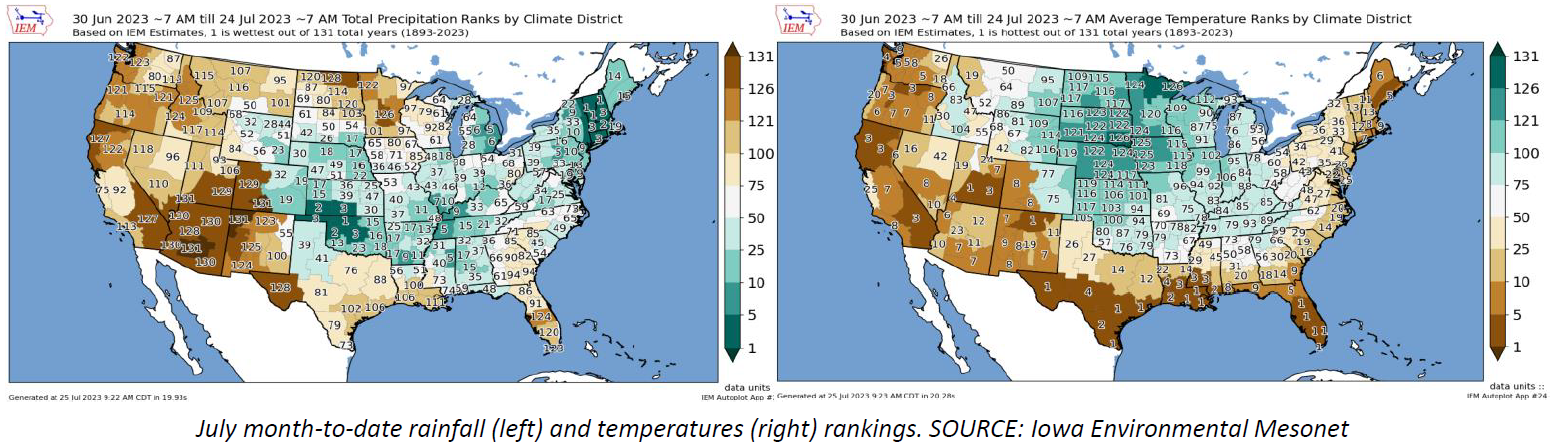
The past month played out as expected across the Midwest, with generally mild temperatures and improved rainfall the primary story, while areas of the northwestern Midwest missed out on many of the desired rains. This period of mostly favorable weather for crops was preceded by a period of significant stress, and it is now being followed by the same, with heat and dryness the story over the coming week to 10 days. Forecast models still call for conditions to improve in the early days of August, leading to another generally favorable period of weeks when mild temperatures and improved rainfall favor crop development. The key question then will revolve around the extent of limitations put on yield potential due to stress in June, and again in the days ahead, and how much of that can be offset by favorable conditions seen in July, and anticipated again for much of August sandwiched around the period of stress? The bottom line is that odds of a trend or above yield are not favorable. But neither do we see a major crop failure at this point. Corn has both the acres and the weak demand to give the balance sheet some room for a decline in yield. Soybeans do not have that luxury, so that's where the concern needs to be focused. StoneX will release its first customer-survey based yield and production estimates on August 2nd.