July 28 – Wall Street is taking the U.S. / E.U. deal in stride, with stocks starting the week on a positive note as the major indexes all trade in the green at mid-day. The VIX is up around 2% on the day but remains quite muted as it trades just below the 15.3 level. The dollar is seeing considerable strength in the wake of the deal’s announcement, rising 0.8% to trade below 98.5, the highest level seen since last Monday. Treasuries are up on the day as well, with 10-year yields pushing above 4.41% and 2-year yields above 3.93%. Crude oil is starting the week off strong with the U.S. / E.U. agreement alleviating some demand fears, while President Trump’s threats today of shortening his initial 50-day deadline on Russia for potential punitive sanctions, tariffs, and/or secondary tariffs on buyers of Russian oil due to the lack of progress on peace talks with Ukraine adds further upside pressure. The ags are mostly lower with August forecasts for the Midwest continuing to look less threatening after another cooler shift in the outlook over the weekend coupled with the widespread rains seen, though the livestock sector is mostly in the green to start the week.
Manufacturing activity in Texas saw an unexpected jump in July, with this morning's Dallas Fed Manufacturing Index returning to expansionary territory for the first time since January with a 0.9 reading. This is a major improvement from the -12.7 seen in June and the 5-year low of -35.8 hit back in April amid the height of tariff fears; analyst estimates were for a much more moderate improvement to -9.0 in July. The Production Index saw a massive 20-point month-on-month increase to 21.3, the highest reading in more than three years, helping drive the headline reading higher. The manufacturers’ outlook for future conditions improved notably in July as well, with the Company Outlook subindex seeing its first positive reading in six months at 4.7, while the Outlook Uncertainty Index fell four points to come in at 11.2. Employment saw an improvement as well, with that subindex rising from 5.7 in June to 8.4 in July, while hours worked also rose. Inflationary pressures are still showing signs of potential re-emergence as they remain elevated to 2023/24 levels but did improve in July, with the Prices Paid subindex falling from 43.0 to 41.7 and Prices Received falling from 26.1 to 11.1.
China’s industrial profits fell 4.3% month-on-month in June, according to this weekend’s data release from China’s National Bureau of Statistics. On a positive note, this was an improvement from the 9.1% month-on-month drop seen in May, but continues to raise red flags regarding the impact of the ongoing trade spat with their top trading partner, the U.S. The worst performance was seen for state-owned firms, posting a 7.6% decline month-on-month, while private-sector firms saw a 1.7% month-on-month gain, and foreign firms led the way higher with a 2.5% gain. However, foreign direct investment into China took another step back in June, falling 15.2% year-over-year to 423.23B Yuan (~$59.2B), sharper than the 13.2% decline seen in May and sharper than analyst estimates of a more moderate decline to -14% to mark the worst drop since February.
With the U.S. and E.U. agreeing to a framework trade deal, all eyes shift back to negotiations between the U.S. and China as the two sides meet in Stockholm. While no major breakthrough is anticipated, expectations are to see the two sides agree on another 90-day extension of tariffs and export controls that are currently set to expire on August 12. If that does happen, the deadline would be pushed back into November, potentially setting up for an in-person meeting between Presidents Trump and Xi that has been rumored to be in the works for this fall. Given the enormous weight of the world’s two largest economies, this obviously has implications for the entire global economy, but the agriculture sector is especially impacted. The U.S. currently has zero bushels of ‘25/’26 soybeans, corn, wheat, or milo sold to China, a rare but not unheard-of situation at this time of the year. But, with the calendar turning to August this week, harvest of massive U.S. crops is looming in the not-so-distant future, meaning we’ll have a huge amount of production looking for homes soon, further raising the importance of reaching some form of agreement with China.
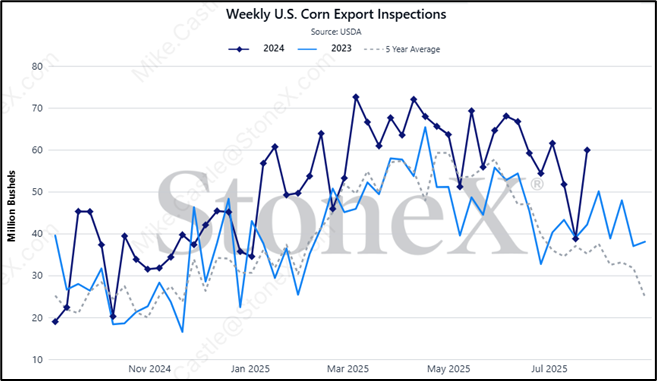
USDA inspected 59.9 million bushels of corn for export in the week ending July 24, a sharp rebound from the week prior and coming in above even the top-end trade estimate of 55.1 million. Japan and Mexico were the featured destinations, with the two combining to account for most of the week’s shipments. Soybean inspections came in at 15.1 million bushels, toward the high-end of expectations and marking a seven-week high. All wheat inspections fell to a five-week low at 10.6 million bushels, falling below the low-end trade estimate of 11 million with Nigeria, Japan, and Mexico the featured destinations. Milo inspections rose to a five-week high at 1.3 million bushels, all going to Spain. As has been the case for some time now, zero bushels of corn, soybeans, wheat, or milo were destined for China.