July 31 - A bullish forecast from AMD provided a boost for tech stocks this morning, as traders continue to wait for this afternoon's updated policy statement and press conference from the Federal Open Market Committee. However, all of this takes place in the shadow of mounting fears of a broader war in the Middle East as Iran pledges revenge on Israel for the killing of Hamas and Hezbollah leaders in a 24 hour period - one of which took place in Tehran. Now there are unconfirmed reports that the Commander of Iran's Islamic Revolutionary Guard has been assassinated near Syria's capitol. The VIX is trading near 16 at midday, while the dollar index is trading near 104.3. Yields on 2-year Treasuries are trading near 4.10%, while yields on 2-year Treasuries are trading near 4.35%. Crude oil prices are nearly 4% higher at this hour, while the grain and oilseed sector is mixed to higher on short-covering.
The pending home sales index rose 4.8% month-on-month to 74.3 for June. That indicates a turnaround from the 1.9% month-on-month contraction seen in May, and it is well above the 1.1% gains anticipated by analysts. All four U.S. regions saw monthly gains in June, while the West is the only region that saw a year-on-year gain. The PHSI is a forward-looking indicator of home sales that is based on actual contract signings. A rise in housing inventory is starting to lead to more contract signings. Multiple offers are in decline, making it more of a buyers market currently.
The Federal Reserve no doubt took note of today's data, while also looking at segments of the economy that are still struggling. No policy change is expected today, but the main point of discussion ahead of this afternoon's statement and press conference likely surrounds the changing of the wording that it makes in both. Wall Street is eager to read everything with a dovish slant. Word things too dovish, and the reaction could quickly over-stimulate the economy, spurring a rebound in inflation. Keep too much of a hawkish bias to the comments, and it could result in a sharp negative reaction by Wall Street and a sharper downturn in consumer sentiment that the Fed would prefer to avoid.
U.S. commercial crude oil stocks (excluding the Strategic Petroleum Reserve) fell by 3.4 million to 433 million barrels in the week ending July 26, putting them roughly 4% below seasonal levels. Gasoline stocks dropped by 3.7 million barrels, putting them 3% below the five-year average for late July. Distillate stocks rose by 1.5 million barrels last week, but they are still 7% below levels typically seen in late July. Ethanol stocks rose to 24.0 million barrels last week, up from 23.7 million the previous week, and 22.9 million barrels the previous year. Ethanol production hit a record 1,109K barrels per day in the week ending July 26, utilizing an estimated 110.2 million bushels of corn. Estimated marketing year to date corn use for fuel ethanol production totals 4.916 billion bushels, up 222 million or 4.7% from the previous year's pace.
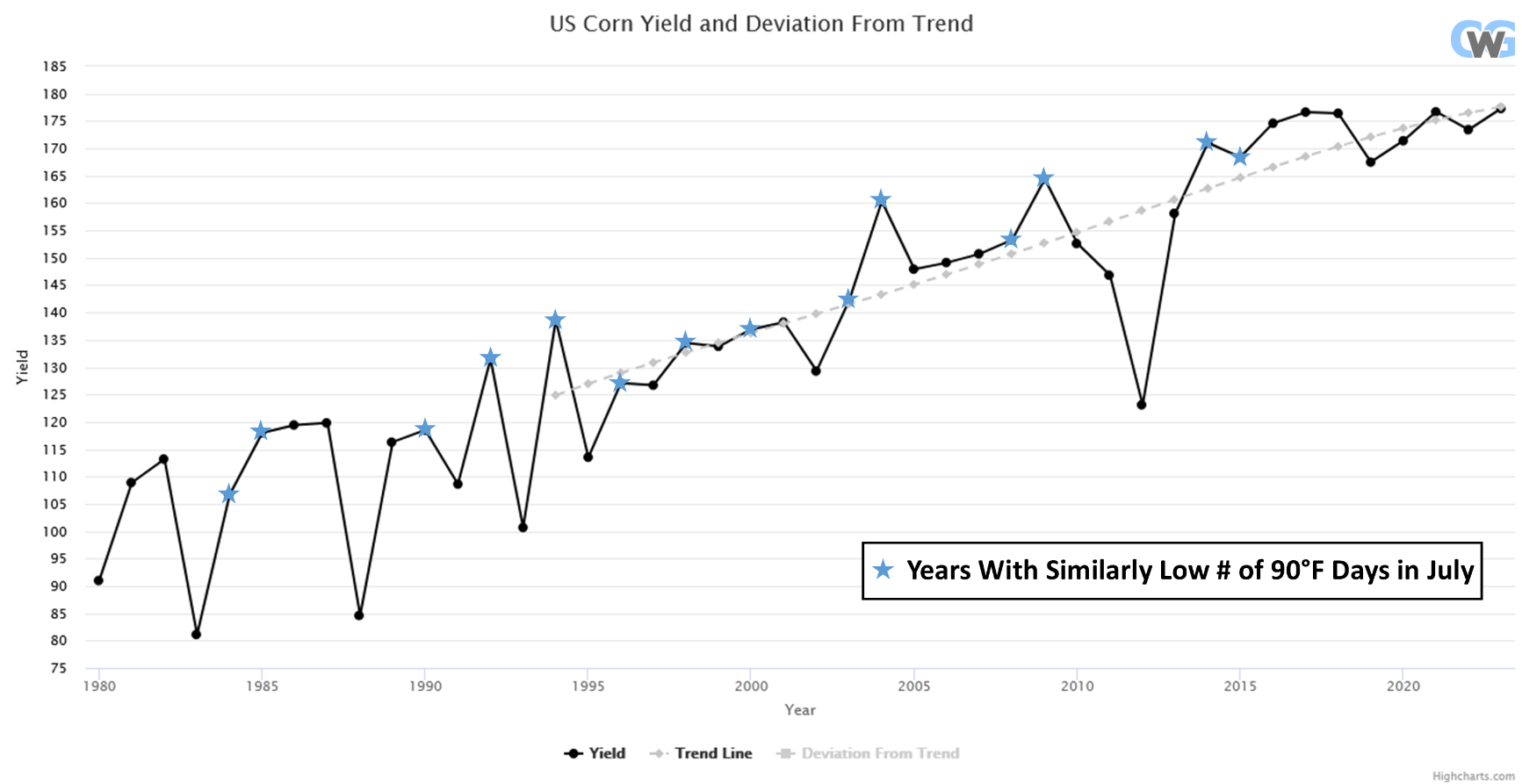
Commodity Weather Group noted the low number of times that daytime temperatures in the Midwest Corn Belt topped 90°F or topped 70°F for overnight lows. In fact, it's the lowest since 2015, as shown in the graphic below. CWG identified 14 of the past 44 years that saw similar temperature patterns in July, as are indicated in the graphic. Just one of the years (1996) ended up with a slightly below trend corn yield. The others were above trend to varying degrees, with 43% of the years more than 5% above trend, although many of those years were early in the data set. CWG notes that the current outlook for August also looks favorable, further reinforcing ideas that this could be a big crop.