June 18 - Stocks are moderately higher ahead of this afternoon's Fed policy statement release, with values firming after President Trump called for a rate cut in a mid-morning news conference. However, gains were limited by the possibility of further escalation of the Iran - Israel war. The VIX is trading near 20 at midday, while the dollar index trades near 98.6. Yields on 10-year Treasuries are trading near 4.35%, while yields on 2-year Treasuries are trading near 3.92%. Crude oil prices are 1% lower in a pullback, while the grain and oilseed sector is mostly higher, led by chart-driven fund short covering in wheat.
The protein sector is mixed this morning as the industry tries to sort out the Trump Administration's position on immigration enforcement in the sector. It's no secret that the packing industry depends heavily on immigrant labor to harvest animals at a pace that will keep our nation's grocery store shelves stocked with meat. These packing plants generally participate in the E-Verify program when hiring, although they can't guarantee whether the documents that they are presented are genuine or fake. As such, the raid last week on an Omaha plant yielded the retention of some workers, which sent a chill through the industry, with workers at other plants choosing to not to come to work. President Trump stated over the weekend that he would call off the ICE raids at the packing plants, as well as food and leisure establishments to protect those industries, but the markets came under pressure yesterday when the Washington Post published a story quoting immigration officials saying that they would continue to enforce the law at these facilities. I think they wanted to avoid sending a message that employers had a green light to hire undocumented workers. President Trump reiterated today that he still intends to protect these industries. I anticipate that we'll see officials be very careful with raids on these facilities, but ICE may find different ways to do their enforcement. Nonetheless, we still have enough uncertainty that concerns over worker availability remain, although the markets firmed some on the president's comments this morning.
The Atlanta Federal Reserve district conducts of survey of businesses each month to determine their perceived expectations about inflation. This month's survey revealed that businesses expect inflation to be 2.4% looking out a year ahead, which is down from 2.5% in last month's survey. That's obviously above the Fed's 2% mandate, which we've been above for more than four years now. But it's also well-below consumer surveys this spring that showed expectations for inflation reaching 7%. Those consumer expectations are starting to moderate now as well, although they generally remain elevated well above the above reported business expectations.
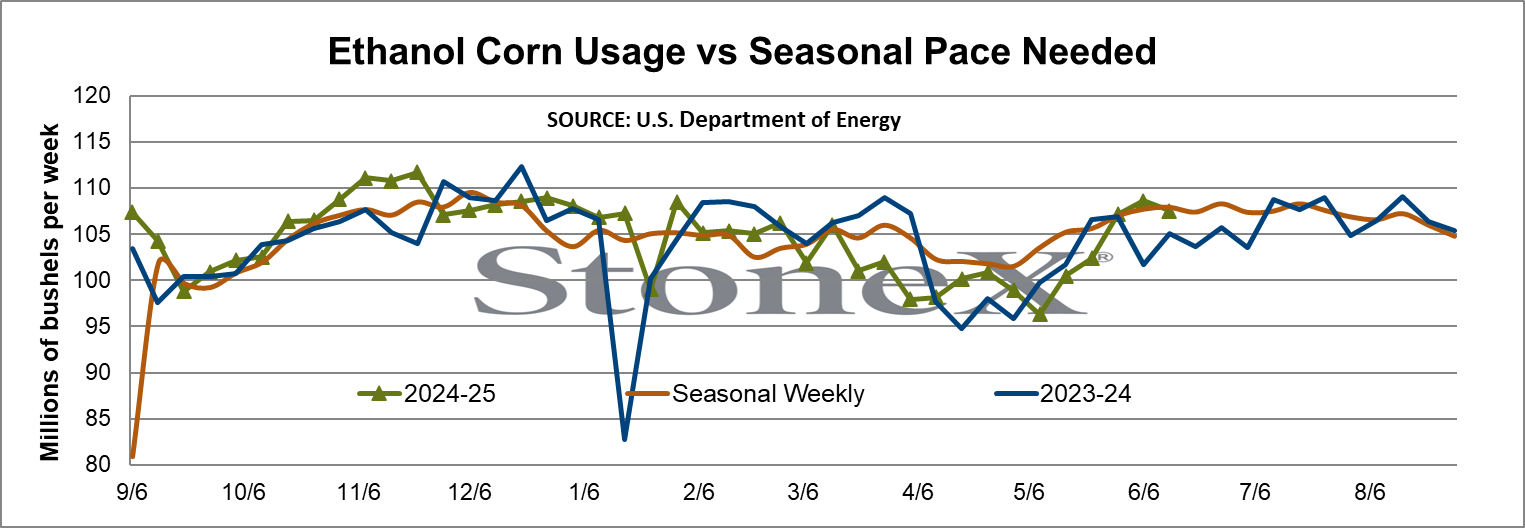
U.S. commercial crude oil inventories (excluding the Strategic Petroleum Reserve) plummeted by 11.5 million barrels in the week ending June 13, putting them at 420.9 million barrels. That puts them 10% below the five-year average for mid-June. Gasoline stocks rose by 0.2 million barrels, leaving them roughly 2% below seasonal levels. Distillate stocks increased by 0.5 million barrels during the week, but they are still about 17% below levels typically seen in mid-June. Ethanol stocks rose to 24.1 million barrels in the week ending June 13, up from 23.7 million the previous week, and up from 23.6 million barrels in the same week last year. Ethanol production slipped to 1,109K barrels per day in the week ending June 13, down from the previous week's record 1,120K bpd. Estimated corn used to produce ethanol last week totaled 107.5 million bushels, down from 108.6 million bushels the previous week, but up from 105.1 million bushels in the same week last year. Estimated marketing year to date corn use for fuel ethanol production totals 4.277 billion bushels, which is roughly equal to the previous year's pace. On a related note, the Supreme Court ruled today that the Washington, D.C. Circuit Court would be the proper venue for any legal challenges to the Environmental Protection Agency's small refinery exemption rulings. That's key, because it prevents having a lot of different courts making conflicting rulings, and it reduces the risk of decision reversals.