June 26 - It's been a choppy mixed session on Wall Street thus far today, as traders continue to mark time ahead of Friday's key inflation data release. The VIX though managed to slip below 13 late-morning, while the dollar index rallied to trade above 106.0, representing an eight-week high. Yields on 10-year Treasuries are trading near 4.31%, which is their highest level since June 13, while yields on 2-year Treasuries are trading near 4.75%. Crude oil prices traded both sides of unchanged. The grain and oilseed markets are mixed to firmer at midday, as we begin to see some book squaring for the end of the month, end of the fiscal quarter and the approach of Friday's USDA quarterly grain stocks and updated planted acreage numbers. The end of June USDA reports are known for their surprises, leaving those traders who are leaning heavily in one direction nervous.
Friday's acreage report will be based on a farmer survey officially dated June 1st, although USDA continued to take results for much of the first two weeks of June. That period came ahead of the severe flooding in the northwestern Midwest, so don't expect it to reflect the impacts of the flooding. We may see USDA resurvey these areas, with the results to be included in the August crop report, but at the very least we can expect a debate through the summer over the reduction in harvested acres to account for flooded areas in fields. Let me be clear - the problems in southern Minnesota, southeast South Dakota and northwest Iowa are severe, with production immediately along the Rivers downstream negatively impacted as well. Those farmers in the most effected areas are seeing a lot of problems, but for the Midwest as a whole, the current situation isn't even close to what we saw in 1993. More on that in my Friday webinar.
New home sales fell to an annualized rate of 619K in May, down from analyst expectations of 650K. However, the April numbers were revised significantly higher to 698K, up from the originally reported 934K units sold. Yet, the current pace remains substantially below the annualized rate of 741K sold in May 2023. The seasonally adjusted estimate for new houses on the market on May 31 was 481K units, representing a 9.3 month supply of new homes. The median sales prices for new homes sold in May was $417,000, versus $421,000 a year earlier, while the average sales price was $520,000, versus $496,000 a year earlier. Tomorrow we should get data on durable goods orders in May, as well as weekly jobless claim data and a third reading of GDP numbers for the first quarter of this year.
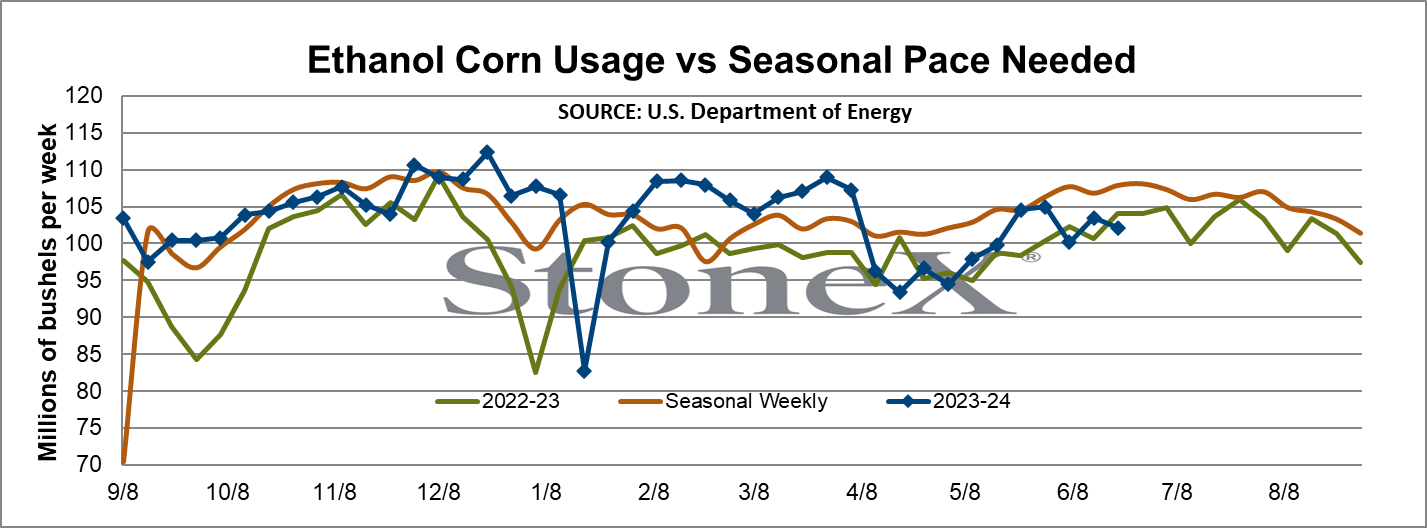
U.S. commercial crude oil inventories (excluding the Strategic Petroleum Reserve) rose by 3.6 million to 460.7 million barrels in the week ending June 21. This leaves them roughly 2% below the five-year average for mid-June. Gasoline stocks increased by 2.7 million barrels, putting them very close to levels typically seen in this week of the year. Distillate stocks dropped by 0.4 million barrels last week, putting them about 9% below levels typically seen in mid-June. Ethanol stocks slipped to 23.4 million barrels in the week ending June 21, down from 23.6 million barrels the previous week, but up from 23.0 million barrels in the same week last year. Ethanol production dropped to 1,043K barrels per day last week, down from 1,057K bpd the previous week, and down from 1,052K bpd in the same week last year. The production of ethanol utilized an estimated 102.1 million barrels last week, down from 103.5 million bushels the previous week and down from 104.1 million barrels the previous year. Marketing year to date estimated corn use for ethanol totals 4.361 billion bushels, up 185 million bushels or 4.4% from the previous year's pace, and 32 million bushels above the seasonal pace needed to hit USDA's target. However, we will likely see production for the week ending June 28 take a hit in areas of the northwestern Midwest that are impacted by the severe flooding, which has shut down a lot of rail movement in the region. That makes it difficult for processors to move ethanol to buyers, causing it to back up, resulting in the curtailing of production. That results in lower corn demand as a result.