June 6 – The stock market is looking to end the week on a positive note, with the major indexes all remaining in the green at mid-day, though off from morning highs, while the VIX cools to a two-plus month low around 17. The dollar is looking to recover losses from the previous two sessions as it pushes back above the 99 level and hovers near 99.2 at the time of writing. Treasuries are in the green as well, with 10-year yields trading near 4.48% and 2-year yields trading at 4.02%. Crude oil is up ~2% on the day as nearby WTI trades near $64.50, but it will be interesting to see if it can close above the elusive $64 resistance level after not having done so since early April. The ags are mixed, with grains largely weaker but soybeans attempting to cling to small gains, while cattle futures had attempted to continue their rally after yesterday's sharp break higher with extremely hot cash trade fueling strength but appear to be losing steam at mid-day.
The healthcare sector was the main driver of U.S. job growth in May, adding 62k jobs, with leisure and hospitality also adding 48k. Professional and business services saw the biggest decline at 18k, followed by manufacturing with a decline of 18k. While there were some warning flags in this morning’s data, including the revision showing 95k fewer jobs being created in March and April than previously reported, the headline beat is largely being taken as a sigh of relief by the market. A resilient labor market with unemployment holding steady at 4.2% should be taken positively by the Fed, and we’ll get a fresh look at the second half of their dual mandate with May inflation data due out next week (CPI on Wednesday, PPI on Thursday). While the continued better-than-expected economic data has helped ease investors concerns and allowed stock markets to recovery notably, it also adds further justification to the FOMC’s position of holding rates steady, with markets still not anticipating a cut until September.
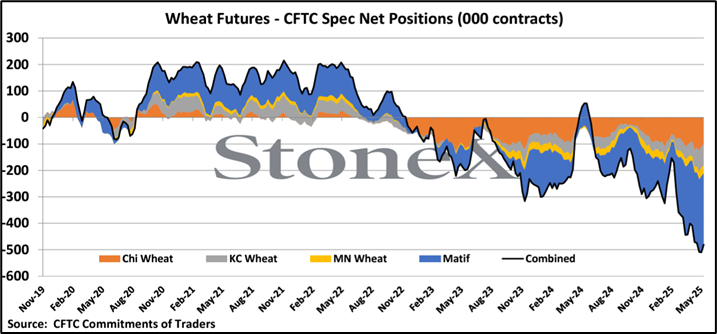
Russia carried out widespread attacks on Ukraine overnight, with 400+ drones and nearly 50 cruise and ballistic missiles being fired, targeting not just the capital, Kyiv, but also striking deep into western Ukrainian cities far from the frontlines. Could this be the response Putin alluded to during his call this week with President Trump in the wake of Ukraine’s Operation Spiderweb that caused immense damage to the Russian military’s air assets? That remains to be seen, but the wheat market will be keeping a close eye on these escalations, especially given the massive managed money shorts seen across the wheat complex. The real headline risk that could spook more of these shorts out would be if Russia resumed strikes on Ukrainian export infrastructure, with both corn and wheat potentially impacted. The below chart provides some context for just how short the speculative trade is across the entire wheat complex, though this is from last Friday’s CFTC report; we’ll get a fresh update later this afternoon. Take note of the small amount of short covering seen in the week prior, as well as previous bouts of major short covering that helped drive wheat prices higher following major headline risks (last year around this time is a prime example).
Fundamentally speaking, expectations for the size of the U.S. winter wheat crop have grown significantly this spring following a notable improvement in the moisture situation across the Southern Plains, but the market is being forced to wait for verification of those expectations with combines largely sidelined due to consistent wet weather in the region. More scattered rains are falling across the Plains today, and forecasts call for more to come this weekend. If this continues, we could see widespread quality issues, adding additional pressure to the crop after already struggling with disease issues in many areas. Our neighbor to the north, Canada, is dealing with an opposite problem, with the spring wheat crop on the prairies off to a below average start due to lingering heat and dryness. Elsewhere around the globe, the E.U. wheat crop is a mixed bag, with top E.U. producer France’s soft wheat ratings declining to 69% good/excellent, holding above the ugly 62% seen at this time last year but still a relatively weak print due to ongoing dryness in the country. The Black Sea crop has seen notable improvement from initial expectations after a poor start to the growing season but looks to face some potential heat stress and lack of rain in the near-term before an expected improvement in the 6-10-day window. Conversely, the South American wheat crop is largely dealing with too much moisture as it gets started, though Argentina does look to finally dry out to aid planting in the near-term. The point is, there are a handful of potential supply issues out there that may add to the lingering anxiety of speculative wheat shorts. The demand side of the equation certainly isn’t helping, however, but the potential of a short covering rally does remain in play if we see the right headline, again most likely stemming from escalations in the Black Sea.