March 1 - Stocks are attempting to end the week on a positive note, with the major indexes all in the green at mid-day, led by the tech-heavy Nasdaq on the back of continued AI mania strength in chip stocks as well as 20%+ gains for both Dell Technologies and NetApp following better than expected earnings results. The VIX is weakening through the morning, trading below 13.3 at the time of writing as a sense of calm remains on Wall Street. The dollar has fallen hard over the last hour or so following weaker than expected data releases, wiping out yesterday's gains as it pushes towards 103.8 after trading above 104.2 earlier in the session. Treasuries are softer on the day as well, with 10-year yields trading below 4.2% and 2-year yields below 4.55%. Crude oil is surging, with nearby WTI attempting to hold above that elusive $80 level as it trades near $80.4 at the time of writing as geopolitical risks continue to provide support following escalations in the Middle East. The ags are largely mixed on the day, with the soy complex attempting to hold onto small gains while the wheat complex sells off hard.
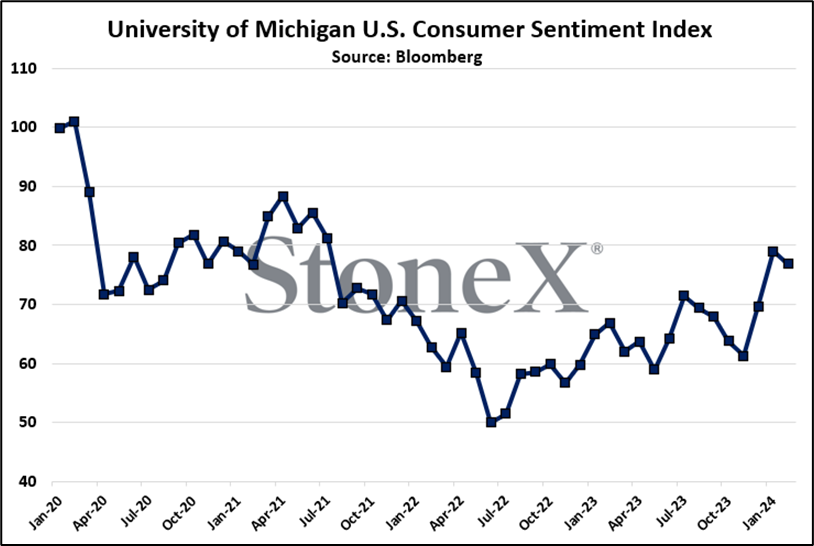
Consumer sentiment weakened in the U.S. in February, with this morning's final reading from the University of Michigan declining to 76.9, down sharply from its preliminary 79.6 reading and below January's roughly two and a half year high of 79. Despite the step back, U.S. consumer sentiment has been steadily trending upwards since bottoming out in June 2022, as can be seen in the graphic below. Consumer perceptions of the current state of the economy and their expectations for the next six months both saw declines in February, with the former falling 3.1% from January and the latter down 2.5%. Consumer expectations for average inflation over the next year rose slightly to 3.0% from the 2.9% seen in the month prior, with the rise in energy costs in February likely adding to concerns of lingering inflationary pressures. Longer-term inflation expectations (5-10 years) remained the same as the month prior at 2.9%. Only 37.1% of respondents think their family's income will beat inflation over the next 5-years, down from 39.5% in January, while 17.5% think their spouse will lose their job over the same span, up from 17.2% in January.
The U.S. manufacturing sector got contrasting news this morning, with S&P Global's February Manufacturing PMI showing a surprisingly strong jump further into expansion while ISM's Manufacturing PMI took a surprise step back further into contraction. With a reading of 52.2, this morning's S&P Manufacturing PMI showed a second consecutive monthly increase and reached its highest level since July 2022. On the flip side, ISM's reading of 47.8 was a dip from January's 49.1 and well below analyst estimates of a rise to a 49.5 reading. One of the other main points of interest from these readings, the employment portion, showed contrasting news as well, with S&P reporting a five-month high in employment for the sector while ISM showed a sharp step back to a seven-month low. Unfortunately for the doves, these contradicting reports give us little in terms of fresh direction for the Fed, meaning members are likely to stick to their plan of remaining cautiously hawkish through at least the first half of the year. We continue to hear from more members today after a slew of speeches throughout the week, all of which have been relatively consistent and seem to have finally driven the trade to be more realistic with their expectations for rate cuts in 2024.
U.S. construction spending fell for the first time since December 2022, with January falling 0.2% month-on-month to $2.102T compared to December's 1.1% gain. The biggest driver of the decline was a 0.9% drop in public construction, with highway construction down 2.1% and educational construction down 0.7%. Private construction increased ever so slightly in January, up 0.1% month-on-month as residential construction rose 0.2% while nonresidential fell by 0.1%.