March 12 - Stocks are trading mixed to higher at midday, as they consolidate above nearly half-year lows following recent liquidation on tariff concerns. Wall Street is worried that President Trump's tariff actions will send the United States into recession, and possibly pull other economies down with it. The economic data is concerning, but not recession worthy yet at this point, and this morning's inflation data was encouraging. As such, the VIX is trading near 25 at midday as it pulls back from its Tuesday highs just below 30, while the dollar index firms to trade near 103.5. Yields on 10-year Treasuries are trading near 4.30%, which is near the top of the trading range that has contained it for much of the past couple of weeks, while yields on 2-year Treasuries are trading near 3.98%. Crude oil prices are more than 2% higher after uncovering fresh buying interest above $65 per barrel this week, while the grain and oilseed sector is mostly lower.
U.S. negotiators met with representatives from Ukraine in Saudi Arabia on Tuesday. U.S. negotiators sought to hear from Ukraine the terms that they would accept for a peace agreement, while also presenting to Ukraine their plan for a 30-day cease fire. Those communications took place, with Ukraine reportedly accepting the U.S. proposal for a ceasefire. All of this must now be communicated to Russia to see if they'll agree to a ceasefire. Meanwhile, both sides appear to be trying to get their last big blows in before a potential ceasefire is signed. Ukraine unloaded its largest attack ever on Moscow yesterday in a drone attack, while Russia struck a ship loading grain at Ukraine's Odessa port, killing at least four people. Ending the war would be expected to remove some of the risks of commodity movement out of the Black Sea Region, but grain and oilseed volume has not been hurt much by the war overall - with the exception of a few time windows when shipments slowed.
Tuesday's market reaction to the USDA WASDE crop report was rather muted, which was somewhat surprising considering the lack of adjustments to the U.S. corn and soybean balance sheets once again this month. Prices plummeted in February when USDA failed to raise corn and soybean exports, and it kicked the proverbial can down the road again in the March report. For soybeans, it likely waited to adjust exports upward due to not knowing yet what to do with domestic crush demand amid a lack of direction on the 45Z guidelines for biofuel production with soybean oil. But there's no reason why it should not have made a substantial increase to corn exports. It stated that it assumed the current condition regarding tariffs, and that it therefore did not consider the impact of tariffs that have not yet taken affect, and that won't take affect until April 2nd. As such, based on its statements, it had little reason to believe that the current strong corn export program is frontloading ahead of tariffs. Some of that may be the case, but then USDA should have changed its statement. Disappointment in USDA's failure to make changes may not have submarined the markets yesterday, but it does appear to be a factor today.
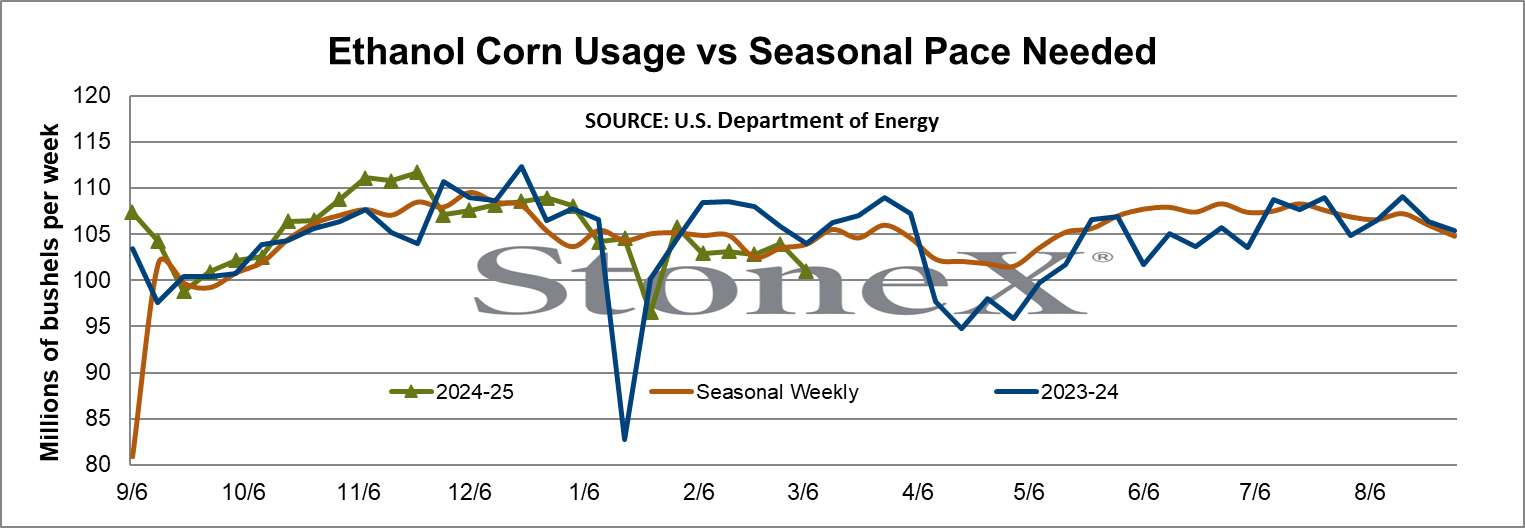
Commercial crude oil stocks (excluding the Strategic Petroleum Reserve) increased by 1.4 million to 435.2 million barrels in the week ending March 7, putting them roughly 5% below the five-year average for the first week of March. Gasoline stocks fell by 5.7 million barrels, leaving them 1% above seasonal levels. Distillate stocks dropped by 1.6 million barrels, putting them 5% below levels typically seen in early March. Ethanol stocks firmed to 27.4 million barrels in the week ending March 7, up slightly from 27.3 million the previous week, but well above the 25.8 million barrels on hand in the same week last year. Ethanol production fell to 1,062K barrels per day last week, down from 1,093K bpd the previous week, but still well above the 1,027K bpd produced in the same week last year. Estimated corn use for ethanol production totaled 101.0 million bushels last week, down from 104.0 million the previous week. Estimated marketing year to date corn use for ethanol totals 2.829 billion bushels, down 8 million bushels from the previous year's pace, but 21 million bushels above the seasonal pace needed to hit USDA's target for the year.