May 8 – The stock market is loving today’s announcement of a trade deal between the U.S. and U.K. even without much detail being given to this point, as this provides a much-anticipated first sign of progress in broader trade talks. The major stock indexes are up anywhere from 1.3% - 1.7% on the day, with the S&P 500 and Nasdaq both reaching their highest levels since late March, while the Dow Jones is at its highest level since April 2nd. The sense of relief has also pushed Wall Street’s fear index to its lowest level since April 2nd, with the VIX hovering around the 22.1 level at the time of writing. The dollar is rallying sharply as well, pushing to 100.6 to mark a four-week high. Treasuries are joining in on the rally too, with 10-year yields pushing higher to 4.35% and 2-year yields rising to 3.89%. Crude oil is up ~3% at mid-day, with nearby WTI trading around $59.70/barrel as trade deal hopes improve demand expectations following recent pessimism. The ags are mixed, with soybeans attempting to cling to small gains, while the wheat complex leads the way lower as conditions in both the U.S. winter wheat belt and Black Sea region continue to improve.
Year-ahead consumer inflation expectations rose slightly in April to 3.63%, according to data released this morning from the New York Fed’s Survey of Consumer Expectations. This was a very minor 0.05% month-on-month increase but still marks the highest reading for the metric since September 2023. The longer-term picture was a little worse, with three-year inflation expectations rising from 3.00% in March up to 3.17% in April, the highest level seen since July 2022. At the same time, consumer perceptions regarding their current and future financial situations deteriorated as well. Median expected earnings growth for the year ahead fell to 2.54% in April, down from 2.79% in March and marking the lowest level since December 2023. Softening consumer sentiment has been a persistent theme throughout the last month, but we’ve still yet to see much hard data to confirm these fears to this point. This adds more intrigue to next week’s inflation data, with April CPI due out on Tuesday and PPI on Thursday. The market is happy to ignore today’s ugly data, however, with euphoria over a first trade deal providing a boost of optimism for traders.
Corn and milo sales on this morning’s USDA Export Sales report came in at 12-week and 8-week highs, respectively. This keeps cumulative corn sales sharply ahead of the seasonal pace needed to meet USDA’s 2.550-billion-bushel export target, with inspections even further ahead. With this in mind, it will be interesting to see if USDA ratchets their U.S. corn export estimate up further on next Monday’s (5/12) May WASDE after increasing by 100 million bushels last month. The milo demand picture is far less rosy, however, with cumulative ‘24/’25 sales sitting at only ~56 million bushels and no sales to our traditional top customer, China, left on the books. Because of the weak demand picture, USDA has U.S. milo exports pegged at their lowest level since ‘18/’19 and ending stocks at their highest level since the same year.
Although they were a small chunk of this week’s corn business, record demand to Mexico has been a major driver of pushing U.S. corn exports to their second-largest level on record in the ‘24/’25 marketing year. This hasn’t been exclusive to corn either, as U.S. export sales of wheat to Mexico are currently sitting at a record pace as well, while milo sales are at their strongest pace in five years, and soybean sales are at their strongest pace in three years. Obviously, the volumes on the soybean and milo side are nowhere near large enough to offset potential lost Chinese demand, but it certainly helps soften the blow. USDA currently estimates Mexico’s imports of corn, soybeans, and wheat to all reach fresh record levels in ‘24/’25. With trade uncertainty still prevalent, though finally showing some signs of progress, it will be very interesting to see where USDA pegs their ‘25/’26 demand estimates for not only Mexico but other major buyers as well.
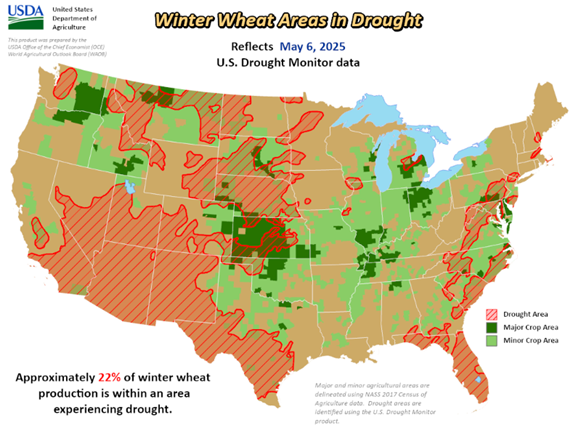
Continued beneficial rains across the Southern Plains have reduced the portion of the U.S. winter wheat crop experiencing some level of drought to 22% according to this morning’s update, down sharply from 37% at the start of April. This has coincided with a solid improvement to U.S. winter wheat conditions, with this week’s 51% good/excellent marking the highest reading for the comparable week in five years. The improved prospects for the U.S. winter wheat crop, as well as similar recent improvements in the Black Sea region, have weighed heavily on the wheat market, with July Kansas City wheat futures carving out fresh contract lows at the time of writing.