November 4 - Uncertainty around this week's election and Federal Reserve meeting weighed on stock trading today, with the major indices slipping lower for the day thus far. The VIX remains elevated above 22 at midday, while the dollar index is notably lower near 103.8 on pre-election positioning. Election day is tomorrow, but roughly 77 million people have already voted in this election. Yields on 10-year Treasuries are trading near 4.30%, while yields on 2-year Treasuries are trading near 4.17%. Crude oil prices are nearly 3% higher as OPEC+ decides to wait until at least January 1st to increase output, while the grain and oilseed markets are also mostly higher today.
The weaker dollar provided tailwinds for the grain and oilseed markets today. Corn and soybeans saw early support from fresh export sales, while also seeing some support from solid export inspection data released mid-morning. Soybean prices found support just above the August lows, but follow-through strength just isn't there currently, with good rains falling in Brazil. Wheat prices traded both sides of unchanged today, as they continue to drift while waiting for anticipated export restrictions out of Russia. Good rains fell across many areas of the winter wheat belt, although some areas continue to be missed.
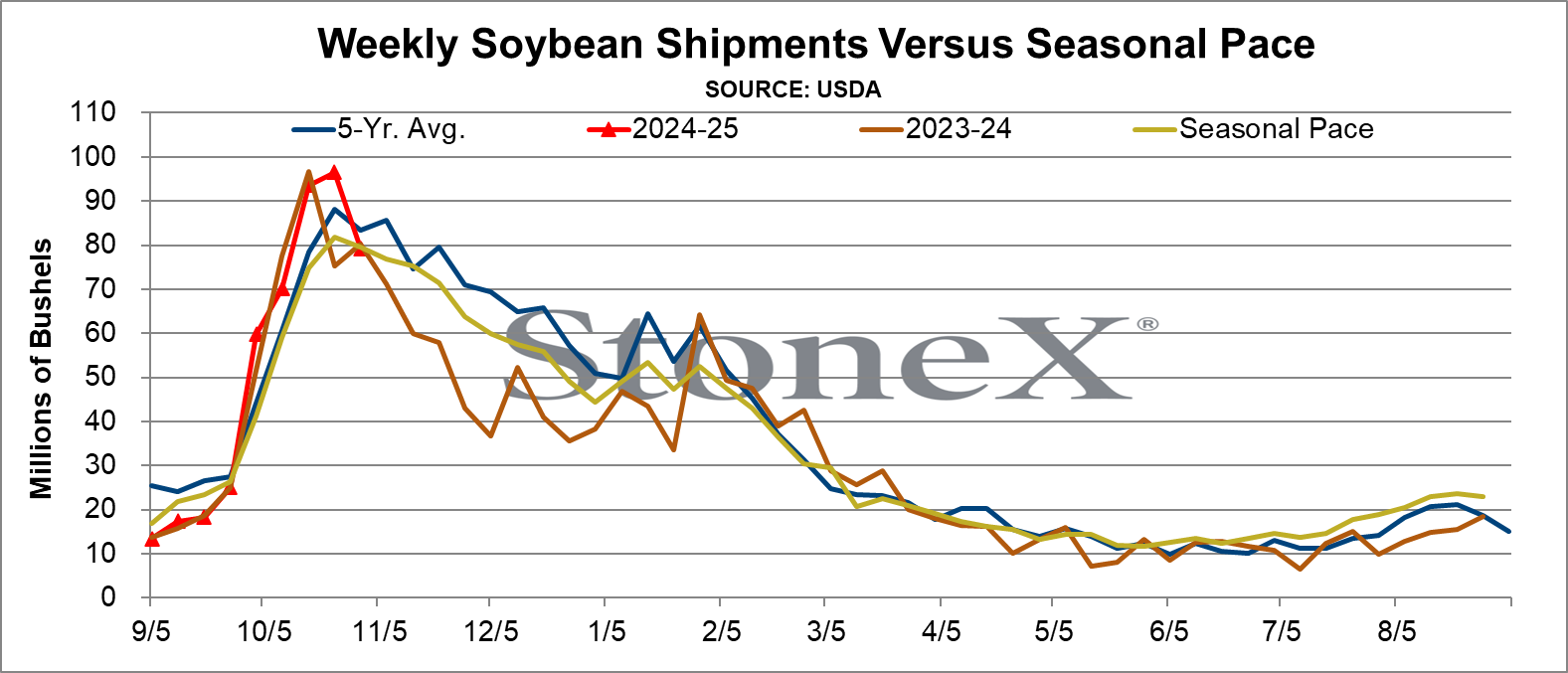
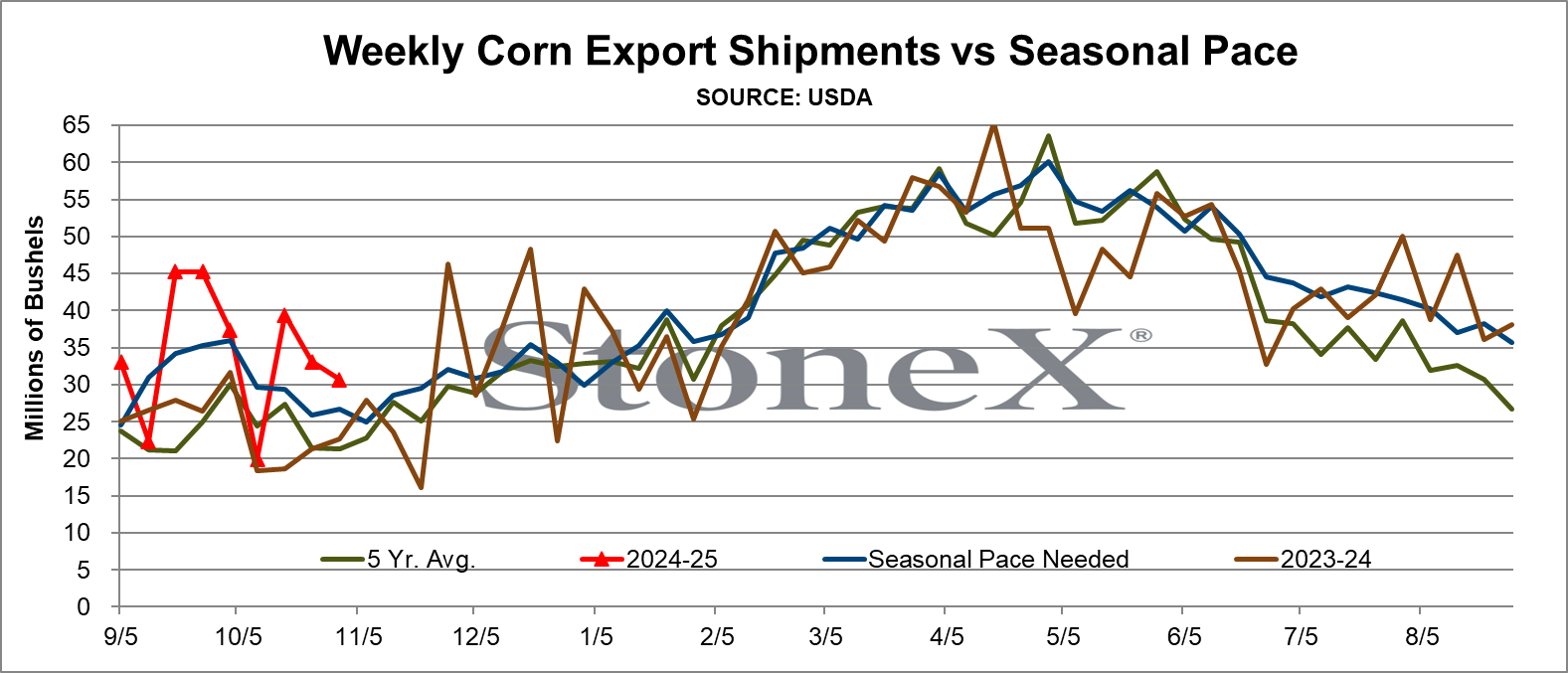
USDA inspected 79.3 million bushels of soybeans for export shipment in the week ending October 31, as shown below, along with 30.7 million bushels of corn, 7.1 million bushels of wheat, and 2.6 million bushels of grain sorghum. The portion of the above that was inspected specifically for shipment to China included 51.4 million bushels of soybeans, 0.06 million bushels of corn, and 2.6 million bushels of grain sorghum, with zero wheat shipped to China. Marketing year to date grain sorghum export inspections continue to fall short of the seasonal pace needed to hit USDA's target by 2 million bushels, while wheat export inspections to date exceed the seasonal pace by 8 million bushels. Marketing year to date soybean export inspections total 470 million bushels, up 16 million or 3.5% from the previous year's pace, and up 45 million bushels from the seasonal pace needed to hit USDA's target for the year. We need to see strong sales continue in the weeks ahead though to sustain the pace, as sales continue to lag the seasonal pace needed to hit USDA's target. Soybean export inspections thus far total 25% of USDA's target for the year. We typically inspect two-thirds of the crop for export shipment by the end of January, with the final third shipped in the last seven months of the marketing year. Marketing year to date corn export inspections total 292 million bushels, up 74 million or 34% from the previous year's pace, and 20 million bushels above the seasonal pace needed to hit USDA's target. That's a positive sign, considering that shipments are typically strongest in the last half of the marketing year.
Private China analyst JCI cut its 2024-25 corn production estimate to 271 million metric tons, down roughly 1 mmt from its September estimate, and down 9 mmt from its estimate for the 2023 crop. That compares to USDA at 292 mmt for this year's Chinese corn crop, up from 288.8 mmt last year. It's noteworthy that JCI's estimate is well below China's official estimate of 297 mmt for this year's crop. But that's how things go in China, where trustworthy crop surveys simply do not exist in the way that we have here in the States. Industry consensus seems to be that this year's crop is 3 - 10 mmt smaller than last year's crop. As for corn imports, JCI expects this year's imports to total 10 mmt, down 2 mmt from its previous estimate, and notably lower than last year's 23.5 mmt of imports. USDA currently pegs Chinese corn imports at 19 mmt, while China's official import estimate is at 13 mmt.