October 2 - Stocks were mixed to higher at midday, while traders monitor both the U.S. port strike and escalating geopolitical risks in the Middle East. The VIX is trading near 19 at midday, while the dollar index is trading near 101.6, representing fresh 20-day highs. Yields on 10-year Treasuries are trading near 3.79%, while yields on 2-year Treasuries are trading near 3.64%. Crude oil prices are modestly higher today, while trading nearly $2 off their session highs. The grain and oilseed markets remain mixed, with corn and wheat prices higher, while soybean and soymeal prices are mostly lower.
Much of the food and energy based commodity sector found support from positive money flow today. Escalating weather and geopolitical risks combine with rising global central bank stimulus to suggest that demand will rise, while supply could be at risk. That's perhaps most pronounced in the crude oil market, where this week's Iranian attack on Israel, and the resulting promise for retaliation, has created a $6+ swing in prices over the past two days alone. Wheat prices are also rallying hard on speculative short covering and some outright buying as major exporter supplies tighten and drought worsens in the Black Sea Region. The protein sector isn't that impacted by the above, although the port strike will have some impacts on shipments, but this sector also benefited from today's positive money flow as charts triggered buy signals. I continue to hear chatter of reinflation concerns supporting the commodity sector as central banks around the world cut rates to stimulate economic activity. On the other hand, we've seen significant selling in soymeal, soybeans, coffee, and cocoa related to a delay in implementation of a controversial deforestation rule in Europe.
The European Commission confirmed today that is is seeking a 12-month delay to enforcement of its landmark deforestation rule. I mentioned earlier in my morning Commentary that Bloomberg was reporting this possibility. The extension would allow time for all parties to get ready for the law, although it continues to get significant kickback from both major exporting countries who will be negatively impacted, as well as consumer groups within Europe who believe it will be inflationary at a time when the region's economy is already battling inflation. The proposed delay in enforcement will need approval from both the European Parliament and EU member states, but that is expected to occur. The deforestation rules require a complex tracking system for commodity purchases, necessitating that importers collect precise information on field plots where the commodity was grown. Importers must certify that products that they bring into the EU were not produced on areas deforested or degreaded after 2020. An example provided by StoneX's Uros Vukov illustrates this well. "A 250K tonne shipment of cocoa could be attributed to 4,000 different farmers. If each cultivates 2 plots, operators would be required to provide geolocation maps for 8,000 farm plots in Africa in order to comply with EUDR." That would not only be cumbersome, but it would be inflationary.
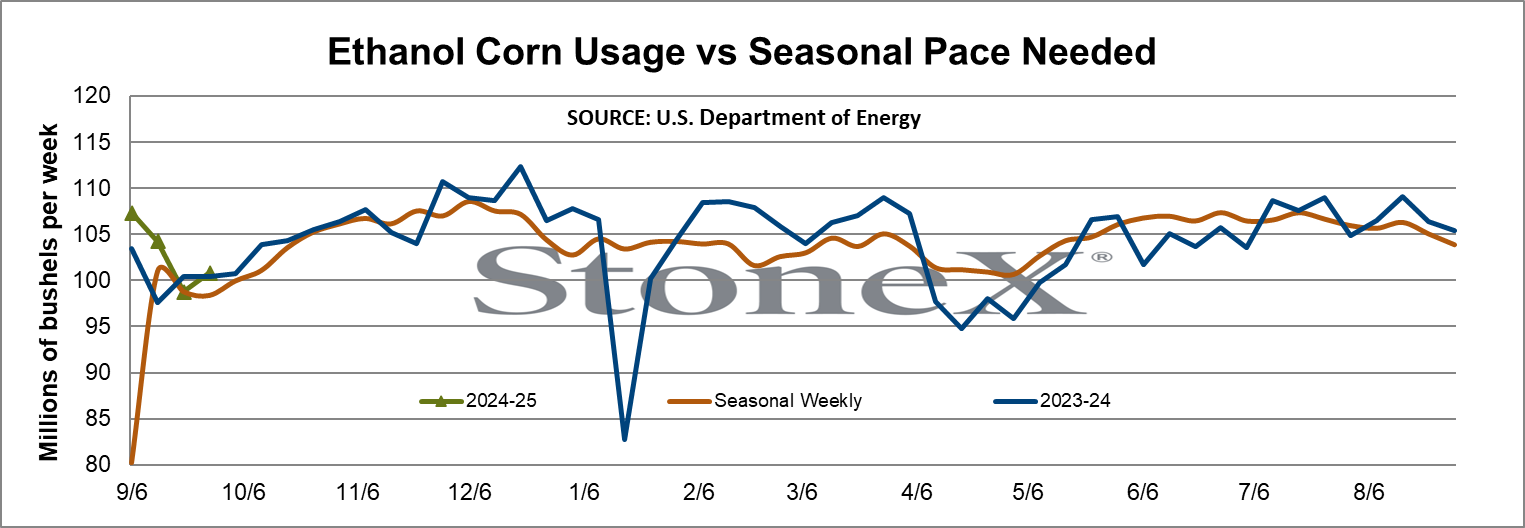
U.S. commercial crude oil inventories rose by 3.9 million to 416.9 million barrels in the week ending September 27, putting them roughly 4% below the five-year average for late September. Gasoline stocks increased by 1.1 million barrels, leaving them 1% below seasonal levels. Distillate stocks fell by 1.3 million barrels, putting them 8% below levels typically seen in late September. Ethanol stocks were unchanged this week at 23.5 million barrels, although that is up from 21.9 million barrels in the same week last year. Ethanol production rose to 1,015K barrels per day last week, up from 994K bpd the previous week, and up from 1,009K bpd in the same week last year. The production of ethanol utilized an estimated 100.8 million bushels of corn last week, up from 98.8 million bushels the previous week, and up from 100.4 million bushels in the same week last year. Estimated corn use for ethanol through the first 27 days of the new corn marketing year total 396 million bushels, which exceeds the early seasonal pace needed to hit USDA's target by roughly 17 million bushels. Much of the seasonal maintenance down time should now be behind us, supporting additional strength in corn grind going forward.