October 8 - Stocks firmed off of a soft opening today, with traders focused on this week's start to earnings season, inflation data to be released at the end of the week, and to a perceived easing of geopolitical risks in the Middle East. The VIX continues to trade near 21 though at midday, while the dollar index is trading near 102.5. Yields on 10-year Treasuries are trading near 4.03%, while yields on 2-year Treasuries are trading near 3.96%. Crude oil prices are sharply lower - trading nearly 5% lower on the day - after making new highs earlier in the session that peaked above $78, before falling to nearly the $73 level on peace talk speculation. Meanwhile, the grain and oilseed markets are mostly lower, with soybeans leading the way lower amid ongoing harvest pressure.
More than a fifth (21%) of the U.S. soybean crop was harvested last week. The current dry weather pattern is rapidly drying the crop, with farmers hurrying to bring the crop in to avoid harvest losses tied to the soybeans getting too dry. Market sentiment is weakest for soybeans, relative to corn, with big production increases expected in South America. We entered the harvest season with 300 million bushels more grain in on-farm storage this year, with record corn, and possibly record soybean crops needing to find a home. Farmers are saving their on-farm storage for corn, for the most part, bringing the soybeans to town. That's pushing soybeans onto the market as commercial storage fills up, pressuring both basis and futures. Similar pressures are seen in corn, but not to the same extent as soybeans. Good rains are in the forecast for dry areas of Brazil this week into the rest of the month, reinforcing the bearish sentiment.
Profit taking weighed on wheat prices after both the Chicago and Kansas City December wheat futures contracts failed to sustain a move above the 200-day moving average on Thursday. There's still underlying support beneath this market supported by the drought in the Black Sea Region, although rains now in the forecast could put a dent in that drought over the next 10 days to 2 weeks. Traders remain reluctant to build big short positions again in the market until they see if those rains actually materialize, but neither are they willing to build ownership until they see if they verify as well. That has the wheat market carving out a new sideways consolidation pattern for now.
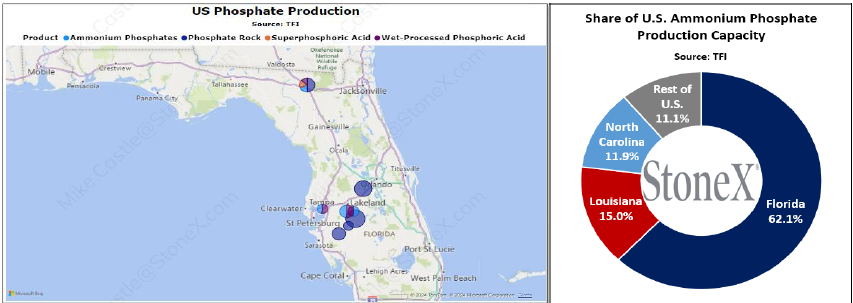
Hurricane Milton is one of the strongest hurricanes on record. Milton weakened somewhat today as he interacted with the Yucatan Peninsula, but he is expected to regain some strength before hitting the west coast of Florida tomorrow night. Milton is expected to be at least a Category 3 hurricane when he hits somewhere near Tampa, Florida, packing sustained winds well over 100 miles per hour. The Tampa metropolitan area is home to several million people, but it is also home to much of our nation's phosphate fertilizer production. The winds will be bad enough, but the effect of the winds on pushing water into the bay area could prove to be the more devastating impact. One of the keys to storm damage will be the specific location of the storm's eye relative to the bay. Passing just to the north of the bay could push a wall of water more than 12' high into the bay, with waves on top of that. However, passing just to the south of the bay could actually pull the water out of the bay, shifting its area of greater risk further to the south. Citrus crops are expected to be impacted as Milton quickly crosses the state, but U.S. agriculture will likely be most impacted if the storm hits areas of major phosphate production areas in the region, as shown on the graphic below. Florida accounts for nearly two-thirds of U.S. phosphate production. I won't speculate on possible damage for a storm that hasn't arrived yet, and therefore we also cannot know what the long-term production implications will be for the years ahead. But this is certainly a risk worthy of our attention that could have significant implications for U.S. Ag.