September 19 - Housing starts tumbled in August, while new permits surged, with Wall Street reacting negatively ahead of tomorrow's policy announcement from the Federal Reserve. The VIX is slowly trending upward toward 15 at this hour, while the dollar index firms to trade near 105.1. Yields on 10-year Treasuries are trading near 4.34% after stopping just short of setting fresh 16-year highs this morning, while yields on 2-year Treasuries are trading near 5.09%. Crude oil prices are on the cusp of new one-year highs at midday, while the grain and oilseed markets are mostly mixed in relatively quiet trade. Corn and soybean prices both set fresh new lows for the move today, before seeing modest profit taking lift prices off those lows, with corn moving into positive territory.
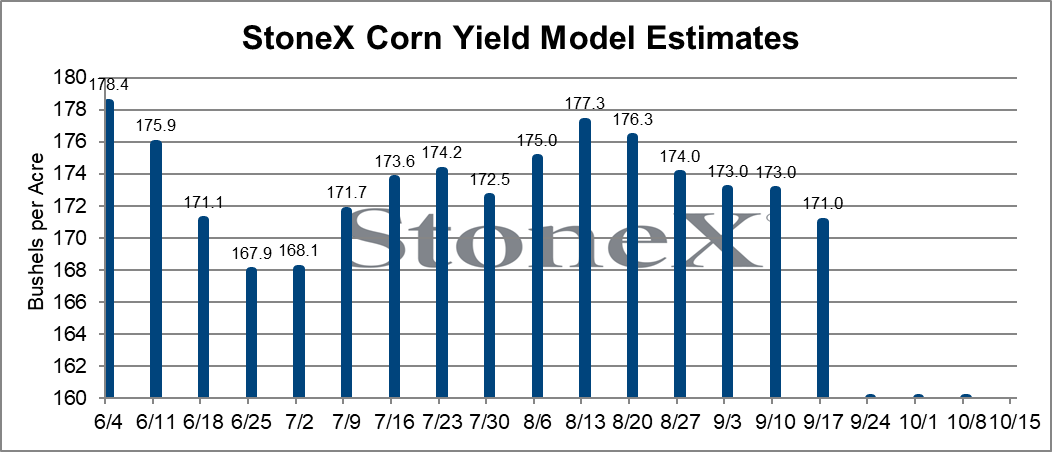
U.S. crop ratings continue to slide, suggesting that the dryness of the past month is taking a toll on crops as they move into maturity. These ratings are subjective in nature - a beauty contest rating if you will about how the crops "look." As such, the ultimate test is with the harvester. USDA reports that crop ratings declined modestly for both corn and soybeans again over the past week, with corn taking the bigger dip. Just 9% of the crop was harvested as of Sunday, but that number should rapidly gain momentum over the next 10 days, telling us a great deal more about the crop. The corn condition index score slipped to 332 (500=perfect crop) this week, down from 337 the previous week and down from 333 in the same week last year, but down more significantly from the 10-year average for the week of 361. Only four out of the past 37 years of USDA records had a lower rating in this week of the year. This week's decline drops my yield model to 171.0 bushels per acre, down 2 bushels on the week. Our StoneX official yield estimate is at 175 bpa, based on our September 6 customer survey. It will be updated with another survey on October 2nd. Corn ending stocks projections would drop to 1.834 billion bushels using USDA's demand estimates, up nearly 400 million bushels from the previous year. Using my lower demand estimates, ending stocks would drop to 2.054 billion bushels. Regardless of whose demand numbers you use, poor demand is still the greater focus of the market.
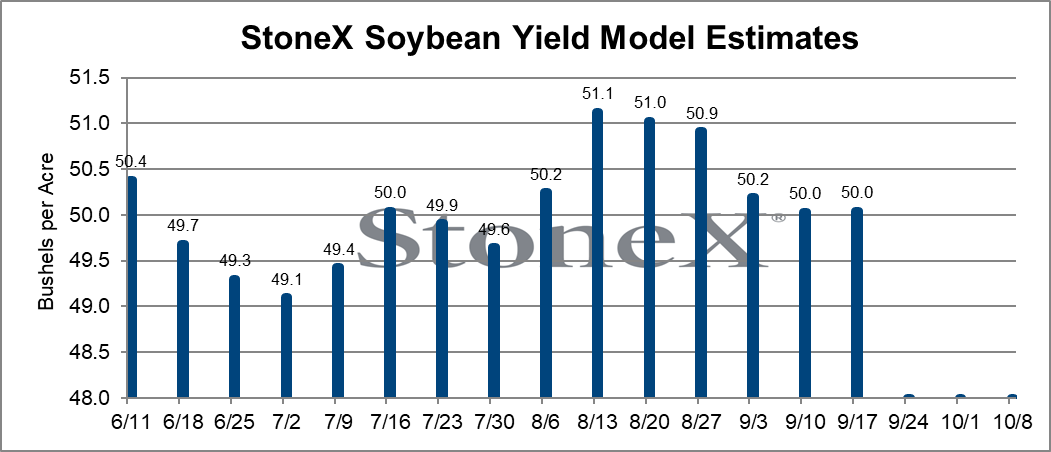
USDA reports that 5% of the soybean crop was harvested as of Sunday, with that number expected to also rapidly gain momentum over the next 10 days, telling us a great deal more about it. The crop rated a condition index score of 336 this week, down 1 point on the week, but down 8 points from the same week last year and down 23 points from the 10-year average for the week. Seven other crops since 1986 had lower ratings for this week of the growing season. My yield model essentially remained unchanged at 50.0 bpa this week. That matches well with our official StoneX yield estimate of 50.1 bpa from our September 6 customer survey, which will also be updated with another survey on October 2nd. USDA's yield is also at 50.1 bpa. Here again, I believe that USDA's export demand estimate is too high, but in this case, I believe that its domestic demand estimate is too low. Either way, we are in danger of seeing USDA's stock estimates slip closer to the psychological 200 million bushel mark. The risk to exports is to the downside due to still competitive supplies in South America, and low water levels on the Panama Canal and the Mississippi River. However, I'm not sure USDA will be comfortable cutting exports further in the October report. That may wait until November and beyond. On the other hand, it's not likely to increase domestic demand until later in the year when the trend becomes more apparent. Friday's NOPA report provided valuable insight into the speed at which the renewable diesel industry is pulling oil, and this crop may be on the lower side for oil yield.