September 20 - Stocks were mixed, while Treasury yields pulled back from recent highs ahead of this afternoon's anticipated policy release from the Federal Reserve. The VIX is trading near 14 at midday, while the dollar index is trading near 104.8. Yields on 10-year Treasuries are trading near 4.32%, while yields on 2-year Treasuries are trading near 5.06%. Crude oil prices are modestly weaker at midday, while the grain and oilseed sector is mixed to higher. Wheat prices are mostly weaker as they continue chopping sideways trying to form yet another bottom on the charts, while corn and soybean prices are modestly higher on follow-through strength following USDA's lower crop ratings on Monday.
U.S. commercial crude oil stocks (excluding the Strategic Petroleum Reserve) fell by 2.1 million to 418.5 million barrels in the week ending September 15, leaving them roughly 3% below levels typically seen in mid-September. Gasoline stocks dropped by 0.8 million barrels, putting them also about 3% below the five-year average for mid-September. Distillate stocks dropped by 2.9 million barrels last week, putting them 14% below seasonal levels. Ethanol stocks rose to a four-week high of 21.7 million barrels in the week ending September 15, despite a slowdown in production. That's up from 21.2 million barrels the previous week, but down from 22.5 million barrels in the same week last year. Ethanol production slowed to a 19-week low 980K barrels per day last week - partially due to the ADM explosion that curtailed operations in Decatur, but more so due to seasonal down time for maintenance. The ADM ethanol operations are said to be back to normal now, while soybean processing is expected to resume in the weeks ahead. Last week's ethanol production estimate was down from 1,039K bpd the previous week, but up from 901K bpd in the same week last year. The production of ethanol utilized an estimated 94.7 million bushels of corn last week.
The biggest question regarding the size of this year's crops, in my mind anyway, is seed size. Small changes in seed size are difficult to detect visually, unless you can put them side by side with previous year's seeds. Yet, a few percentage point reduction in seed size would be expected to have a similar negative impact on yield. The theory behind lower seed size would be the adverse conditions faced by the corn and soybean crops as they closed out the growing season. The extreme dryness, combined with heat at times, would tend to speed up the maturation process of the crop, resulting in smaller seed size, at least in theory. It showed up a bit in USDA's September sampling, but very little of the crop was mature enough at that point to show up in the sampling. Early harvest results suggest a trend toward smaller seed size in the western half of the belt, but I've learned to be skeptical of early harvest results. They don't always tell the whole story.
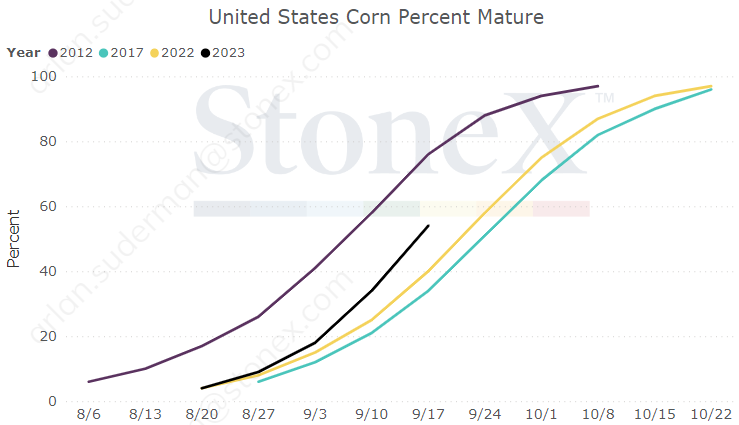
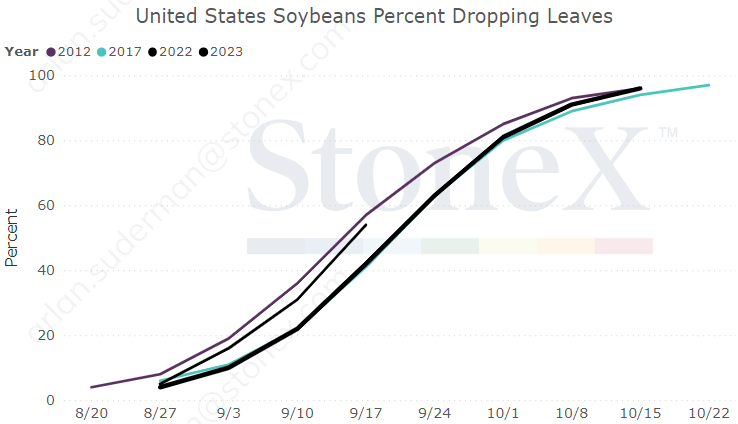
That leaves me looking at the speed at which the crops matured, while monitoring harvest results. The graphics below show the speed at which this year's corn crop reached maturity (left) and the soybean crop began dropping leaves (right), reflecting maturity. I compare this year's maturity pace with 2012, which has become the standard for crop stress for our modern crops, as well as 2017 and with last year. I include 2017 because it was a year that saw the opposite finish to the growing season. It was on the dry side, but it was also very mild to close out the year, which delayed the maturation process enough to increase seed size, resulting in yields that surprised to the high side. Soybean maturity is more bunched among the years, because the soybean is more daylength sensitive, whereas corn maturation is more spread out due to being more heat sensitive. Even so, I expect seed size to be an issue for both, albeit to different degrees. To be fair, August was a mixed bag of extremes, so I was unable to find an analog year to this one. As such, I may be wrong about the seed size issue, but thus far I haven't seen anything to indicate such.