October 20 – Stock futures are pointing to a lower open to start the day, with the tech sector bracing for earnings from SpaceX and Netflix after today’s close, followed by Meta, Tesla, Texas Instruments, and IBM tomorrow. Eye-popping AI spending will be in focus, particularly as financing costs rise, with investors needing to see corresponding revenue growth to justify additional spending. The VIX is elevated slightly, hovering near 18.7 at the time of writing. The dollar is modestly lower to start the day, off roughly 0.2% to trade near 101.75. Treasury yields are starting the day mixed, with 2-year yields slightly higher to trade near 4.765%, while long-term yields are slightly lower, with the 10-year near 5.105% and 30-year just below 5.43%. Crude oil has carved out fresh highs this morning, with nearby WTI breaking above $100 for the first time in a month earlier in the session but now hanging near $99.70, while nearby Brent posted a five-month high near $112 but now trades near $110.30 at the time of writing. The ags are looking at a mostly higher start, with the grains and oilseeds looking for some turnaround Tuesday action.
Ukrainian President Volodymyr Zelenskyy is set to meet with U.S. envoy Steve Witkoff today in Norway, attempting to repair the relationship with the administration amid Trump’s growing public support for Russia and pressure on Zelenskyy to step down in recent weeks. Despite an attempt at declaring an energy ceasefire between the two nations, strikes on energy infrastructure on both sides have continued, with Russia overnight expanding their attacks on Ukraine’s energy sector, targeting oil, gas, and electrical infrastructure across the country, continuing their annual campaign of degrading heating capabilities ahead of winter. Ukraine’s ability to intercept such strikes will surely be a feature of the conversation, as there are credible reports and direct statements from Zelenskyy that Patriot interceptors already paid for by allied governments are being delayed by the U.S. approval process. Whether that constitutes deliberate withholding for political leverage remains an allegation from the Ukrainian side rather than a publicly confirmed U.S. policy, but the pressure on Ukraine has become rather clear in recent weeks. Kremlin spokesman Dmitry Peskov today stated Russian hopes for a meeting between Witkoff and Putin to follow, noting “Mr. Witkoff will be able to brief President Putin on their contacts with both the Ukrainians and the Europeans.” Given the continued European push for rearmament and public support for Ukraine, it remains difficult to see a meaningful end to this war in the immediate term despite this pressure, keeping ongoing restrictions to commodity flow from the region present.
U.S. corn and soybean harvest moved slower than expected last week, with corn advancing 11% week-on-week to reach 44% complete, missing the average analyst estimate by 5%, while soybeans advanced 18% week-on-week to reach 64% complete, missing the average analyst estimate by 2%. Harvest of both crops remains off to the slowest start since the waterlogged 2019 campaign, each trailing their respective average paces. The most notable delays remain in the heart of the Corn Belt, with Iowa (-24%) the furthest behind their previous five-year average on corn, while Nebraska (-19%) is the furthest behind their five-year average on soybeans. Both states should be back in full to start this week, with forecasts showing chances of rains returning to the area this weekend, incentivizing farmers to make as much progress as possible in the days ahead. On the conditions side, soybean ratings are no longer being published with harvest surpassing the halfway mark last week, but corn ratings held steady at 56% good/excellent this week, matching analyst expectations.
U.S. winter wheat planting remains off to its slowest start on record, advancing another 12% week-on-week to reach 63% complete, slightly behind the average analyst estimate of 65%. The biggest progress was seen in soft red wheat country in the Eastern Midwest, with Illinois (+25%), Ohio (+21%), and Michigan (+18%) seeing the largest weekly advancements, though it is worth noting that Ohio still remains the furthest behind their previous five-year average pace, lagging it by 24%. In hard red wheat country across the Plains, the northern and western regions have successfully caught up, with South Dakota, Nebraska, and Colorado all matching their average paces now, though Kansas (-9% vs. 5YA) and Oklahoma (-22% vs. 5YA) remain behind schedule. Heavy rains covered much of Texas, Oklahoma, and portions of Kansas last week, which kept equipment out of the field but should provide the needed boost to soil moisture profiles to incentivize farmers to put the hammer down as Mother Nature allows. Forecasts call for more scattered systems to cover the area in the weeks ahead, so we’ll need to keep an eye on how these verify; the financial incentive is certainly there to see an uptick in winter wheat plantings this fall, but farmers still need to be able to get into the field to make that happen.
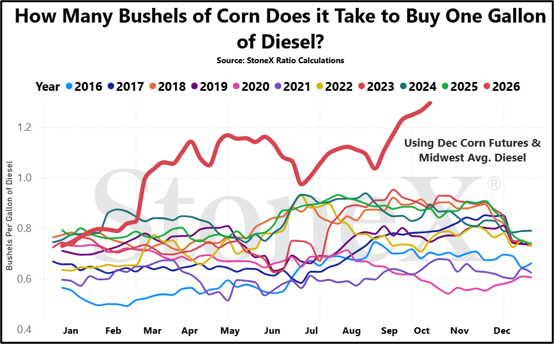
Amid the ongoing fall field work season, all-time high diesel costs have come into focus. Speaking from an event in the Wichita, Kansas area last night, President Trump announced that the USDA will be “launching a new harvest fuel relief program, providing our farmers with $8B in support to offset diesel costs during this harvest season.” While full details on the pgrogram are not yet known, it will be administered by the FSA and structured similarly to the previous Farmer Bridge Assistance (FBA) program that delivered another $12B in one-time payments to farmers earlier this year. Commodity-specific payment rates will not be released until next month, but we know that the program will be using a “uniform formula to cover a portion of modeled losses during the 2026 crop year,” with USDA noting it will be based on FSA reported planted acres, ERS production cost estimates, and WASDE yields and prices. Obviously, this provides a boost to farmers facing at time record-high and now near-record-high diesel costs that have acted to compress farm margins, with the ratio of Midwest average diesel prices to new crop corn futures at its worst level in decades.
However, it must be noted that this influx of cash coming during or post-harvest will likely drive an uptick in fertilizer demand for the fall application season. Of the big three nutrients, nitrogen has seen a notable correction through the latter half of 2026 after the initial Iran war spike this spring, bringing its affordability back roughly in line with the recent five-year average, while potash remains cheap. The real issue lies with phosphate (and sulfur), with demand destruction being the only thing keeping a lid on prices thus far. If farmers wrap up harvest with better than expected yields and that gets followed up with fresh checks in the mail, that demand could return much quicker than previously expected. With supply both domestically and globally already notably constrained as phosphate producers feel the squeeze of skyrocketing input costs (namely sulfur and ammonia) due to the ongoing disruptions in the Middle East and cut back production, any unexpected resurgence of demand this fall, or even into the spring of 2027, could ultimately drive prices even higher.