The outlook for soybean supply has changed significantly throughout 2021. The year began with estimates of a very tight supply-demand balance in the US and Brazil ending the 2019/20 crop with very low stocks. Then, the 2020/21 Brazilian crop reached a record, even with weather issues affecting crop potential in several states.
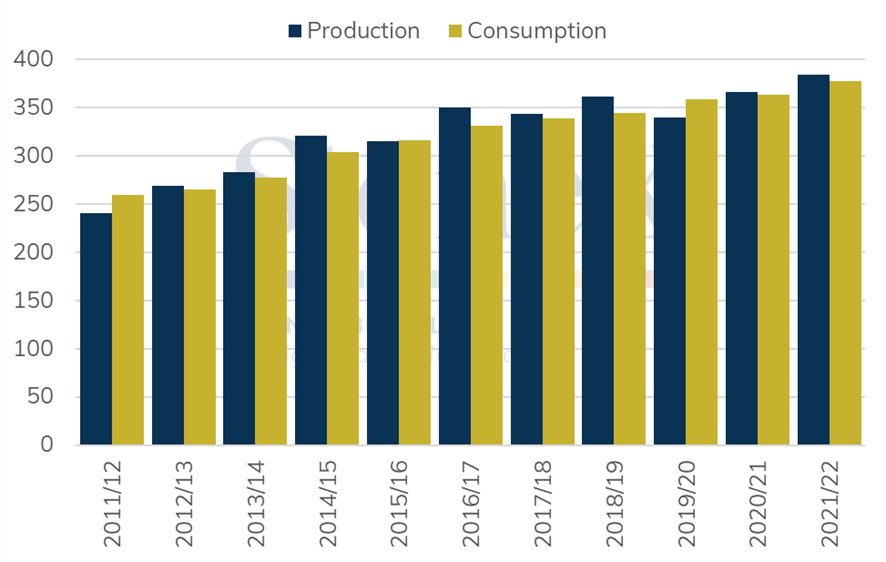
According to the USDA, world production in 2021/22 is expected to reach 384 million tonnes, exceeding consumption and resulting in growing ending stocks. However, it is important to remember that the oilseeds production is highly concentrated in three countries, Brazil, the US and Argentina, and any change in availability in one of them can significantly impact the global supply and demand balance.
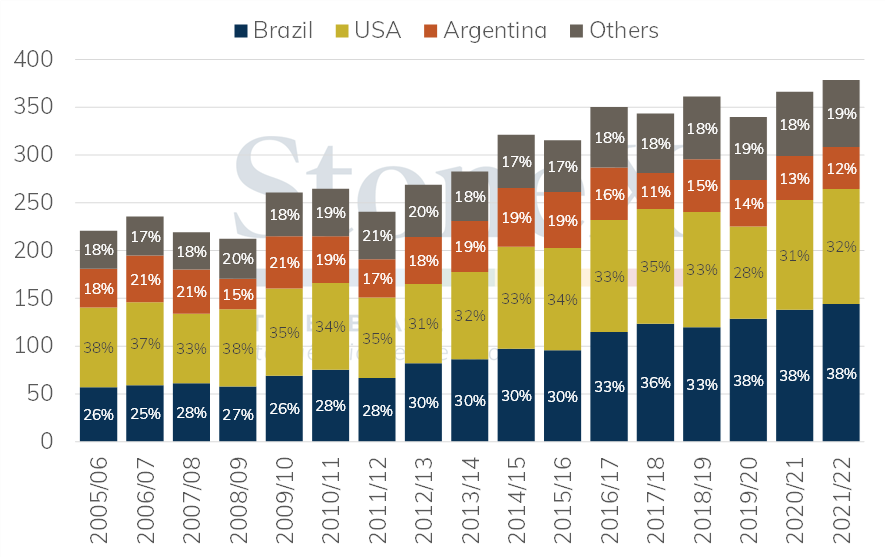
Given this context, South America's crop is in the spotlight, with planting underway, while the North American harvest draws to an end. Everything points to a new production record in Brazil, with StoneX's latest figure at 144.7 million tonnes. On the other hand, the first estimates for Argentina already bring divergences.
In its November report, the USDA revised Argentina's 2021/22 production figure downward from 51 million to 49.5 million tonnes.
However, there remains a significant difference to the projection of the Buenos Aires exchange, which stands at 44 million tonnes.
With this, the Department of Agriculture expects production to be 5.5 million tonnes higher than the Argentinean institution's estimate.
According to the USDA, this lower estimate for Argentina would practically "erase" the production advantage over world consumption in this cycle, which today is estimated at 6 million tonnes. Thus, even though the indications are for relief on the supply side of soybeans around the world, the coming months need to be closely monitored, with the crop development in South America, at a time of possible impacts of the La Niña phenomenon, which can result in drier weather in Argentina and southern Brazil areas.
Besides the concern with the weather, the area planted with soybeans in Argentina should decrease, standing at 16.5 million hectares, also according to the Buenos Aires exchange. Argentinean planting reached 28.6% of the forecasted area last Thursday, with good rainfall occurring in most producing regions.
It is noteworthy that this decrease in soybean acreage in Argentina reflects the higher rates that the oilseed complex is subject regarding exports (retenciones), compared to other crops such as corn and wheat, which end up having more attractive margins due to the lower tax burden.
Although retenciones are an old tax collection mechanism in Argentina, the Kirchner government significantly increased the incidence on soybean in 2007, reaching 35%, a percentage above that of corn and wheat. Since then, this taxation has been extremely important for government revenues, with the percentages varying depending on the country's economic situation and the political profile of the occupant of the Casa Rosada.
In any case, the retenciones affect the volume of grain produced, with area switching among crops. In the 2005/2006 cycle, Argentina produced just over 40 million tonnes of soybeans, reaching a record 61.5 million in 2014/15, and should drop below 50 million in 2021/22.
On the other hand, Brazil, which has the advantage of having areas for agricultural expansion without advancing on other products, went from 57 million to over 144 million tonnes in the same period. A similar movement was observed in the US, with 83.5 million tonnes produced in 2005/06 versus 120.4 this year.
Accordingly, Argentina has been losing share in the global soybean supply due to the strong increase of the Brazilian percentage in the total and as a response to the impacts of retenciones on its oilseed cultivation.